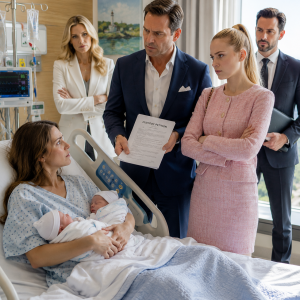
Neither spoke.
“Go ahead,” I said. “Ask whether she is all right.”
My mother recovered first. “Of course we care. How is the baby?”
“What is her name?”
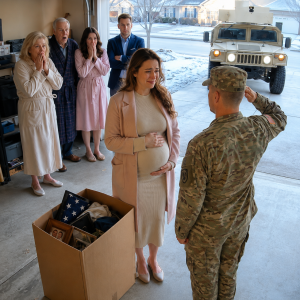
Silence settled over the driveway.
I had told them twice that Owen and I had chosen the name Grace. Neither remembered.
My mother began to cry. “We made a mistake, but we are still your parents.”
“This was not one mistake. It was years of choices.”
My father insisted Caroline had turned me against them, then listed ordinary acts of parenthood as if they created a lifelong invoice.
“And I paid your debts, your trips, your doctors, your dinners, your cars, and every expense attached to this house,” I said. “If you want to keep score, then count everything.”
My mother’s expression hardened. “Owen would be ashamed of what you’re doing.”
For six months, hearing his name had felt like touching a bruise. That afternoon, however, her attempt to borrow his memory for leverage closed the final door between us.
“Do not use my husband to excuse the way you abandoned me,” I said.
Caroline then explained that the bank was reviewing my father’s claim of ownership and that the disputed renovation agreement had been referred to the proper authorities. My mother immediately protested that she had signed only because her husband told her I approved.
“Be quiet, Judith,” my father snapped.
That was the first real crack between them. It came not from remorse but from fear of losing the money, the house, and the admiration of people who did not know who financed their comfortable life.
They were escorted inside. My father stopped in the living room and picked up a framed photograph of Owen and me.
“I’m taking this.”
“No,” I said. “That belongs with me.”
He stared into the camera. “Then you are no daughter of mine.”
As a child, those words would have dismantled me. I had earned perfect grades for his approval, hidden sadness from my mother, and spent adulthood turning money into an apology for my success.
But threats lose their power when the thing being taken away has already become a burden.
“That only frightens me if being your daughter still feels like an honor,” I said, and ended the call.
The Family Grace Would Know

Caroline later reported that my parents left with four suitcases, medication, and personal papers. My father tried to conceal jewelry inside a box belonging to the household inventory, but the deputy stopped him. My mother signed the final record with a trembling hand.
Within two weeks, a judge upheld the termination of their occupancy. My mother acknowledged using my signature without permission and agreed to restitution and community service. My father’s loan was denied, and the civil claims required him to sell two parcels of land. They moved into a modest rental outside Pueblo, where their lifestyle finally had to fit the income they earned.
Six weeks later, Grace arrived healthy, loud, and wonderfully impatient. I was not alone. Caroline waited nearby, along with Owen’s sister, two close friends, and Beth, the nurse who had remained beside me on the night my own family chose an airport lounge.
When the nurse placed Grace against my chest, I finally cried—not for the lake house or the parents I wished I had, but because I understood how long I had confused sacrifice with love, silence with respect, and financial dependence with family loyalty.
A year later, I sold the Dillon property. Part of the proceeds established a small emergency fund through a local nonprofit for expectant mothers facing urgent medical situations without reliable support. With what remained, I bought a bright, unpretentious home with a small backyard, where I planted an apple tree near the kitchen window.
On Grace’s first birthday, she stood barefoot in the grass, gripping my fingers while afternoon light moved through the young branches. She looked up at me and laughed with complete trust, and I remembered the broken glass, the empty chair, and my mother’s champagne photograph.
For a long time, I believed my act of justice had been taking back the lake house.
It was not.
The house was only property. The money was only money. My real freedom began when I stopped calling a transaction love, and when I decided that the family my daughter would know would be built not from obligation, appearances, or fear, but from the people who stayed when staying mattered.