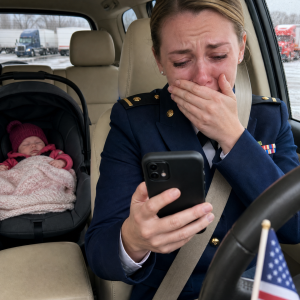
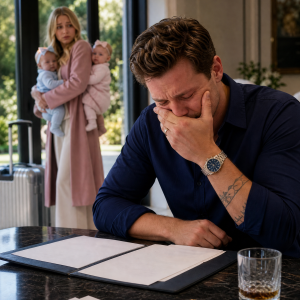
The hospital brought us a small white outfit for Rose. It was too large, and my hands shook as I fastened the tiny buttons. Aaron stood by the window answering messages from work. He said he would take time off after the presentation, but he went to it first, then returned to the office the next morning for several hours. I learned later that his managers had praised his commitment.
For three days, the hospital corridors blurred together with forms, quiet voices, and decisions I could barely follow. We had already discussed cremation months earlier, when we imagined a very different future, so the arrangements were made according to the wishes we had once shared.
I came home with a small box of photographs and a heart that felt too tired even to break. The nursery waited upstairs, its pale walls and paper-star mobile untouched. I did not go in.
On the third afternoon, I heard cars arrive outside. My mother called from the hall to say everyone was there. Through the bedroom window, I saw Molly step out of a dark car beside Mark. Aaron came in carrying a folder from the funeral home.
“What is that?” I asked.
He looked down at the papers. “There’s something we need to discuss.”
The top page asked for permission to display Rose’s cremated remains at Molly’s reception, as a symbol of family unity and love.
I read it twice, hoping the words would change.
“You want to bring our daughter’s remains to the wedding?”
No one answered. My mother stood near the front door. Molly’s eyes were already filling with tears.
“Get out,” I said.
My mother whispered my name. I pointed toward the door. “All of you. Leave Rose out of your celebration.”
Aaron started to say that the family needed something meaningful to hold on to. I told him she was not a symbol. She was our daughter, and she had been a baby before she became a memory anyone could use.
When they finally left, I noticed a handwritten note tucked beneath the folder. Aaron had addressed it to me, but he had not given it to me.
I carried it upstairs to the nursery and sat in the rocking chair beside the empty crib. I could not open it right away. The room smelled faintly of fresh paint and lavender sachets, and the paper stars Aaron had made moved gently in the air from the vent.
I opened the note only after dark. He wrote that he had stayed at the rehearsal because he convinced himself Molly’s evening had to remain intact, though he knew it would have survived his leaving. Rose had needed her father, and he had not come. He admitted he had confused being needed by everyone with doing what was right.
The words hurt, but they did not surprise me. What I had not expected was the photocopy folded behind the letter. It was from the fertility clinic where Aaron and I had gone through years of treatment. A form showed that he had requested an indefinite pause in our treatment six months earlier, before Rose was conceived.
He had told me the clinic wanted us to wait for medical reasons. He had never told me he had signed the request himself. The clinic had been concerned about risks from my previous treatment cycle, but that was not the same as the story Aaron had allowed me to believe. He had kept the last embryo in storage and planned to tell me after Molly’s wedding.
The next morning, I went to the clinic and asked to speak with a patient advocate. A woman named Bethany reviewed the records with me. She explained that the doctor had placed a temporary hold on treatment while I recovered, but Aaron had separately requested an indefinite pause. No transfer had been scheduled, so he had not canceled an appointment; he had asked the clinic to stop moving forward and had not told me.
“Did he ever ask the doctor to revisit the decision?” I asked.
Bethany checked the notes. “Not according to the record.”
The paperwork also showed that my mother had helped arrange the embryo’s transfer to a storage center in another state. She had signed an authorization and continued paying the storage fees. A note in Aaron’s handwriting said, “Do not tell Julia until after the wedding.”
That evening, Aaron came to the house. I asked him for every message and document connected to the embryo. He sent them to me without argument. One email from my mother said I could not endure another treatment cycle and that they should wait until after Molly’s wedding to explain the situation.
I looked up from the screen.
“You both decided I couldn’t be trusted with my own future.”
Aaron lowered his eyes. “I thought I was protecting you.”
“You were protecting yourself from watching me choose something you feared.”
He nodded. He did not try to make the sentence kinder.
I met with an attorney, Helen Price, who helped me separate the practical questions from the pain. I did not want a public fight or strangers reading Rose’s private story. I wanted the truth written down, and I wanted to decide what happened to the embryo without being hurried or pressured.
I also wanted a place at the hospital where parents could sit quietly after losing a baby, with no one telling them their grief should be smaller because their time together had been brief.
“I want to make a garden,” I told Helen. “A place for families to remember their children.”
What They Called Protection
Molly came to my house a few days later. She stood on the front step, hands tucked into her coat pockets, and did not ask to come in until I opened the door.
She admitted she had known our mother was worried about the wedding. Before the rehearsal, Ruth had told Aaron that the evening might fall apart if he left, and that Mark’s parents could withdraw their financial support if the plans changed again. Molly said she had asked Aaron to stay until after the first dance, believing he would come to the hospital afterward.
“You knew I was in the hospital,” I said.
She looked down. “Yes.”
“You knew I was asking him to come.”
“Yes.”
“And you still asked him to stay.”
She began to cry. I did not comfort her. I had no spare strength to make her feel better about a choice that had left me alone.
Molly also told me that our mother had known Aaron was postponing his leave for the work presentation. Ruth had been afraid that if he left work and the wedding became connected with grief, Mark’s family would see the whole event as a burden. The wedding had become something everyone was trying to protect, though no one had considered what it was costing me.
“I thought someone else would make the right choice,” Molly said.
“You were someone else.”
She accepted that. She did not ask me to forgive her. Before leaving, she told me she had postponed the reception and was speaking honestly with Mark about what had happened. I hoped they could build a marriage that did not require them to hide difficult truths beneath careful arrangements.
My mother came the next day. She admitted she had helped move the embryo and kept paying for storage. She said she feared another treatment cycle would harm my health, and that she thought preserving the embryo would give me time to decide later.
“You didn’t give me time,” I told her. “You gave yourself the right to decide what I could know.”
She said she was sorry. I believed that she had been afraid. I did not believe her fear made the decision hers.
She had brought the storage agreement. It showed that Aaron had signed away his claim to make future decisions about the embryo, leaving the choice to me. Beneath his signature, he had written that he would not ask me to preserve a future he had been too afraid to tell me about.
I read that line several times. It did not undo what he had done, but it meant he had finally stepped back from a decision that belonged to me.
A doctor from the storage center called that evening. There was a note on the file asking that I be contacted directly if the embryo’s status changed. Beside my name, Aaron had entered Rose’s as a memorial designation.
I told the doctor to remove it.
“She should not have to carry a decision that belongs to me,” I said.