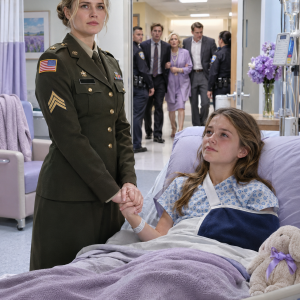
The Night the Rain Brought the Truth to Light

The first thing my former husband said when I found our daughter lying motionless on his front walk was that she had brought it on herself.
“If she passed out, maybe now she’ll remember not to defy me.”
I was kneeling on the wet concrete, one hand beneath fifteen-year-old Willa’s shoulder, while cold rain ran down my neck and soaked through my coat. Her backpack lay several feet away, its faded blue fabric dark with water, and one of her sneakers had come off somewhere between the porch and the driveway. The light above the front door cast a pale circle over us, but the rest of the yard was nearly black.
I had driven almost two hours through a storm to pick her up from her father’s house in a suburb outside Columbus, Ohio. Earlier that afternoon, I’d sent Graham a text saying I would arrive between seven and seven-fifteen. He had replied with one word: “Fine.”
I had left a work seminar later than planned, and by the time I turned onto his street, my shoulders were stiff from gripping the wheel. I’d been looking forward to getting Willa home, warming up the soup I’d made the day before, and listening to her tell me about school if she felt like talking. For months, I had tried to make our shared custody arrangement feel ordinary for her, even when it required a good deal of careful swallowing on my part.
Our divorce had been final for four years. I had made peace with the fact that Graham and I would never be close again, but I still believed we could be civil. More than anything, I wanted Willa to feel she had two parents who could put their disagreements aside for her sake. I had told myself that being fair, patient, and cooperative was how I protected her from the strain of a divided home.
Then my headlights swept across the driveway, and I saw her.
I shoved the car door open before I had properly shifted into park. The tires rolled a few inches before the emergency brake caught, but I barely noticed. I ran through the rain and dropped to my knees beside her.
“Willa? Honey, can you hear me?”
Her face was turned toward the ground, her wet hair pasted to her cheek. I touched her shoulder and felt how cold she was. When I gently turned her toward me, her lips looked pale, and she did not open her eyes.
The front door swung wide. Graham stood inside, dry beneath the porch roof, wearing a gray sweater and a look of annoyance. His wife, Denise, watched from behind him with her arms folded across her chest.
“What happened?” I called, brushing the hair away from Willa’s face.
Graham didn’t come down the steps.
“She’s grounded.”
“She’s unconscious, Graham.”
He gave a short, dismissive shake of his head.
“She threw a fit because we took her phone. She’s putting on a show.”
My fingers were shaking so hard that I had to try twice before I could unlock my phone and dial 911. When the dispatcher answered, I gave the address and said my daughter was unresponsive and cold from the rain.
Graham’s voice followed me through the call.
“Don’t make this into a scene. She’ll be fine once the ambulance leaves.”
I held Willa’s hand between both of mine, trying to warm her fingers.
“How long has she been out here?”
He stared at me without answering.
The sirens arrived a few minutes later, their lights flashing across the houses and the soaked pavement. Two emergency responders hurried up the drive. One, a tall man whose badge read Nolan Pierce, knelt beside Willa and checked her breathing and pulse while his partner opened a medical bag.
Nolan looked up toward the porch.
“Did anyone here call for help earlier tonight?”
Graham crossed his arms.
“No.”
Nolan studied him for a moment, then turned back to Willa and spoke quickly to his partner. They placed her on a stretcher and covered her with warm blankets. As they lifted her, Nolan came close to me.
“Ma’am, is that your husband?”
“My former husband.”
He hesitated, glancing toward the house.
“I’ve been sent to this address before.”
For a moment, I couldn’t make sense of the words.
“For Willa?”
His partner called to him from the ambulance before he could answer. I started after them, but Graham caught my shoulder and turned me around.
“Don’t try to use this to change the custody agreement,” he said in a low voice. “You’re not going to turn one little incident into a legal battle.”
I pulled away from him.
“I’m trying to get my daughter help. I’ll find out what happened when she’s able to tell me.”
I followed the ambulance to the hospital, keeping both hands on the steering wheel and my eyes fixed on the red lights ahead. I don’t remember most of the drive. I remember the rain, the wipers beating back and forth, and the thought that kept returning no matter how many times I tried to push it away: I had left Willa in that house because I believed the adults there would keep her safe.
At the emergency department, nurses brought her inside and started warming her. Hours passed before she stirred beneath the blankets. When she opened her eyes, they moved anxiously around the room until they found me.
“Is Dad here?”
“No, sweetheart. It’s just me.”
Her shoulders lowered against the pillow, and she let out a long breath.
“Please don’t make me go back there.”
I took her hand carefully.
“I won’t. But I need to understand what happened.”
Willa swallowed, her voice rough and quiet.
“Denise said I was being disrespectful because I sighed when she asked me something. They took my phone, and Dad said I couldn’t come back inside until I apologized.”
“How long were you outside?”
She stared at the blanket.
“I don’t know. It started raining. I knocked, but they didn’t open the door.”
Her eyes filled, and she turned her face toward me.
“I heard the garage door. They left. Mom, I was so cold.”
I sat beside her, holding her hand while the monitor beside the bed marked the quiet minutes. Later, after she had fallen asleep under fresh blankets, a nurse brought me a plastic bag with Willa’s belongings. Her backpack was still damp, and I thought I should take out her schoolbooks before the pages were ruined.
When I unzipped the small front pocket, my fingers caught on a folded piece of notebook paper tucked deep inside the lining. It was creased into a small square, as if someone had tried to keep it hidden. I opened it on my knee and recognized Willa’s neat handwriting.
She had written dates with short notes beside them.
Tuesday: They wouldn’t let me in after school. I waited on the porch.
Friday: Sent to bed without dinner because I left a glass by the sink.
Sunday: They took my phone so I couldn’t call Mom.
Wednesday: Denise said Mom would think I was making things up.
At the bottom, the last sentence was underlined twice: If it happens again, I have to wait until someone sees me. Maybe then Mom will know.
I read it again, but the words didn’t change. The rain, the stretcher, Willa’s fear when she asked whether her father was there—all of it seemed to gather around that one sentence.
Until then, I had thought of the night as a terrible argument that had gone too far. The note told me it was something Willa had been trying to explain for a long time, in the only way she thought might make me listen.
The Things I Had Missed

At seven the next morning, I called Marianne Cole, the family-law attorney who had helped with my divorce. I read her the note, and she listened without interrupting.
“Don’t go to Graham’s house,” she said when I finished. “Don’t threaten him, and don’t post about this online. We need records, dates, and statements from people who saw what happened. Let’s protect Willa carefully and keep everything documented.”
Her advice was hard to hear when all I wanted was to drive back and demand answers. Still, I knew she was right. Anger might have helped me get Willa out of the rain, but it wouldn’t be enough to keep her safe through what came next.
I stayed beside Willa’s hospital bed and tried to piece together the past year. She had become quieter when she came home from visits with Graham. She had lost weight, and she sometimes flinched when a door shut too hard. When I asked how the weekends had gone, she would shrug or say, “Fine.”
I had taken her silence for teenage moodiness. I had told her to give Denise time to adjust to having a stepdaughter in the house. I had said Graham was allowed to set rules and that she should try to meet him halfway. I had been so determined to keep the peace that I mistook my own discomfort for proof that everything was probably all right.
A few hours later, Marianne called me back.
“The responder, Nolan Pierce, contacted child services this morning,” she said. “He remembered a call to Graham’s address about three months ago.”
My grip tightened around the phone.