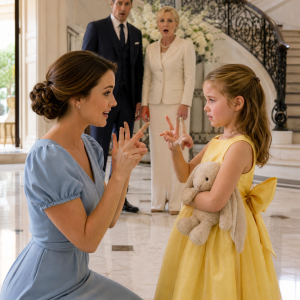
I stopped several steps above him. Willa held tightly to my hand.
“Somewhere safe.”
“You have no money, no family, and no place to go.”
It was the old story, spoken as though repetition could make it true.
I looked past him, toward the open front door. My brothers were there with the officers, and behind them stood a pair of neighbors who had come outside after seeing the cars. Thomas was silver-haired now, broader through the shoulders than he had been when we were young, but I recognized the steady set of his mouth. Peter stood a little behind him, calm and alert. Charles carried a folder. Simon held a tablet. Elise was not there yet, but she was on her way.
Everett followed my gaze and seemed to understand, all at once, that the story he had been told about my past was not the whole story.
Thomas stepped forward.
“You’ve met Mara’s family before,” he said. “You simply weren’t told our names.”
Everett stared at him. “This is a private issue between my wife and me.”
Charles answered before I could.
“The officers are here because a child was placed in distress and a report was made. We’ll let them handle the immediate questions. The rest can be addressed through counsel.”
No threats. No shouting. No dramatic display of power. Just the plain, formal language of people who knew how to let a situation be examined without turning it into another spectacle.
Maren’s face had gone pale.
“I didn’t do anything,” she said. “Willa must have misunderstood.”
Willa pressed closer to me. I put my arm around her.
“She knows what she saw,” I said.
One of the officers asked whether Willa would be willing to speak with a female officer in a quiet room. I told them she could, as long as I stayed nearby. Willa nodded. The officer led us to the sitting room while Thomas remained in the hall.
Everett tried to come after us.
Peter moved a step to the side, not touching him, simply placing himself between Everett and the doorway. An officer asked Everett to stay where he was.
“I’m her father,” Everett said.
“Then you’ll have a chance to speak with us,” the officer replied. “For now, give her space.”
Willa sat beside me while the officer listened. She spoke slowly and carefully, explaining what she had seen. She did not embellish anything, and she did not look toward Everett for approval. I sat near enough for her to touch my sleeve whenever she needed reassurance.
By the time the officer finished, Elise had arrived. She came in wearing a travel coat over her work clothes and crouched beside Willa, asking before she touched her. Willa leaned into her, and Elise wrapped her in a gentle hug.
“You were brave to tell the truth,” Elise said. “You don’t have to solve the grown-up problems. Your job is to be a kid.”
I felt my throat tighten. I had wanted to give Willa a childhood free of the things I had carried, and I had not managed it. But perhaps I could still show her that speaking up mattered, that safety was something we could choose, and that family did not have to mean enduring every hurt in silence.
We left the house before one in the morning. I did not look back at the bedroom or the blue gown. At the front walk, the rain had softened to a mist. The neighborhood was quiet except for the low hum of a helicopter passing high above the distant freeway. It was not part of a rescue operation, as the story Everett would later tell people suggested. It was a company aircraft carrying two of my brothers west, and it had been rerouted to land at a nearby airport. Still, the sound overhead seemed to mark the end of one life and the beginning of another.
A Life of My Own

Thomas drove us to a private guesthouse owned by the family foundation. It sat behind a high wall on the edge of town, but it felt less like a fortress than a place where people could sleep without listening for footsteps in the hall. Willa fell asleep in the car with her rabbit under her chin. I watched the streetlights pass and kept thinking about the cupcakes I had left on the kitchen floor.
In the morning, the story began to unfold in a more ordinary way than the rumors would later suggest. A family lawyer arranged temporary housing and helped me file for a protective order. Elise took Willa to a pediatric appointment, where the doctor made sure she was physically well and gave her a quiet place to talk. Charles worked with local counsel to preserve messages and records connected to the household and to the company. Simon helped identify which information could be collected lawfully, then handed the work to the proper professionals.
Thomas’s acquisition of Everett’s employer became public within the week. Everett was placed on administrative leave while the company reviewed his conduct and potential conflicts of interest. The new board did not take his money, and no one emptied his accounts. The legal process moved at its own pace, as it should. But he could no longer control every room by raising his voice, and he could no longer tell me that I had nowhere to go.
Maren’s gown became evidence in the investigation, but it did not matter nearly as much as she had thought it would. Willa’s account matched details the officers later found in messages Maren had sent to a friend, including a complaint about being forced to share the guest suite and a remark about making sure I “finally learned what the dress was worth.” The evidence did not settle every question about my marriage, but it confirmed what Willa had told me.
The first weeks away from Everett were not easy. Freedom did not feel like a bright door swinging open. It felt like standing in a quiet room after a storm and not knowing what to do with the silence. I woke before dawn, reached for my phone, and checked whether anyone had texted. I kept expecting a message telling me I had misunderstood, that I should come home, that everything could return to the way it had been.
But nothing returned to the way it had been. That was a kindness, though I could not recognize it at first.
My brothers did not tell me how to live. They did not ask me to move back to Maine or insist that I take a place in the family business. They offered help, and then they waited for me to decide what help I wanted. For the first time in years, I was allowed to make choices without defending them.
I rented a modest house near Willa’s school and found work at a neighborhood flower studio. The owner needed someone who could arrange centerpieces and teach weekend workshops. When I walked into the shop on my first day, the scent of eucalyptus and roses brought back the person I had been before my life narrowed around Everett’s expectations.
Willa began to laugh again. Not all at once, and not every day, but often enough that I noticed. She kept the stuffed rabbit on her bed and started drawing pictures of a small blue house with a garden. One afternoon, she asked whether we could make cupcakes together.
I bought a box mix, and we made a mess of the counter. The frosting was too soft, and Willa put on so many sprinkles that the cupcakes looked like they were dressed for a parade. We ate one while the others cooled, sitting side by side at the kitchen table.
“I’m glad we left,” she said.
I looked at her small hands, sticky with frosting, and felt the words settle into me.
“So am I.”
Months later, people still asked about the night my brothers arrived. Some had heard that helicopters circled the neighborhood, that a famous family had descended on a quiet street, that Everett had lost everything before sunrise. The details grew more dramatic each time they were retold.
The truth was less like a legend and more like a family doing what families are supposed to do when someone finally asks for help. My brothers made calls. A lawyer came. Officers listened. My daughter told the truth. And I walked out the front door with her hand in mine.
I sometimes think about the woman I had been when I first arrived in Arizona, certain that being loved meant making myself easy to keep. I wish I could tell her that a quiet life is not the same as a small one, and that asking for help does not make your choices less your own.
Most of all, I wish I could tell her that the people who love you do not need you to become helpless before they come looking. They only need you to let them know where you are.
I had spent years hiding my family because I wanted to be seen as myself. In the end, I learned that being myself did not require disappearing from everyone who had known me first. It meant telling the truth, even when my voice shook, and letting the people who cared about me stand beside me while I found my way forward.