“The offer expires at one. After that, Harbor Lantern withdraws and the lenders proceed.”
The Price of Rescue

My mother began to cry, softly at first and then with the offended sorrow of someone who had always believed consequences belonged to other families.
“Are you going to put your parents out of their home?”
“I did not pledge your home,” I said.
“We are still your family.”
“We share relatives. Family is measured by what people protect when protecting it costs them something.”
My father sank back into his chair.
“What do you want from us?”
“Nothing personal. That is what you still don’t understand.”
I pointed to the employment schedule. Two hundred fourteen people depended on the company, and some had worked there longer than Blake had been alive. They did not deserve to lose what they had earned for one indulged son.
The terms removed the current officers immediately. My father would receive no ceremonial chairmanship, my mother’s consulting payments would end, and Blake would lose his title, vehicles, accounts, and building access.
“You can’t take our name off our own company,” Blake said.
“You already took everything that gave the name value.”
Blake demanded a vote, but his shares had been pledged against personal loans. My father searched the final page as if it might turn me into the obedient son again.
“If I sign, will you help us keep the house?” he asked.
“The company is not purchasing your private debts. You will have to sell the property and negotiate what remains.”
“Your mother built her whole life there.”
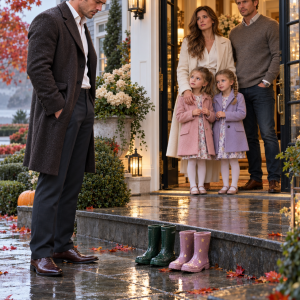
I thought of my little girl in the driveway, rain running over icing on her dress.
“June built ten years of trust before that afternoon. You were willing to trade it for Blake’s comfort in less than a minute.”
At 12:46, my father signed. He did not do it because he understood me. He did it because every easier option was gone.
Blake refused until Nora reminded him that the secured lender could act on his pledged shares. When security collected his access badge, he shouted through the lobby that Colewell carried his family’s name and no outsider could take it from him.
I stood beside the reception desk where employees had gathered in uneasy silence.
“The people who kept this place running are not outsiders,” I said. “And the company will have a new name by Monday.”
We renamed it Beacon Ridge Packaging. The audit uncovered more false invoices, unsafe shortcuts, and improper contracts. We replaced managers who had enabled Blake, inspected the equipment, corrected benefit records, and restored every verified dollar missing from employee accounts.
The lessons from the Bellweather kitchen followed me into the factory. A beautiful surface means nothing if the support beneath it is failing. You do not save a leaning structure by polishing the top. You uncover the weak joints, remove what cannot carry weight, and rebuild from the base.
Natalie used her records to secure a stable home for her children. I created independently managed education trusts for them.
“You didn’t owe us that,” Natalie said when I gave her the documents.
“Children should not pay for the choices adults made around them.”
My parents sold Hawthorne House and moved into a modest condominium outside Stamford. I did not celebrate. A boundary is not revenge simply because the person outside it dislikes the view.
The Call I Had Waited Years to Refuse
Four months after the sale, my father called from a number I did not recognize. His voice sounded older, stripped of the authority that had once filled every room before he entered it.
“The water heater has stopped working,” he said. “I thought you might know someone who could come by. Your mother also wondered if you and June would join us for dinner.”
Across my living room, fifteen-year-old June sat at the coffee table working through an algebra problem, her hair tied carelessly on top of her head. The pale line beneath her eye was barely visible.
“I’m busy running two companies,” I said. “You probably wouldn’t understand the pressure.”
He recognized one of the phrases he had used whenever I asked why Blake received another rescue while I was told to manage alone.
“There’s no need to be cruel to your father.”
“I’m not being cruel. I’m refusing to pretend that access to my life is something you can request with a repair call.”
“Your mother misses June.”
“June can decide whether to contact you when she is older. Until then, protecting her is my responsibility.”
There was a long pause.
“Don’t I deserve another chance?”
I had once longed for that question, but now I understood he was not asking how to make amends. He was asking when his discomfort would end.
“Changing is not the same as demanding quick forgiveness,” I told him. “If your improvement depends on me reopening the door before I feel safe, then it isn’t growth. It’s another negotiation.”
I ended the call without raising my voice, and afterward I did not feel triumphant. I felt peaceful, which was better.
Later that year, I saw Blake working at a used-car dealership in Norwalk. We did not wave. I drove on, thinking it might be his first position where no parent could edit the outcome or move someone else’s money beneath his mistakes.
The Castle in the Light

For June’s sixteenth birthday, we gathered on a maritime museum’s glass-roofed terrace with Evelyn, our employees, Natalie and her children, and June’s friends. The harbor reflected the last peach-colored light of sunset.
I spent a month designing another castle, rising from dark chocolate cliffs and silver sugarwork. Its highest tower floated on a concealed magnetic frame, tiny windows glowing above lavender flowers like those from six years earlier.
When the staff rolled it onto the terrace, the room grew quiet. June brought both hands to her mouth, exactly as she had at ten, and tears gathered in her eyes.
“Dad, it’s perfect.”
I took her hand.
“You’re safe and happy. That is the part that matters.”
She studied the floating tower, then looked at me.
“Do you remember my other castle cake?”
“Every detail.”
“I don’t remember much about the cake,” she said. “I remember you picking me up. I remember you taking me out of that house.”
For years I blamed myself for failing to anticipate Blake’s cruelty. June’s memory gave me a gentler truth: parents cannot prevent every hurt, but they can decide what happens next. They can preserve a false peace, or lift the child and prove that dignity is worth more than approval or inheritance.
My phone vibrated as the candles were being arranged. A message from an unknown number appeared on the screen.
“Your father’s birthday is next week. We want the family together. We miss June.”
I deleted it, blocked the number, and returned to June beside the illuminated castle. There was no fear in her face and no one saying a shared name required her to accept humiliation.
That night I understood what I should have learned as a child. Adults create golden children and disappointments when they distribute affection as a prize, inflate one child until entitlement feels natural, and diminish another until scraps resemble gratitude. My parents had trained Blake to claim every room and trained me to mistake silence for kindness.
Breaking the pattern did not mean ruining them. It meant declining to participate any longer.
I had surrendered a promised inheritance, but promises from people who use love as leverage are only elegant chains. In its place, I gained a daughter who knew her feelings mattered, a safe home, and a career built from the ability my family dismissed.
Near the end of the party, June cut the first slice herself. She handed it to me on a white plate, making sure it included one of the glowing windows.
“Every castle needs lights,” she said.
I smiled because she remembered.
Sometimes a structure collapses in one careless moment, and for a while all you can see are the pieces. Then life places the tools back in your hands and asks what you will build when no one else chooses the blueprint. Sometimes the answer is simply a home where a child can breathe, a business where honest work is honored, and a table where love is never conditioned on silence. The first castle fell because the people around it were careless. The second stood in the harbor light because everything beneath it had been made strong.
So had we.