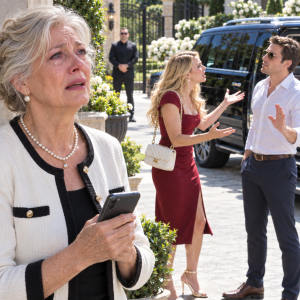
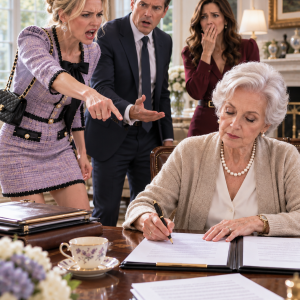
“And when did you decide you missed me?”
“That’s not fair.”
“Isn’t it?”
He reached toward me, then stopped.
“Maren, I didn’t come because of money.”
“Then why didn’t you come yesterday?”
Silence.
“Or three days ago?”
He looked down.
“Why didn’t you come the morning after your mother packed my suitcase?”
Still nothing.
I felt something inside me settle.
Not anger.
Clarity.
My Parents’ Final Gift
I reached into my bag and pulled out one of the folders Franklin had given me.
Cole looked at it.
“What’s that?”
“The reason your mother is standing by the elevator pretending she suddenly cares about our marriage.”
“Maren—”
I raised my hand.
“My parents left these assets to me. They are being handled according to the trust documents and the legal advice I’ve received. Your mother doesn’t get a vote. Vaughn doesn’t get a vote.”
Cole looked hurt.
“And me?”
That question almost broke my heart.
I rested my hand over our daughter.
“Twelve days ago, I asked whether your daughter and I were your family.”
He closed his eyes.
He remembered.
So did I.
“You answered me when you watched us leave.”
He Finally Understood
Doreen approached us.
“This has gone far enough.”
I turned toward her.
She lowered her voice.
“You and Cole are married. Whatever you’ve inherited affects your family’s future.”
There was that word again.
Family.
Only now that I had something valuable, apparently I qualified.
I looked directly at her.
“When you thought I had nowhere to go, you put my suitcase beside the door.”
Her face tightened.
“I was upset.”
“When you thought I had no money, you were comfortable watching me leave.”
“You’re twisting this.”
“And now that you’ve heard about my parents’ trust, you’re standing outside my apartment talking about family.”
Vaughn stepped forward.
“Nobody wants your money.”
I looked at him.
“Good. Then there should be nothing to discuss.”
For once, Vaughn had no response.
I Didn’t Need Revenge
I could have told them the valuation.
I didn’t.
I could have shown them the property documents.
I didn’t.
I could have explained exactly how much the company shares were worth.
They didn’t need to know.
That was one of the most important lessons I had learned.
Not everyone deserves access to everything simply because they ask.
Cole stayed after his mother and brother finally left.
He stood outside my apartment door looking exhausted.
“Can we fix this?”
I didn’t give him the answer he wanted.
But I didn’t give him a cruel one either.
“I don’t know.”
His eyes filled with regret.
“I love you.”
I believed that he believed it.
But love had never been the only problem.
“Then you need to learn something, Cole.”
“What?”
I looked down at my stomach and then back at him.
“A wife and daughter aren’t people you choose after everyone else is satisfied. We were supposed to be your family too.”
He nodded slowly.
This time, there was no argument.
Two Months Later
Our daughter, Elowen Bellrose Hargrove, arrived on a bright January morning.
Cole was there.
But not because I had forgotten what happened.
He was there because over the previous weeks, he had started doing something I had rarely seen him do.
He stopped explaining his mother.
He stopped defending his brother.
He started taking responsibility for himself.
When Doreen complained that I wouldn’t let her control the baby’s first weeks, Cole told her:
“Mom, this isn’t your decision.”
When Vaughn accused me of using money to separate Cole from the family, Cole answered:
“No. My choices nearly separated me from my wife.”
Those words mattered more to me than an apology.
Because apologies are easy.
Change is expensive.
The Question I Never Needed to Ask Again
I eventually moved into the coastal house my mother had left inside the trust.
I stood in the nursery one afternoon with Elowen sleeping in my arms while sunlight came through the windows.
Cole stood in the doorway.
We were still working on our marriage.
Slowly.
Carefully.
Nothing had magically returned to normal.
I didn’t want it to.
Normal had been me constantly making myself smaller so his family could remain comfortable.
This was different.
Cole understood that if our marriage survived, it would not be because I needed his house, his family’s approval, or his money.
It would survive only if we both chose it.
He walked over and looked down at our daughter.
“I almost lost both of you.”
I looked at him.
“You didn’t almost lose us because of your mother.”
He nodded.
“I know.”
“You almost lost us because you let her make a decision that belonged to you.”
He was silent for a moment.
Then he said:
“I know that too.”
That was when I realized something.
My parents’ greatest gift had never been the company shares.
It wasn’t the commercial building.
It wasn’t even the beautiful house where I now stood holding my daughter.
Their greatest gift was choice.
They had quietly made sure their daughter would never have to stay somewhere simply because she couldn’t afford to leave.
And once I understood that, everything changed.
Sometimes the most valuable inheritance parents can leave their children is not simply money or property, but the freedom to make important decisions without being trapped by financial dependence.
A marriage becomes fragile when one partner repeatedly treats their spouse as someone standing outside the family instead of recognizing that the marriage itself created a new family deserving protection and respect.
Someone who remains silent while another person mistreats you is still making a choice, because refusing to take a position often gives the person causing the harm exactly what they want.
Financial independence cannot solve every relationship problem, but it can give someone the freedom to decide what they will and will not accept without fear of having nowhere else to go.
An apology becomes meaningful only when behavior changes afterward, because regret expressed in words means very little if the same choices continue whenever pressure returns.
People sometimes become interested in repairing relationships immediately after circumstances change, and it is reasonable to look at their timing and actions before deciding how much trust they deserve again.
Family should never be a word used only when someone wants access to your time, your child, your home, or your resources; family should also describe the people who show up when you have nothing convenient to offer them.
You do not have to reveal everything you own, earn, inherit, or plan simply to prove your worth to people who previously decided your value based on what they thought you lacked.
Forgiveness and reconciliation are not the same thing, because you can release anger toward someone while still requiring them to rebuild the trust their own choices damaged.
Sometimes the greatest turning point in life comes when you realize that having the ability to walk away does not mean you must leave forever—it simply means that if you stay, you are staying because you freely chose to, not because you had nowhere else to go.