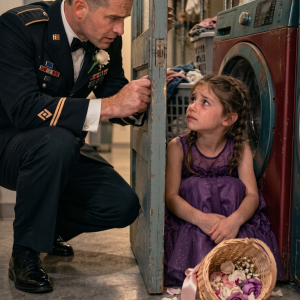
My father finally spoke from across the room.
“Son, maybe everybody should sit down and talk this through.”
I shook my head.
“Not today.”
I picked up Maisie’s small backpack from beside the front door.
My mother followed me.
“You’re really leaving?”
I turned around.
“Yes.”
“Over one misunderstanding?”
I looked at her for several seconds.
“I found my four-year-old daughter hiding upstairs, shaking and afraid. If that is what this family calls a misunderstanding, then we have a much bigger problem than I thought.”
Then I walked outside.
The Question My Mother Never Asked
I drove Maisie to a medical clinic.
The staff examined her carefully and documented what they observed. They also explained what steps were available to ensure she was safe.
I answered every question as accurately as I could.
Maisie remained beside me, wrapped in a soft blanket and holding my hand.
That evening, she finally whispered something.
“Daddy?”
“Yeah, sweetheart?”
“Are you mad at me?”
I nearly broke down.
Instead, I leaned closer.
“No. Never for telling me when you’re scared.”
She watched my face carefully.
“Even if people get upset?”
I understood exactly what she was asking.
“Even then.”
The following morning, someone began pounding on my front door.
It was my mother.
Her eyes were swollen from crying.
Before I could say much, she started talking.
“Nolan, please. You need to think about what happens next.”
I waited.
She continued.
“Corinne has a job. She has a son. She has responsibilities. If this becomes a bigger situation, it could affect everything.”
I stared at her.
She had been standing on my porch for almost a minute.
She still hadn’t asked about Maisie.
“Mom.”
“Please listen to me.”
“How is Maisie?”
She stopped.
“What?”
“That’s the question you should have asked when I opened this door.”
Her expression hardened.
“Obviously I care about Maisie.”
“Then why are you here asking me to protect Corinne?”
“Because she’s your sister!”
I nodded.
“And Maisie is my daughter.”
My mother lowered her voice.
“Your sister made a mistake.”
“Then she can take responsibility for it.”
“You could destroy this family.”
For years, those words would have worked on me.
I had grown up believing keeping the family together was almost a sacred responsibility.
But standing there, I finally understood something.
A family is not protected by hiding what went wrong.
It is protected by caring for the person who needs protection.
“I’m not discussing this anymore.”
My mother stared at me.
“So that’s it?”
“For now, yes. Please leave.”
When Everyone Started Rewriting the Story
During the following weeks, the messages began.
My father said I had embarrassed everyone.
My mother repeatedly asked me to consider my nephew.
Corinne insisted I had exaggerated the entire situation because I had always been “too protective.”
Other relatives began calling.
Some were genuinely concerned.
Others wanted to know whether I could simply forgive Corinne so holidays wouldn’t become uncomfortable.
I stopped explaining myself.
Instead, I saved every message and followed the guidance I had been given.
I changed the people authorized to pick Maisie up from preschool.
I made sure Corinne could not contact her directly.
I stopped attending family gatherings.
Most importantly, I found a child therapist who understood how to help young children rebuild a sense of safety.
The first few weeks were difficult.
Maisie wanted bathroom doors left open.
She sometimes woke during the night and came running into my room.
Sudden arguments on television made her nervous.
I never told her she was overreacting.
I never told her to toughen up.
Instead, I reminded her:
“You’re home.”
And:
“You’re safe with me.”
And whenever she apologized for being scared, I answered the same way.
“You never have to apologize for telling me how you feel.”
Slowly, things began changing.
The Day Our Family Had To Face Reality
Eventually, the matter went through the appropriate legal process.
I won’t pretend it was easy.
Sitting in a formal room while people discussed your child’s most frightening experience is something no parent wants to endure.
But I also learned that facts sound very different when they are removed from family excuses.
My sister could no longer dismiss everything with a laugh.
My mother could no longer end the conversation by saying, “That’s just how Corinne is.”
My father could no longer change the subject.
There were records.