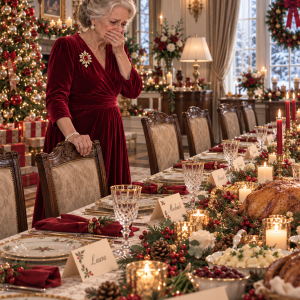
Camille’s expression changed instantly.
Nolan turned toward her.
“What is he talking about?”
For the first time, Ellis realized something important.
His son had clearly known more than he should have known, but perhaps not every detail.
Camille tried to speak.
“Ellis, we were only trying to solve some temporary financial problems.”
“With an account in my name?”
Nolan stared at his wife.
“Camille?”
Ellis raised one hand.
“No shouting. No excuses. The bank is reviewing everything, and my attorney already has the documents.”
He slid the trust papers back across the table.
“I will never sign this.”
Then he looked at his son.
“But you and I still need one honest conversation.”
Back to the Same Restaurant
One week later, Ellis reserved the same table at The Rivermont Grill.
This time, he sat at the head.
Howard attended.
So did Nolan, Camille, and two extended family members who had repeatedly heard Nolan describe himself as entirely self-made.
Ellis ordered a ribeye.
When the server asked whether the table wanted bread, Ellis smiled.
“Absolutely. Bring plenty.”
After dinner, Ellis removed a folded sheet of paper from his jacket.
“I want to correct something.”
He read the three amounts he had given Nolan over the years.
College.
The house.
The struggling business.
Nolan stared at the table.
“I never expected repayment for those gifts,” Ellis said. “Helping my son never embarrassed me. What embarrassed me was hearing that my help had been erased because acknowledging it didn’t fit the story you wanted people to believe.”
Then Ellis placed another document on the table.
“And the birthday dinner we ate here was charged to an account created with my information.”
Camille went pale.
Nolan’s eyes filled with tears.
Ellis continued calmly.
“The financial issues are now being handled through the bank and attorneys. I didn’t bring you here to embarrass you publicly.”
He looked directly at Nolan.
“I brought you here because this is where I finally understood how little respect remained between us.”
Nolan’s voice trembled.
“Dad, I knew we were having money problems. I knew Camille was moving money around. I didn’t understand how far it had gone.”
Ellis waited.
Nolan swallowed.
“But I knew enough to ask questions, and I chose not to. That part is mine.”
For Ellis, those words mattered more than a dramatic apology.
Responsibility had finally entered the room.
The Person Who Still Loved Him Without Conditions
The financial dispute took time to resolve, but the questionable accounts were frozen and the proposed trust disappeared.
Ellis kept his home.
He kept control of his finances.
More importantly, he kept his relationship with Wyatt separate from the mistakes of Wyatt’s parents.
Every Sunday morning, grandfather and grandson went to a small neighborhood diner.
Wyatt ordered pancakes with too much whipped cream.
Ellis ordered eggs and black coffee.
They talked about soccer, science projects, classmates, teachers, movies, and whatever else mattered enormously to a ten-year-old.
One Sunday, Wyatt looked across the table.
“Grandpa, can we keep doing this when I’m grown up?”
Ellis smiled.
“If you can still find time for pancakes with an old man.”
Wyatt laughed.
“You’ll be extremely old by then.”
“Thank you for reminding me.”
Wyatt reached across the table and stole one of Ellis’s pieces of toast.
Ellis allowed him to take it.
Some things, he had learned, were worth sharing freely.
Other things required boundaries.
What Ellis Finally Understood
For most of his life, Ellis had believed that keeping peace inside a family was a sign of love.
He now understood that peace built on silence was fragile.
Love did not require pretending disrespect had never happened.
Forgiveness did not require handing someone the keys to your home, your bank account, or your future.
A parent could love an adult child and still say no.
A father could hope his son became better without protecting him from every consequence of his choices.
And an older person did not become less deserving of dignity simply because someone younger decided his best years were behind him.
Months later, Ellis finally painted the faded shutters on his house the deep navy shade Margaret had wanted for years.
Standing in the yard afterward, he looked at the finished work and smiled.
Margaret had once told him that some problems did not need more strength.
They needed more light.
Ellis finally understood.
The most important thing he had protected was not his house.
It was not his savings.
It was not even the inheritance.
It was his right to remain the author of his own life.
When someone repeatedly accepts your generosity while rewriting history to make your sacrifices disappear, protecting your dignity does not make you selfish; it simply means you have finally stopped allowing love to be confused with unlimited access to you.
Family relationships can survive uncomfortable truth far more easily than they can survive years of hidden resentment, because genuine love needs honesty to grow while false peace only teaches everyone to avoid the real problem.
Growing older should never mean surrendering control over your choices, your finances, your home, or your voice, because age may change the pace of your life without reducing the value of your judgment or the respect you deserve.
Helping someone you love is beautiful when it comes from freedom and trust, but generosity becomes painful when another person begins treating your kindness as an entitlement rather than recognizing it as a gift.
A parent’s love does not require rescuing an adult child from every consequence, and sometimes the most loving boundary is the one that finally forces that child to look honestly at the decisions they have been avoiding.
You can forgive someone without immediately trusting them again, because forgiveness concerns what you choose to carry in your heart while trust must be rebuilt slowly through consistent behavior, responsibility, and truth.
Never allow another person’s polished words to persuade you to sign away something you do not fully understand, because healthy love will always give you enough time, information, and freedom to make important decisions for yourself.
Children should never be used as emotional leverage in conflicts between adults, and protecting a child’s future sometimes means separating their innocence from financial arrangements, arguments, and decisions they are far too young to understand.
The people who truly value you will still want your company when there is nothing expensive on the table, because real affection is revealed not by what someone hopes to receive from you but by how they treat you when there is nothing to gain.
Sometimes the strongest response to disrespect is not a loud confrontation or a dramatic act of revenge, but a calm decision to read the fine print, establish firm boundaries, protect what is rightfully yours, and quietly say, “No.”