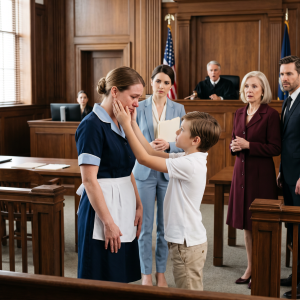
“No. He was going to stop lying for it.”
Vivian stared at me for a long moment before asking the question that revealed what she had actually been afraid of all morning.
“What happens to me now?”
Three days earlier, I might have started solving that problem automatically.
I would have thought about where she would live, whether Grant could support her, what Daniel would have wanted, and how to make everything less painful for everyone else.
That had been my role in this family for sixteen years.
Smooth things over.
Absorb the insult.
Pay the forgotten bill.
Invite the difficult relative.
Explain what someone “really meant.”
Keep the peace.
But there was my husband in a casket because life had ended without asking any of us whether we were ready, and there was our son clutching my hand because the adults around him had nearly turned his father’s funeral into a battle over money.
I was done making other people’s choices easier to survive.
“I don’t know,” I told Vivian. “And for the first time, Vivian, it isn’t my responsibility.”

THE PART OF THE RECORDING THAT WASN’T ABOUT MONEY
Noah pulled on my hand again.
“Mom, there’s more.”
I looked at the screen.
The recording still had two minutes left.
I nearly turned it off.
We had heard enough evidence. Enough accusations. Enough family secrets.
But Noah whispered, “Dad said there was something for me.”
So I pressed play.
Daniel took a long breath on the recording.
When he spoke again, his voice sounded different.
Softer.
“Buddy, if you’re hearing this, I need you to listen to me carefully.”
Noah covered his mouth.
I crouched beside him.
“You are not the man of the house.”
Several people began crying.
Daniel continued.
“People say that to boys when their dads die because they think it sounds strong. I don’t want anybody saying it to you. You’re eight. Your job is to be eight.”
Noah pressed his forehead against my shoulder.
“You don’t protect Mom from grown-up problems. You don’t fix money. You don’t fix Grandma. You don’t fix Uncle Grant. You go to school, complain about vegetables, play baseball badly until you get better, and leave your socks everywhere like you already do.”
A laugh escaped me through tears.
Noah did too.
“Mom takes care of you. You take care of Mom by letting her be your mom. That’s enough.”
I closed my eyes.
Suddenly I understood why Daniel had trusted Noah with the phone.
Not because he wanted an eight-year-old boy carrying evidence against his uncle.
Daniel had known me.
He knew that if he gave the phone directly to me and told me it contained something that could destroy his mother and brother, I might hesitate.
I might wait.
I might try to protect Noah from conflict by protecting everyone else from consequences.
But if Noah brought it to me himself, I would listen.
Daniel had found one final way to make sure I stopped carrying his family for him.
Then his voice addressed me.
“Elena, I’m sorry I didn’t tell you everything sooner.”
My throat tightened.
“I thought if I could fix this quietly, I could protect you and keep my family together. That was arrogant. You deserved the truth when I found it.”
Vivian turned away.
Daniel continued.
“If Mom has made you defend yourself in front of people who already decided what they wanted to believe, don’t spend the next year trying to win them back. The people who love you will ask questions. The people who want a villain will find one no matter what you say.”
I looked across the chapel at the relatives who had whispered behind me.
Several lowered their eyes.
“I love you. I believe you. Take care of Noah. Take care of yourself. And please don’t waste whatever life gives you after me explaining yourself to people who chose the lie because it was more convenient.”
The recording ended.
No dramatic music followed.
No final accusation.
The screen simply returned to the list of files.
I stared at Daniel’s name until the letters blurred.
Then I locked the phone.
WHAT HAPPENED AFTER EVERYONE WENT HOME
The apologies began before we left the chapel.
Aunt Marlene came first.
She touched my arm and said, “Elena, I should have called you before believing any of this.”
I nodded.
I did not tell her it was fine.
It was not fine.
One cousin apologized for repeating something Grant had told him about the loans. Another admitted Vivian had been discussing my supposed financial problems for weeks.
I listened.
I thanked them when appropriate.
I forgave no one on command.
Grant left through a side door before the burial.
Vivian remained until the end but did not approach Noah again.
At the cemetery, I stood beside my husband’s grave with our son and watched the casket disappear beneath the earth. The phone remained in my purse, suddenly heavier than any object that small had a right to be.
Three weeks later, the bank’s fraud review confirmed that the disputed signatures did not match my verified signatures on file. The company’s outside accountant found additional transactions involving Westbridge, and Grant resigned from every operational position at Mercer Industrial while the financial investigation continued.
There was no theatrical arrest.
No television reporters.
No spectacular collapse.
He simply lost access to the thing he had believed he could quietly take.
Control.
I kept Daniel’s management team in place and hired an independent controller to review authorization procedures. No single Mercer family member would ever again be able to move significant company money without a second approval.
Martin asked whether I intended to become involved in daily operations.
“Eventually, enough to understand what I own,” I told him. “But I’m not pretending I can do Daniel’s job because I inherited his shares.”
He smiled.
“He would have liked that answer.”
Vivian hired an attorney.
She challenged nothing successfully.
I did not prevent Noah from speaking to her forever, but I made one rule clear: any future relationship with him would happen slowly, with boundaries, and never through me pretending the funeral had not happened.
She was never invited into my house again.
That consequence mattered more than anything else.
For sixteen years, Vivian had walked through our front door without knocking because Daniel always said, “That’s just Mom.”
After the funeral, I changed the lock.
Not because she had a key.
Because I wanted the door to belong to me again.
“MY HOME”
Several months later, on Daniel’s birthday, Noah asked if we could go to Miller’s Burger Shack.
It was not elegant. The booths were cracked red vinyl, the fries were too salty, and the same neon milkshake sign had buzzed in the front window since Daniel and I were twenty-seven.
It was also where we had our first date.
Daniel had spent forty minutes pretending he understood baseball because a game was playing above the bar.
I discovered three dates later that he did not know what an RBI was.
Noah ordered Daniel’s usual cheeseburger with extra pickles.
While we waited, he asked for his father’s phone.
We had gone through most of it together by then. Photographs. Notes. Terrible screenshots. A grocery list from two years earlier that included “milk, coffee, Noah cereal, something green so Elena thinks I tried.”
Noah laughed every time he read that one.
He scrolled through the photographs until he stopped.
“Mom.”
He turned the screen toward me.
The picture had been taken on a flight home from Florida the previous summer. I was asleep with my head on Daniel’s shoulder, my hair falling across half my face. Daniel was looking into the camera with the faint smile he always wore when he thought he was getting away with photographing me without permission.
I had never seen it.
Beneath the photograph, Daniel had typed two words.
My home.
For a while, neither Noah nor I said anything.
The waitress brought our burgers and asked whether we needed ketchup. Noah said yes. I said no. She walked away without knowing that the ordinary little phone between us had once exposed a half-million-dollar betrayal in front of an entire family.
Now it was only showing me a photograph.
Noah looked at Daniel’s face on the screen.
“Do you think we’re going to be okay?”
I reached across the table and took his hand.
I could have promised him nothing bad would happen again.
I could have told him his father was watching us.
I could have given him one of those answers adults give children because uncertainty frightens us almost as much as it frightens them.
Instead, I squeezed his fingers.
“Yeah, buddy. I think we are.”
He nodded and stole one of my fries.
I let him.
Then I looked at the photograph one more time before locking the phone and setting it beside Daniel’s empty place at the table.
Vivian had intended to use my husband’s funeral to bury my reputation with him.
Instead, she gave Daniel one final room full of people who needed to hear him.
His voice did not bury the wife he loved.
It buried the lie his family had built around her.
And months later, when the same phone lay between Noah and me in a cracked red booth, I finally understood that Daniel’s last word on our marriage had never been about money, signatures, shares, or evidence.
It had been there in that photograph all along.
My home.