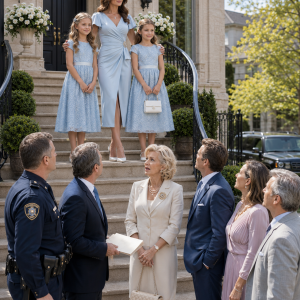
Luke told his parents the complete story. Cheryl’s expression changed from disbelief to grief. She had spent six months calling him lazy and telling relatives that marriage had made him soft; now she learned that his misguided silence had begun with an act of decency.
“Why did you not tell me?” she whispered.
Luke gave a weary smile. “Because you do not listen when the truth interferes with the answer you already chose.”
Cheryl flinched. Martin reached for her hand, and she held it tightly.
Then she looked at me. “I made you pay for my fear. I treated your money as family money when I wanted it, and your car as Luke’s property when that suited me. I made you feel small in my house.”
“Yes, you did.”
Her eyes filled, but I did not rescue her from the discomfort. An honest apology sometimes needs room to remain uncomfortable.
“I am sorry,” she said. “I know saying it does not repair anything.”
“It does not,” I replied. “But it can be where the repair begins.”
The Call That Changed the Balance

The next morning, while Natalie and Luke were meeting with investigators, I received a call from an unfamiliar number. A man introduced himself as counsel for Alden Health Distribution and asked whether General Prescott was using government contacts to interfere with a private employment matter.
My heart began racing, but Dad, who was across the kitchen making oatmeal for Miles, noticed my expression. I placed the phone on speaker.
“Mrs. Bennett,” the caller continued, “your husband remains bound by a valid agreement. Public accusations could create serious financial consequences for your household.”
Dad did not speak. He simply wrote on a notepad: Ask for his name and written communication.
I steadied my voice. “Please give me your full name, and send any concern through our attorney. Do not call this number again.”
The man paused. “You may want to consider whether escalating this is in your family’s interest.”
“Our attorney will respond in writing.”
I ended the call. My hands were trembling, but beneath the fear was something new: I had answered for myself. Dad had not taken the phone, announced his title, or frightened anyone into silence. He had merely reminded me that I was allowed to set a boundary.
The call was reported to Rachel, who preserved the details and forwarded them to the investigators. By afternoon, Alden Health issued a notice instructing its representatives not to contact witnesses directly.
The inquiry lasted several weeks. Analysts traced invoices, attorneys reviewed employment files, and former staff members began describing the pressure they had endured. The board placed Pike on leave and ordered an outside review.
During those weeks, Luke and I remained with Dad and Helen. We did not pretend that exposing Pike’s conduct had repaired our marriage. Luke began counseling, updated me on every legal conversation, and stopped hiding rejection letters. I learned how easily gratitude could turn shelter into control. We opened new accounts, transferred the car loan into both names, and made a budget no parent could edit.
Cheryl did not demand immediate forgiveness. She returned the extra household money she had taken and asked before visiting Miles. Martin began counseling with her, admitting that his habit of keeping peace usually required someone quieter to absorb the conflict. Alden later withdrew the allegation against Luke, corrected his employment record, and compensated him for lost wages. He accepted only after his attorney approved language protecting his right to cooperate with investigators.
What Justice Looked Like
By early November, several vendor contracts had been suspended. Warren Pike was removed from his position and agreed to cooperate with the wider inquiry. The companies returned much of the disputed money, and the health network established independent reporting channels. Natalie received a formal correction to her record and accepted a new role in Charlottesville.
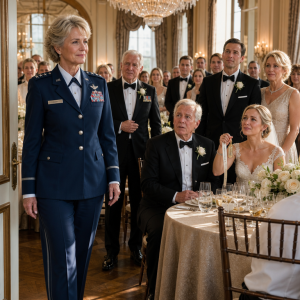
There was no triumphant press conference in my father’s living room. Dad’s name appeared nowhere, which was exactly as he wanted it. He had opened one proper door, and then trained professionals had followed the evidence. When Cheryl once remarked that Pike had learned what happened when he challenged a general’s family, Dad corrected her gently.
“He faced consequences because ordinary people documented the truth and had the courage to present it. Rank did not create the facts.”
That sentence stayed with me.
For years, I thought strength looked like Dad in uniform. That autumn, I recognized its quieter forms: Natalie telling her story with shaking hands, Luke admitting that one honorable choice did not excuse months of dishonesty, Martin confessing the cost of his silence, Cheryl returning a key without a demand, and a tired young mother saying that an apology was a beginning rather than a receipt for forgiveness.
In January, Luke found work in a university purchasing office where his inconvenient questions were valued. We rented a small townhouse near a park. On our first evening there, I stood among unopened boxes and felt richer than I ever had in Cheryl’s beautiful house.
Our marriage recovered slowly. He told the truth even when it made him look foolish, and I spoke before resentment hardened into silence. We learned to disagree without inviting our parents to become judges.
Cheryl saw Miles every other Sunday and began asking before bringing food or making plans. The questions were ordinary, but for her they were evidence of change.
Several months later, she and I were alone in the kitchen while Luke and Martin assembled a wooden play table in the living room. The men had ignored the instructions and were quietly blaming the screws.
Cheryl dried a plate and said, “I still think about you carrying Miles on that road.”
I waited.
“I told myself you needed to become tougher,” she continued. “The truth is, I needed to feel powerful because I was afraid my son was falling apart. I chose the person least likely to fight me.”
“I was less likely then,” I said.
A small, rueful smile crossed her face. “Yes. I have noticed the difference.”
I smiled too. It was not the easy closeness some families claim after a crisis. It was something more careful and, perhaps, more dependable: two women seeing each other clearly and agreeing not to return to old roles.
One Honest Step at a Time

On the first warm Saturday of spring, Dad came to help us plant a young maple beside the townhouse patio. Miles, now steady enough to walk, followed him across the yard with a plastic shovel and solemn concentration. Luke was inside making sandwiches, and I sat on the back steps, my ankle long since healed.
Dad lowered himself beside me and watched his grandson pat dirt around the tree.
“You look peaceful,” he said.
“I am, mostly.”
“Mostly is better than people admit.”
I asked whether he had known, when he stopped beside me that afternoon, how much would unravel afterward.
“Of course not,” he said. “I knew my daughter was hurt and needed a ride. The rest came one decision at a time.”
“Cheryl thought you arrived to take command.”
Dad laughed softly. “People often misunderstand leadership. They think it means entering a room with all the answers. Usually it means recognizing who has been prevented from speaking and making enough space for the truth.”
I watched Miles lose his balance, sit in the grass, and look offended by the ground. Dad offered a hand, but our little boy pushed himself upright before accepting it.
That was when I understood what my father had given me. It was not rescue in the way I once imagined rescue—a stronger person charging in, defeating everyone who had been unkind, and returning my life to me neatly repaired. He had given me a ride, a safe room, proper advice, and the confidence to use my own voice. Then he had trusted me to decide what came next.
Luke stepped onto the patio carrying a tray. He kissed my forehead and asked whether I wanted tea or lemonade. It was a small question, almost laughably small after everything we had faced, but our new life was built from questions like that. What do you need? What do you think? Is this all right? Do you want me to stay? Every one of them returned a little dignity that silence and control had taken away.
I chose lemonade.
In time, the missing funds became a paragraph in a regional newspaper, the workplace case became a set of private agreements, and Dad’s involvement became a family footnote. Yet I never forgot his window lowering beside that curb. I had believed I was walking home; in truth, I was disappearing one concession and one swallowed sentence at a time. He interrupted that disappearance, but the next choices belonged to all of us: mine when I accepted the ride, Luke’s when he brought the notebook, Natalie’s when she presented her records, and Cheryl’s when she stopped defending what she had done.
By autumn, the maple leaves had turned copper, and Miles gathered them into crooked piles while Luke followed with a rake. Watching them, I often thought about how close we had come to losing the life we were only beginning to build.
We did not save it with one grand gesture. We saved it with boundaries, paperwork, counseling appointments, returned keys, difficult conversations, and ordinary mornings when we chose honesty over comfort. There was no perfect ending, because real families rarely receive one. There was only a better direction and the willingness to keep walking toward it.
My father once spent a career teaching people that courage was not the absence of fear. That spring, I learned the rest of the lesson: courage can be as quiet as accepting a ride, as humbling as admitting a lie, and as steady as taking one honest step after another until, almost without noticing, you have found your way home.