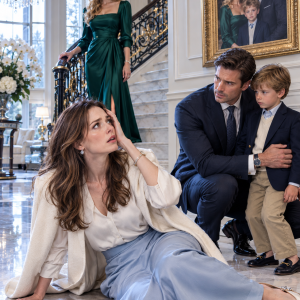
Claire touched my arm.
“Ethan.”
It was the first time she had said my name since I entered the house.
“What’s in the drawer?” I asked.
Lorraine answered before she could.
“Private belongings.”
Claire drew a slow breath.
“My keys.”
I turned toward her.
“Your house keys?”
She nodded.
“Lorraine has kept them for almost two months.”
My mother folded her arms.
“Because she was careless with them.”
For the first time, Claire’s voice became steady.
“I never lost them. You took them the week Ethan left for Milwaukee. You said that if I wanted to leave the house, I had to ask you first.”
Lorraine glanced toward the dining room, perhaps hoping her friends would accept her explanation.
“Someone had to know where she was going. You were never here.”
Claire continued.
“My bank card is in there too.”
I remembered noticing that Claire had stopped buying groceries during my trips. She usually waited until I returned, and I had assumed she preferred shopping together. I had never considered that she might no longer have access to our household account.
“Why didn’t you tell me?” I asked.
Claire’s eyes met mine, and there was more weariness than accusation in them.
“Every time I tried, she was standing nearby. And whenever I hinted that something was wrong, you told me she was only adjusting.”
There was no defense available to me because she was right.
My mother had appeared in the background of nearly every video call. Emma had started glancing offscreen before answering simple questions. Claire had once asked whether Lorraine could stay with my brother for a while, and I had dismissed the suggestion because moving her seemed inconvenient.
The pattern had been visible.
I simply had not wanted to name it.
“Where’s the drawer key?” I asked.
Lorraine pressed her hand against the pocket of her dress.
Claire pointed toward it.
“She keeps it in her right pocket.”
My mother removed a small key ring and closed her fist around it.
“You are not searching through my property because Claire has decided to turn you against me.”
I did not try to take it. I would not create a struggle in front of Emma, and help was already approaching. Instead, I sat beside the cabinet.
“No one is leaving with anything from that drawer.”
Lorraine gave a short, humorless laugh.
“Look at what your wife has made you become.”
A few minutes later, the paramedics arrived, and the house shifted from accusations to practical questions. They examined Emma’s fingers, carefully removed the damp cloth Claire had wrapped around her wrist, and asked both of them what had happened.
Emma answered without looking at her grandmother.
She explained that the water had been too hot, that she had asked to stop, and that Lorraine had said she could not eat until every dish was washed.
Then she added softly, “I’m really hungry.”
Claire covered her mouth and turned toward the wall.
That simple sentence revealed more than anything else could have. Our daughter had stood only a few yards from a table overflowing with food, believing she had to earn permission to eat.
Lorraine finally placed the drawer key on the side table.
The sound was small, but it marked the first time that afternoon she willingly surrendered control of anything.
What My Wife Had Endured

After the paramedics finished their initial examination, I asked Claire—not Lorraine—whether she wanted the drawer opened.
She nodded.
Inside were Claire’s house keys, her bank card, a spare car key, her library identification badge, and several receipts from purchases Lorraine had criticized her for making. There was no dramatic letter or hidden recording, only ordinary belongings that every adult should be able to use without requesting permission.
Their very ordinariness made the truth harder to excuse.
Claire picked up her keys and held them in her palm.
Lorraine began explaining that she had been trying to bring order to our home.
“Ethan is gone half the month,” she said. “Someone had to manage things. Claire spends your money and lets Emma do whatever she wants.”
“It is our money,” Claire replied. “And this is our home.”
I looked around at the abandoned plates, the guests slipping quietly through the doorway, my daughter’s injured hands, and the bandage being placed around my wife’s wrist.
“This isn’t managing a home,” I told my mother. “It’s controlling the people who live in it.”
Lorraine stared at me.
“After everything I sacrificed for you?”
I had heard some version of that sentence throughout my life. It summoned memories of her working long shifts after my father left, stretching groceries until payday, and sitting beside me whenever I was ill. Those sacrifices were real, and I would always be grateful for them.
But gratitude was not permission.