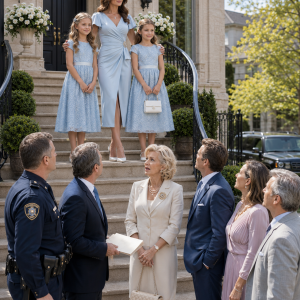
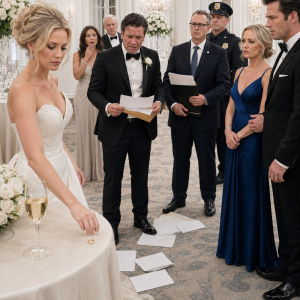
Before Natalie could explain, Daniel called her for the cake cutting. She stepped backward, then pointed gently toward our parents.
“Mom knows where the box is,” she said. “Dad has kept it all these years. It may not excuse anything, but it proves you were never invisible to him.”
What Fear Had Learned to Sound Like

My mother, Ruth, admitted the truth beside the garden windows. Dad had invented Natalie’s request, and Mom had followed with her own message because she had spent fifty-seven years mistaking the prevention of conflict for its repair.
“I thought keeping peace meant I was helping,” she said, her voice unsteady. “Now I think I only taught everyone which person was expected to surrender.”
Samuel had joined the Air Force after high school and trained as an aircraft maintenance specialist. Dad adored him. During a training flight in 1972, a mechanical failure brought the aircraft down, and Samuel did not survive. Their mother preserved his room for more than a decade. By the time I brought home an academy brochure, Dad’s sorrow had hardened into rules and contempt for any dream resembling Samuel’s.
Mom did not excuse his beliefs about women, and I was grateful she refused to polish the past. Yet she also told me he knew the squadrons I had led, the year I received each star, and the communities reached by my disaster-response work. He had followed my career privately while dismissing it publicly.
“How can a person care that much and behave as if he does not?” I asked.
Mom looked toward the terrace, where Dad stood alone beyond the open doors.
“Loving someone and knowing how to love them are different abilities,” she said. “Your father had one. He never practiced the other.”
Outside, Dad leaned against a stone railing, watching lights ripple across the river. When I joined him, he complained that at eighty-one he had earned the right to dislike weddings, hotel coffee, and most music recorded after 1975. It was his usual shield: irritation dressed as personality.
I did not let him hide behind it.
“Natalie told me the truth.”
His jaw tightened. “I was protecting her wedding.”
“She did not ask you to.”
“She does not always know what she needs.”
“You used to say that about me.”
Silence stretched between us until the music behind us changed.
“Tell me about Samuel.”
Dad’s hands closed around the railing. At first he spoke as a principal giving facts: Samuel was twenty-three, funny, restless, and determined to work near aircraft after weak eyesight prevented him from becoming a pilot. Two officers came to the family house on a Tuesday morning. Their mother understood why before they reached the porch.
Then facts gave way to memory. Samuel had called two evenings earlier to complain about cafeteria biscuits and ask whether Walter still planned to marry Ruth. Dad remembered every word because it was their last ordinary conversation.
“Then you came home years later carrying that academy brochure,” he said. “You had the same look he had—the look of someone who could already see beyond our street.”
“So you told me women did not belong in military aviation.”
“Yes.”
“You predicted I would quit.”
“Yes.”
“You skipped my first change-of-command ceremony.”
He closed his eyes. “Yes.”
I had imagined confronting him for most of my life, always with a perfect closing argument. Standing beside him now, I discovered that being right could feel profoundly lonely.
“Why did you keep doing it?”
“Because every achievement carried you farther into the world that took Samuel from us, and because apologizing after a few years would have meant admitting those years were choices.” He looked at me then, without authority or defense. “I chose pride because it was easier than admitting fear. I was wrong.”
The admission did not erase anything, but it opened a door I had assumed was a wall.
“You were afraid the Air Force would take me away,” I said. “So you made sure I could never bring that part of myself home.”
His face folded with recognition. “Yes.”
He reached into his pocket and placed a brass hotel key card sleeve in my hand. Room 612 was written across it.
“There is a wooden box on the desk,” he said. “I brought it because your retirement is next week.”
“Yesterday you said nobody cared.”
“Yesterday I became frightened and reached for the cruelest version of the lie I have told all these years.”
I asked what was inside.
“A letter I wrote the night before you left for Colorado.”
“Why did you never give it to me?”
His answer came so quietly I almost missed it.
“Because the man who wrote it at midnight was more honest than the man who came downstairs at breakfast.”
The Box in Room 612
The box bore my name in Dad’s block handwriting. Inside were academy programs, photographs, Air Force announcements, and a magazine profile. Several carried dates and notes in the margins. He had documented my career with astonishing care, then hidden the record where neither of us could benefit from it.
Beneath everything lay an unmailed envelope addressed simply: For Julia, before you go.
The letter was dated June 24, 1992. Its creases had softened with time, and Dad’s younger handwriting leaned urgently across the page.
“Julia, you are upstairs asleep, and I am sitting at the kitchen table pretending I am not worried. I know I have made your leaving harder than it needed to be. You believe I cannot understand why you want this life, and perhaps I cannot, but I know that when something matters to you, you give it everything you have. You have done that since you were small.”
I paused, unable to reconcile the tenderness on the paper with the man who had mocked my dream the next morning.
“I am afraid, and I do not know how to say that without feeling weak, so I keep telling you that your decision is foolish. Perhaps the foolishness belongs to me. Samuel wanted a wider life than the one he could see from our neighborhood, and I recognize the same light in you. If I ask you to stay only because I am frightened, I am asking you to carry my fear instead of living your own life.”
My vision blurred. I wiped the page with the edge of my hand and continued.
“I want to tell you that I am proud. I hope you prove wrong every person who believes you do not belong there, including me—especially me. Tomorrow I may say all of this badly, so I am writing tonight in case courage fails. Go become the person you are meant to be. If you ever return with stars on your shoulders, I hope I have become wise enough to understand what they cost you. Love, Dad.”
I sat on the edge of the hotel bed holding thirty-four years of withheld truth. A person can spend a lifetime wanting certain words, yet when they finally arrive, they do not enter an empty room; they must find space among every absence, every missed ceremony, and every conversation that ended too soon.
Natalie appeared in the doorway with Mom’s spare key. She knew about the box because she had found it while helping our parents move five years earlier, though she had never seen the letter.
“I asked him to tell you,” she said.
“Clearly your influence has limits.”
She sat beside me, and together we studied a photograph of my first command. Natalie admitted that, as a girl, she had envied me. Dad called her sunshine, but he spoke of me as if I were a storm that could cross any ocean, and to a child, his frustration had sounded suspiciously like awe.
“Everyone thinks someone else received the better family,” she said.
I told her I had envied the dinners she attended, the children’s birthdays she remembered, and the ordinary Saturdays I had traded for a life measured by flight schedules and secure briefings.
“I missed you,” she said.
“I missed you, too.”
“You called at impossible hours.”
“Time zones are not a character flaw.”
“You once left a message saying, ‘Happy birthday, probably.’”