“No.”
I raised an eyebrow.
“That’s not entirely your decision.”
He almost smiled.
“Fair point. Then let me say it differently. If you want to leave, I’ll help you get settled. If you want to stay as my caregiver, you’ll have a proper contract, normal hours and fair pay. I won’t turn what you did for me into a debt.”
Then he opened his desk drawer.
Inside were two reports.
Additional genetic testing showed an extremely strong likelihood that Mason was Everett’s biological son.
Investigators had also located old foster-care records.
The dates matched.
His mother’s information matched.
Everything fit.
Everett stared at the pages.
“I lost him for twenty-nine years.”
“He doesn’t know any of this.”
“I know.”
“And he might not want to know you.”
Everett nodded.
“I know that too.”
The Door That Opened Again
A private investigator eventually located Mason working for an industrial maintenance company in northern Michigan.
Everett decided to go himself.
“You could send a letter,” I suggested.
“I’ll carry the letter.”
“What if he closes the door?”
Everett folded the report carefully.
“Then I’ll live with that. I spent twenty-nine years staying away because I was afraid of a closed door. I’ve already paid enough for that fear.”
Three days later, Everett returned alone.
The next morning, he found Nolan walking along the sofa.
Everett knelt beside him.
“Your father makes that exact face when he’s irritated.”
My heart jumped.
“You saw Mason?”
“Yes.”
“What happened?”
Everett sat down.
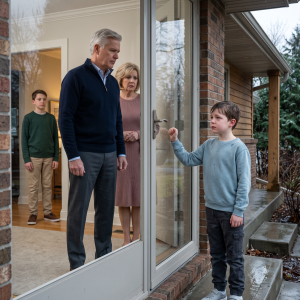
“He closed the door.”
I didn’t know what to say.
Then Everett smiled faintly.
“Ten minutes later, he opened it again.”
Mason didn’t come home immediately.
There was no magical reunion.
He began with text messages.
Then short phone calls.
Eventually he asked about Nolan.
A few weeks later, he asked about me.
Several months after that, Mason came to Connecticut.
The first time he stood in the same room with his father and his son, he looked as though he had forgotten what to do with his hands.
Finally, he turned to me.
“I didn’t come here expecting you to forget what I did.”
“Good, because I haven’t.”
He nodded.
Then he looked toward Nolan.
“I came because I’m tired of running.”
I didn’t forgive him that day.
But I didn’t close the door either.
The Inheritance That Couldn’t Be Written Into a Will
The following spring, we held a small celebration for Nolan in Everett’s backyard.
There was no ballroom.
No expensive venue.
Just tables beneath the trees, good food, and people who were still learning how to become a family.
Everett could walk without his cane by then.
Mason was helping Warren plant a young maple near the edge of the yard.
I looked at Everett.
“Why another tree? You already have plenty.”
He watched Mason cover the roots with soil.
“Because you buy a house for yourself.”
Then he pointed toward the little tree.
“But you plant a tree for people who may not even be here yet. Someone puts it into the ground without knowing who will eventually sit beneath its shade.”
Nolan fell asleep against Everett’s chest.
Almost exactly where I had placed him that first night.
Everett immediately stopped moving.
“Claire,” he whispered. “He’s asleep.”
“Then don’t move.”
Everett smiled.
“I spent enough of my life doing that.”
I laughed quietly.
Nothing about our lives had become perfect.
I still didn’t know what my future with Mason would look like.
Everett could never recover the twenty-nine years he had missed with his son.
And he could never erase the disappointment of discovering what someone he trusted had been willing to do for money.
But standing in that garden, I understood something.
A family does not always arrive complete.
Sometimes it arrives late.
Sometimes people come carrying mistakes, regrets, and years they cannot get back.
Sometimes doors close before they open again.
And sometimes a family begins in the middle of the night when an exhausted mother places her restless baby on the chest of a man everyone else has already given up on.
Everett looked down at Nolan and gently touched his hair.
“I spent most of my life thinking money was what I would leave behind.”
He looked toward Mason.
“Turns out I was wrong.”
Nolan sighed softly in his sleep.
Everett smiled.
“Now I can finally breathe.”
I looked across the yard at Mason planting the tree, at Nolan sleeping peacefully, and at the man whose life had changed because one small child had reached him when no one else could.
“Yes,” I said. “I think we all can.”
Sometimes the smallest and most unexpected moment can expose a truth that powerful people have worked very hard to keep hidden, which is why compassion should never be mistaken for weakness.
Wealth can provide comfort, influence, and security, but it cannot replace the years we lose when fear keeps us from reaching out to the people who matter most.
Claire did not help Everett because she expected money or recognition; she helped him because she saw a vulnerable human being who deserved dignity when others were already treating him like a memory.
Family is not defined only by blood or by the name written on legal documents, because real family is built through presence, responsibility, patience, honesty, and the willingness to stay when life becomes difficult.
Everett’s greatest regret was not losing control of his company or nearly losing his fortune, but realizing that he had allowed twenty-nine years to pass because he was afraid of finding a door that might remain closed.
Forgiveness does not have to happen immediately, because rebuilding trust is often a slow process made from small choices, honest conversations, and consistent actions rather than one dramatic apology.
A second chance does not erase what happened before, but it can give people an opportunity to stop repeating old mistakes and begin creating something healthier for the next generation.
Justice may protect the future, but it cannot restore lost time, which is why the moments we still have with the people we love are often more valuable than anything we can own.
The strongest people are not always those who speak the loudest; sometimes they are the ones who quietly document the truth, protect someone vulnerable, and keep moving forward even when they are frightened.
In the end, the most meaningful inheritance is rarely a bank account, a house, or a famous last name; it is the chance to leave the people who come after us with more love, more courage, and less fear than we inherited ourselves.