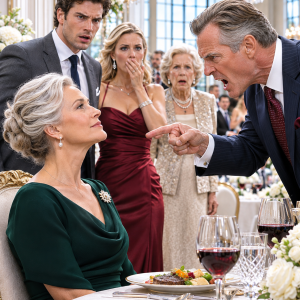
Lydia quickly changed her tone.
“Marjorie, this entire evening has clearly been misunderstood.”
“No.”
“We could have expressed ourselves better.”
“You expressed yourselves perfectly.”
“We were thinking about Adrian’s future.”
“And you decided his mother might damage that future because her dress wasn’t expensive enough?”
Celeste stepped forward.
“That isn’t what anyone said.”
“You didn’t need to.”
Warren cleared his throat.
“Perhaps emotions are running high. We should discuss this another time.”
I looked directly at him.
“Would you want another conversation if I were still the woman you thought had spent her life doing ‘little jobs’?”
He did not answer.
Adrian’s eyes were wet.
“Mom, I’m sorry.”
“What are you sorry for?”
“Everything.”
“Be specific.”
He looked down.
“For letting this happen.”
“Would you be apologizing right now if Scott had not told you I owned this restaurant?”
His eyes met mine.
Several painful seconds passed.
Then he whispered:
“I don’t know.”
I nodded.
“Thank you for being honest.”
The Future I Reconsidered
For years, Adrian had been the primary beneficiary of my estate.
He did not know that either.
I had investments, two smaller restaurant properties, and a commercial building held through a private company.
I had always assumed everything would eventually become his.
That changed that night.
“Adrian, I spent most of my life building something I believed would make your future easier.”
He looked at me.
“Mom…”
“Please let me finish.”
He became quiet.
“I planned to leave most of what I own to you and Maisie. But wealth without kindness can make the wrong things worse.”
Lydia suddenly became very still.
“Maisie’s future will remain protected,” I continued. “Her education will be funded through a trust administered independently. Neither you nor Lydia will control it.”
Adrian looked stunned.
“And everything else?”
“I haven’t decided.”
Lydia stepped forward.
“You’re changing your estate because of one uncomfortable dinner?”
I looked at her.
“No. I’m reconsidering it because tonight showed me what money might encourage if I put it into the wrong hands.”
No one spoke.
Then I looked at my son.
“You invited me here because you wanted me to understand where I belonged.”
His eyes dropped.
“Now I understand perfectly.”
The One Condition I Gave My Son
Adrian followed me toward the door.
“Mom, please.”
I stopped.
“Will you talk to me again?”
There was still a part of me that wanted to pull him into my arms.
Mothers do not stop loving their children simply because those children disappoint them.
But love and permission are not the same thing.
“Yes, Adrian. Someday.”
Hope appeared on his face.
Then I added:
“But only when you can explain why tonight was wrong without mentioning my restaurant, my property, my investments, or anything I might leave you.”
He began crying quietly.
“I do love you.”
“I believe you believe that.”
That hurt him.
I could see it.
But it was true.
“Love without respect becomes something else,” I said. “I need you to figure out what that difference means.”
He nodded.
I touched his arm once.
“Become the man I raised you to be. Not because you want something from me. Do it because your daughter is watching you.”
Then I left.
The Message That Came the Next Morning
I slept badly that night.
Not because I regretted what I had said.
Because I remembered Adrian at eight years old, asleep on the couch with his head in my lap.
I remembered teaching him to drive.
I remembered standing in the rain outside his college dorm while he carried boxes upstairs.
Those memories did not disappear because of one terrible evening.
That was what made the truth so painful.
The next morning, there was a message waiting on my phone.
It was from Adrian.
“Mom, I started writing an apology three times and deleted it because every version sounded like I was trying to get you to forgive me quickly. I don’t deserve that. I treated you differently because I wanted approval from people I thought could help me become important. I let Lydia’s opinions become mine because challenging them was inconvenient. Worst of all, I forgot the person who taught me what real work looked like. I’m not asking about your money. I’m not asking about your estate. I’m going to work on myself, and I hope one day I can show you that I understand what I did.”
I read the message twice.
Then I put my phone down.
I did not respond immediately.
Words mattered.
But I had lived long enough to know that actions mattered more.
The Life I Had Postponed
On Monday morning, I met with my attorney.
I created an education trust for Maisie with protections that would remain in place until she was old enough to manage it responsibly.
Then I made another decision.
For years, I had quietly helped women working in kitchens, hotels, cleaning companies, and childcare centers who dreamed of starting small businesses.
I decided to make that work permanent.
Part of my estate would fund grants for women rebuilding their lives after difficult circumstances.
A week later, I booked a twelve-day trip through northern Italy.
I had wanted to go since I was forty-nine.
There had always been a reason to wait.
Adrian needed something.
The restaurant needed something.
Someone else needed something.
For once, I stopped waiting.
I also signed up for a watercolor class at a local arts center and replaced the worn chair beside my bedroom window with one I had admired for months.
None of those choices were dramatic.
That was exactly why they mattered.
For decades, my life had been measured by what I could provide for other people.
That dinner reminded me that I was allowed to build a life that also belonged to me.
Adrian and I did eventually speak again.
Not immediately.
And not because he suddenly became perfect.
He began visiting alone.
He stopped asking about my finances.
He apologized without defending Lydia.
Most importantly, he began bringing Maisie to see me regularly.
One afternoon, several months later, Maisie sat beside me in the restaurant kitchen decorating a small cake.
Adrian watched from the doorway.
Then he quietly said:
“I understand now why that night wasn’t about the restaurant.”
I looked at him.
“Why?”
He swallowed.
“Because you should have mattered before I knew what you owned.”
For the first time since that dinner, I believed he was beginning to understand.
I smiled.
“That’s a start.”
And for now, a start was enough.
A person’s real character often appears most clearly in the way they treat someone they believe has no money, influence, status, or opportunity to improve their own life.
Parents can give their children years of sacrifice and opportunity, but gratitude only becomes meaningful when it grows into everyday respect rather than appearing only when something valuable may be lost.
A modest home, an older car, or simple clothing can never measure a person’s success, because genuine achievement does not always need an audience or an expensive costume.
Family love should make people feel safe and valued, not force them to repeatedly prove that they are worthy of being included, heard, respected, or given a seat at the table.
Setting a boundary is not the same as seeking revenge, because sometimes distance is the healthiest response when repeated disrespect has been mistaken for something you will always tolerate.
Money may reveal a person’s intentions, but it cannot create character, and sudden kindness that appears only after wealth is discovered should always be examined carefully.
A sincere apology is not measured by tears or beautiful words but by whether someone accepts responsibility, changes their behavior, and continues doing better even when forgiveness is not guaranteed.
No parent should have to display their sacrifices like receipts in order to deserve respect from the children they spent years loving, protecting, and helping become adults.
Sometimes a painful moment does not destroy a family; instead, it exposes the attitudes that were already damaging that family and finally creates an opportunity for honest change.
Your place in this world should never be decided by people who judge your worth according to appearances, because dignity begins when you stop waiting for someone else to tell you that you deserve to belong.