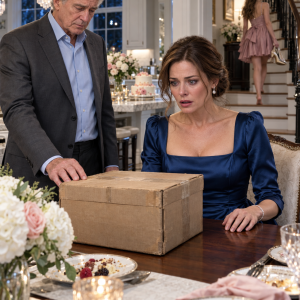
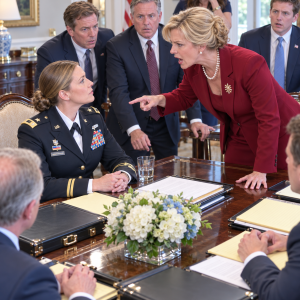
Lorraine lifted her chin. “I was protecting your future. Your company was growing. I believed the pregnancy was meant to bind you to her.”
“So you stole five years from your grandson?”
“I thought she would accept the money and leave.”
Madeline stepped forward. “I did leave, Lorraine, but I kept my child. I built a stable life, found honest work, and raised a kind boy. You did not ruin us. What you took was his chance to know his father, and that choice was never yours to make.”
My mother sank into a chair. “Grant, I made a terrible mistake.”
“A mistake happens once,” I said. “You repeated this one every Sunday you sat across from me and pretended not to know where Madeline had gone.”
Owen quietly offered her a tissue.
“Are you really my grandmother?” he asked.
Lorraine nodded through her tears.
Madeline rested a hand on his shoulder. “She is, but being family means taking responsibility. She has work to do before she can be part of our lives.”
For once, my mother had no answer.
Learning to Stay
A formal test confirmed what none of us doubted: Owen was my son. Yet paper could establish parentage; it could not make me his father. That required time, reliability, and the humility to enter a life already built without me.
With Madeline’s permission, I visited each afternoon. I learned that Owen disliked crusts, loved weather maps, and believed pancakes tasted better when shaped like dinosaurs. At first he called me Grant. I did not correct him.
One day at a park, he asked, “Where were you when I was born?”
“I didn’t know you were coming,” I said. “I wish I had known.”
“Will you go away again?”
“Not without telling you where I’m going, why, and when I’ll be back. You will never have to wonder whether I chose to disappear.”
Several weeks later, I knelt beside him in Madeline’s living room with the test result in my hand.
“Owen, I am your father.”
He glanced at his mother. She nodded.
“The one who didn’t know?”
“Yes. I arrived very late, and I am sorry.”
He considered this, then opened his arms. “Then you can hug me now.”
I held him carefully, understanding that forgiveness from a child is not permission to forget; it is a responsibility to become worthy of the trust being offered.
Rebuilding anything with Madeline took longer. She did not confuse regret with change. We spoke about more than my mother’s deception: my work had occupied too much space, my pride had made questions sound like accusations, and both of us had allowed hurt to become silence. Creating something new required honesty about what had weakened the old marriage.
A year after the voyage, the three of us returned to Rhode Island and rented a small sailboat for an afternoon. Owen wore a bright life vest, his wooden airplane tucked beneath one arm and the brass compass resting against his chest.
Near sunset, he handed the captain Madeline’s camera and ordered us to stand at the bow.
“Closer,” he called. “You look like people waiting for a bus.”
Madeline laughed and stepped beside me. I placed an arm gently around her shoulders, leaving her room to move away. She did not.
Owen squeezed between us. As the captain raised the camera, he looked up at me.
“Dad, keep your eyes open this time.”
It was the first time he had called me that without asking whether he was allowed.
“I will,” I promised.
The camera clicked while the last light stretched across the water. We could not recover his first steps, his earliest birthdays, or the evenings when Madeline had answered questions about a father she believed had rejected him. Money could not purchase those years, and apologies could not recreate them.
Standing there with the compass between us, I understood that finding one’s way home is rarely a single heroic act. It is a collection of ordinary choices: asking another question, admitting where you failed, arriving when you said you would, and remaining after the emotional speeches are over.
Owen did not need a flawless father. He needed one who would listen, tell the truth, and stay. Madeline did not need grand promises. She needed evidence, offered patiently over time. And I needed to learn that protecting a family has nothing to do with controlling its future. It means paying attention to the people standing in front of you before someone else teaches you to doubt what you already know in your heart.