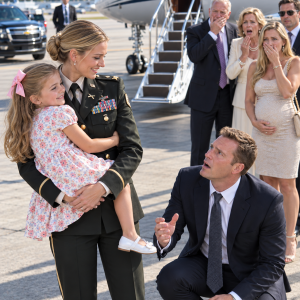
Something in his voice made me turn.
He was staring at the girls with an expression I had never seen on his face before.
“These are your children?”
“Yes,” I answered, keeping one hand on Hazel’s shoulder.
He looked from one little face to another, studying their matching chestnut curls and gray-green eyes.
“All three?”
I nodded.
“They’re triplets.”
His gaze returned to mine.
“How old are they?”
“Four. They’ll turn five next month.”
Nathaniel stopped moving.
I watched him silently work backward through the years, remembering when our divorce had become final and when I had left Connecticut.
Then he looked again at Hazel, whose eyes were so much like his that I had recognized the resemblance from the moment she was born.
“Emily,” he said quietly, “are they my daughters?”
Rachel stepped closer, sensing that the conversation was becoming too serious for three little girls standing beside an airport curb.
I took a moment before answering.
“We need to talk about this, Nathaniel, but not in front of them.”
His expression tightened.
“You knew all this time?”
“I knew I was expecting when I left. I didn’t know how to tell you, and eventually I convinced myself that keeping our lives separate was the safest thing to do.”
He looked away, struggling to absorb my words.
“Almost five years, Emily.”
I could hear the hurt beneath his disbelief, and although I had spent years protecting myself from his judgments, I could not pretend his feelings were unreasonable.
“I understand,” I said. “But the girls come first. We can speak tomorrow.”
I helped my daughters into their seats, promised Nathaniel I would contact him, and climbed into the SUV beside Rachel.
As we pulled away, Willa asked whether the serious-looking man was someone I knew.
“Someone from a long time ago, sweetheart,” I replied.
“Is he nice?”
I looked through the rear window at Nathaniel standing alone beside the terminal.
“I hope he’s learning to be,” I said.
The Secret Hidden in an Old Family File

That evening, after the girls had shown me their drawings, eaten dinner, and settled into bed, my phone rang.
Nathaniel’s name appeared on the screen.
I answered from the kitchen, where Rachel was helping me put away the dishes.
“Emily, I found something you need to see.”
His voice sounded tired.
“What is it?”
“A file from my father’s private office. I came across it last week while reviewing old company records, but I didn’t understand what it meant until today.”
He paused.
“Someone in my family knew about your pregnancy.”
I sat down.
Nathaniel explained that the folder contained correspondence about our divorce, along with a report prepared by a private investigator who had followed my move to North Carolina.
There were references to a medical appointment and a note suggesting that I was expecting more than one child.
At the bottom of the report was a handwritten instruction from his father, Frederick Whitcomb.
The information was to remain confidential until the divorce settlement had been completed.
I felt a familiar heaviness settle in my chest.
Frederick had always viewed family matters through the language of business, treating disagreements as problems to contain rather than feelings to understand.
“Did you know about this?” I asked.
“No,” Nathaniel answered. “I swear I didn’t.”
He sent me copies of the documents, and I spent the next hour reading them beside Rachel.
One letter particularly caught my attention.
It had been written by Nathaniel’s younger sister, Caroline, who had visited me shortly before our separation and had seemed unusually concerned about my health.
In the letter, she urged her father to tell Nathaniel what the investigation had uncovered.
His response was brief and dismissive.
He believed Nathaniel was unprepared for fatherhood and that revealing the pregnancy would complicate the settlement.
Caroline had also attempted to contact me, but I remembered returning an unopened envelope bearing the Whitcomb family address because I had been too anxious to face another confrontation.
I called her that night.
She answered on the fourth ring, and when I introduced myself, she became quiet.
“Emily, I’ve wondered about you for years.”
“You knew I was pregnant?”
“I suspected before you left. Later, I found out my father had ordered someone to investigate. I tried to make him tell Nathaniel, but he refused.”
“Why didn’t you tell Nathaniel yourself?”
She hesitated.
“Because I was afraid of my father, and because I convinced myself that you wanted to be left alone. I should have done more.”
I appreciated that she did not attempt to excuse her silence.
“You could have changed so much,” I told her.
“I know. I’m sorry.”
After we ended the call, I sat beside the window for a long time, thinking about how many decisions had been made by people who believed they knew what was best for everyone else.
I had kept my pregnancy private because I feared Nathaniel’s reaction.
His father had concealed what he learned because he feared the consequences for the family business.
Caroline had remained silent because she feared challenging her father.
And Nathaniel, believing I wanted nothing to do with him, had never questioned the story he had been given.
Our fears had created years of distance that none of us could recover.
The Conversation We Should Have Had Years Earlier
Nathaniel arrived at my office the following morning carrying the original documents in a worn leather folder.
Rachel sat beside me while he took a chair across the desk, and for the first time since I had known him, he seemed uncertain about what to say.
“I owe you an apology,” he began.
I waited.
“Not just for yesterday. For the way I treated you when we were married. I thought providing a comfortable home meant I was doing everything a husband needed to do.”
He glanced toward the window.
“I never understood how lonely you felt until I started remembering the things you used to ask me for.”
I folded my hands.