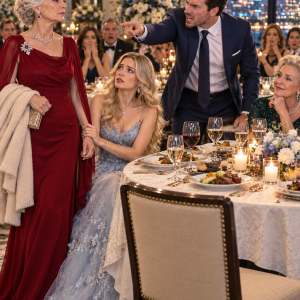
Travis shook his head.
“You’re exaggerating.”
Paige held up one folder.
“Then you can explain your version to the attorneys.”
Two lawyers stepped forward from the guests.
Travis’s confidence disappeared.
One of them spoke calmly.
“Mr. Mercer, effective immediately, your informal access to Bellamy Commercial Group records, facilities, and private documents has been revoked. Any remaining matters will be handled through the appropriate legal channels.”
Travis looked at me.
“Warren, come on. We’re family.”
I felt no satisfaction when I answered.
Only disappointment.
“Paige was your family too.”
There Was No Wedding
Lenora stood beside the altar, still wearing the dress chosen for a future that no longer existed.
Her bouquet rested on a chair.
She looked at me for a long moment.
Then she said quietly:
“I did care about you.”
I wanted to believe her.
That was probably the hardest part.
“Maybe you did,” I said. “But caring about someone and planning around his vulnerability are very different things.”
Her face changed.
The warm expression I had known disappeared.
“Do you know why this worked for so long?” she asked. “Because you wanted to believe it. You were lonely, Warren. All I had to do was listen.”
A few people gasped.
I did not.
Oddly, hearing her admit it gave me peace.
“You’re right about one thing. I was lonely. But trusting someone is not the same thing as giving them permanent permission to deceive you.”
Lenora picked up her purse.
“This isn’t over.”
“No,” I said. “It isn’t. From here, everything gets handled properly.”
She left through the side entrance.
Travis followed several minutes later after speaking with his attorney.
No one applauded.
I was grateful for that.
This was not a victory party.
It was a family realizing how badly trust had been damaged.
I faced the guests.
“There will be no wedding today. I appreciate every person who traveled to be here, but my family needs something different from this day now.”
The reception meal had already been prepared, so we arranged for much of it to be donated to several local community organizations.
The flowers remained in the garden.
Rosalind looked at them and said:
“Flowers didn’t do anything wrong.”
For the first time that day, I laughed.
The Photograph on the Staircase
That night, after the guests were gone, I climbed into the storage room above the garage.
Behind several boxes, I found the framed photograph of Diane that Lenora had removed months earlier.
It was from our thirtieth anniversary.
Diane was laughing.
I was looking at her instead of the camera.
I sat on the floor holding that photograph for a long time.
I had convinced myself that moving forward meant clearing away the past.
It did not.
Moving forward meant learning to carry love without allowing grief to make decisions for me.
I returned the photograph to the staircase.
When I came down, Paige was sitting at the kitchen island.
Caleb was asleep on the couch.
I sat beside her.
“What do you want to do now?”
She thought for a moment.
“I want to separate legally. I want professional support. I want to work again. And I want time to figure out who I am without someone constantly telling me what I’m allowed to feel.”
Old Warren would have immediately said, “I’ll fix everything.”
Instead I asked:
“What do you need from me?”
Paige looked surprised.
Then she smiled faintly.
“Don’t fix my life for me. Just stay close.”
I nodded.
“I can do that.”
What Happened Afterward
The months that followed were not simple.
There were attorneys, financial reviews, difficult conversations, and uncomfortable explanations with business partners.
Travis had used my name to make several people believe I supported arrangements I knew nothing about.
Those situations had to be handled one by one.
The transfers connected to Lenora were reviewed professionally.
The estate documents were replaced.
My company tightened access to confidential information.
Nothing was resolved in a dramatic afternoon.
Real life rarely works that way.
But truth was finally moving in the right direction.
Paige slowly rebuilt her independence.
She found a new position with a regional development firm.
Her first months were difficult.
One evening she came into my kitchen smiling and dropped her bag onto a chair.
“I led my first major presentation today.”
“How did it go?”
“My hands were shaking the entire time.”
I smiled.
“And what did you do?”
She laughed.
“I gave the presentation while they were shaking.”
I had never been prouder of her.
I also apologized to Rosalind.
Then I promoted her into a formal household operations role with far more authority.
She folded her arms when I told her.
“About twenty years late.”
“Probably.”
“I want a raise too.”
“Absolutely.”
The Smallest Person Told the Biggest Truth
Months later, I sat in the garden while Caleb ran through the grass looking for interesting rocks.
Paige brought me coffee.
“Do you still think about the wedding?” she asked.
“Every day.”
“Do you regret meeting Lenora?”
I considered the question carefully.
“I regret not listening to you sooner. But what happened taught me something I should have learned years ago.”
“What?”
I looked at the house, the gardens, and the buildings in the distance that represented decades of work.
“A person can spend a lifetime building companies, houses, investments, and a reputation—and still fail the people he loves if he stops listening to them.”
Caleb ran toward us holding a strangely shaped stone.
“Grandpa, look what I found!”
I immediately put down my coffee.
“Show me.”
He climbed beside me and began explaining why the stone looked like a dinosaur.
I listened to every word.
Because the most important lesson of my life had not come from an attorney, an executive, or a financial adviser.
It came from a four-year-old boy who tugged on my sleeve forty minutes before my wedding and said his mother was crying.
He did not understand trusts.
He did not understand business ownership.
He did not understand legal documents.
He simply knew that someone he loved was hurting.
And he told the truth.
That was enough to open the door the rest of us had failed to see.
Sometimes the people who truly love us are not the ones who tell us what we want to hear, but the ones willing to risk our disappointment by saying something uncomfortable when they believe we are walking toward the wrong future.
Loneliness can make even experienced and successful people overlook warning signs, which is why emotional vulnerability should never be treated as weakness but as a reason to slow down before giving someone complete trust.
Building financial security for a family means very little if the people inside that family become afraid to speak honestly because they believe their concerns will always be dismissed.
A person does not always lose control of his life through one enormous mistake; sometimes it happens through dozens of small compromises that seemed harmless because questioning them felt more difficult than accepting them.
When someone repeatedly tries to separate you from the people who have loved you for years, it is worth asking whether they are creating peace in your life or simply making it easier for their version of events to become the only one you hear.
Listening does not always require solving another person’s problems, because sometimes the most meaningful form of support is simply giving them a safe place to speak without immediately judging, correcting, or deciding for them.
Real strength is not refusing to admit that you were deceived; real strength is being willing to face the truth, accept your part in what happened, and change the habits that allowed the situation to continue.
Children may not understand the complicated language adults use about money, relationships, or control, but they often recognize sadness, fear, and changes in the people they love long before adults are willing to acknowledge them.
The past does not have to be erased in order for life to move forward, because honoring the people and experiences that shaped us can sometimes protect us from mistaking attention for genuine love.
In the end, a family is not held together by a large house, a successful company, shared money, or even a common last name; it survives because someone has the courage to tell the truth and someone else has enough humility to stop and believe them.