Instead, I discovered that the husband I had worked so tirelessly to support no longer seemed comfortable having me around.
He returned to the fitness center, regained his strength, and began receiving invitations to speak about his medical journey at community events, where audiences admired his determination and applauded his remarkable recovery.
At home, however, he became increasingly impatient with me.
He complained that I worried too much, that I preferred quiet evenings instead of social gatherings, and that my presence reminded him of a period he desperately wanted to forget.
One November evening, he placed a folder of divorce documents on our dining room table.
“I need to start over, Natalie. Every time I look at you, I remember being helpless. I can’t spend the rest of my life feeling like the man I was in that hospital.”
For several moments, I simply stared at him, trying to reconcile his words with the promises he had made while holding my hand months earlier.
“I was your wife, Preston. I stayed because I loved you, not because I wanted you to owe me anything.”
He sighed, looking toward the window rather than meeting my eyes.
“I appreciate everything you did, but gratitude isn’t the same thing as love. I need a different life now.”
There are moments when a person realizes that no argument, however reasonable or heartfelt, can restore something another person has already decided to discard.
I signed the documents, and our divorce was finalized in January.
Six weeks later, while staying with my longtime friend, Bridget Lawson, I discovered that I was expecting a baby.
The Story He Told the World

When I called Preston to tell him about the pregnancy, he responded with the detached practicality of someone discussing an unexpected financial obligation.
He agreed to provide child support and establish a parenting arrangement, but made it clear that he had no intention of reconsidering our divorce.
Shortly afterward, Bridget showed me a promotional brochure for a charitable organization Preston had recently established to assist families facing serious marrow disorders.
At first, I was pleased that something constructive might emerge from our difficult experience, but as I read the organization’s website, I realized that Preston had rewritten nearly every important detail of our story.
According to his official biography, his mother and professional associates had organized the community registration drives, while his personal determination had carried him through the challenges of treatment.
There was no mention of my name, the evenings I had spent distributing flyers, the registration events I had arranged, or the twenty-two nights I had remained beside his hospital bed.
Even more painful was a recording of Preston speaking at a fundraising luncheon, where he suggested that his former wife had been unable to cope with his condition and had left him emotionally isolated during the most difficult period of his life.
“Sometimes adversity reveals who truly belongs beside you,” he told the audience. “I learned that the people who promise to stay aren’t always the people who actually do.”
The audience applauded, and I sat alone in my apartment, watching a man receive admiration for a version of events that was almost entirely the opposite of what had happened.
Our son, Benjamin, was born in late August, and although Preston visited the hospital, his appearance was brief because he had an important foundation meeting scheduled that afternoon.
Over the following weeks, I devoted myself to caring for my baby, returning to work when my maternity leave ended, and learning how to manage the responsibilities of motherhood without the partner I had once imagined would share them.
Then, one evening, I received an unexpected message from Russell Bennett, the paramedic who had attended my first registration drive.
He explained that his emergency service department had been invited to one of Preston’s fundraising events, where he had listened to Preston describe the circumstances surrounding his recovery.
“I don’t know what happened in your marriage, and I’m not asking you to explain it,” Russell wrote. “But I remember who organized that registration drive, and I remember who was sitting behind that table. If you ever need someone to confirm what really happened, I’d be willing to help.”
I read his message several times while Benjamin slept against my chest, surprised by how deeply it affected me to discover that someone remembered.
Several weeks later, I agreed to meet Russell for coffee.
We talked about my son, my work, and the challenges of adjusting to a new life, and unlike most people who had heard about my divorce, he never pressured me to explain the painful details.
Before leaving, Russell reached into his wallet and unfolded a carefully preserved piece of paper.
It was one of my original registration flyers.
“The registry contacted me a few months after your event,” he explained. “I was the match they were looking for.”
For a moment, I couldn’t find the words to respond.
Russell told me that he had undergone the donation procedure, recovered, and returned to his work, carrying the flyer with him because it reminded him why he had decided to help.
“I didn’t know your husband personally, Natalie, but I remembered how much you wanted him to come home. Helping him seemed like the right thing to do.”
Sitting across from him, I realized that the stranger whose generosity had made Preston’s recovery possible was also the first person who had offered to defend the truth without expecting anything from me in return.
A Different Kind of Love
Russell and I didn’t immediately begin a romantic relationship, partly because I was still learning to trust my own judgment and partly because he understood that a woman raising an infant needed consistency considerably more than impressive declarations.
Our friendship developed through ordinary acts of kindness.
When my car refused to start outside the supermarket, Russell helped arrange the repair, and when Benjamin developed an ear infection and I was struggling to manage work and sleepless nights, he arrived with homemade soup and groceries.
He helped install safety latches on my kitchen cabinets, assembled Benjamin’s first bookshelf, and occasionally spent Saturday afternoons with us at the park.
What gradually won my heart was the way he treated my son when nobody was watching.
Preston visited Benjamin infrequently, although he regularly shared carefully selected photographs of their time together, accompanied by thoughtful captions about the importance of fatherhood.
Russell, meanwhile, was the man sitting cross-legged on my living room carpet, patiently reading the same picture book for the fourth time because Benjamin wasn’t ready to hear a different story.
One evening, I watched him help Benjamin assemble a wooden train set, allowing the little boy to work through his frustration without rushing to complete the task for him.
“You have more patience than anyone I’ve ever met,” I told him afterward.
Russell smiled.
“He’s only going to be this little once. I don’t want him growing up thinking the people who love him are always in a hurry to be somewhere else.”
Two years after Benjamin’s birth, Russell and I married in a small ceremony at a countryside inn outside Cedarburg, Wisconsin, surrounded by fifty relatives and close friends.
During his vows, Russell took the old registration flyer from his jacket pocket and held it between us.
“The first time I met you, you were asking strangers to give ten minutes of their lives to help someone you loved. Today, I’m asking you to let me spend the rest of mine loving you and Benjamin.”
We purchased a comfortable white farmhouse with a spacious backyard, where Russell built a sandbox, planted vegetables, and installed a wooden swing beneath an enormous maple tree.
Benjamin began calling him Daddy naturally, without encouragement or instruction, because Russell was the person who tucked him into bed, comforted him when he was frightened, and celebrated every small accomplishment.
For the first time in years, I felt that my life belonged to me again.
Then my cousin, Caroline, announced her wedding.
Her fiancé had known Preston through regional athletic events, and because Preston had supported several charitable projects involving his family, he insisted upon including him on the guest list.
Caroline called me apologetically, explaining that she would understand if I preferred not to attend.
“You’re practically my sister,” I told her. “I’m not missing your wedding because someone from my past happens to be invited.”
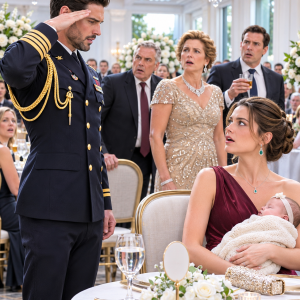
Russell agreed, and on a beautiful autumn afternoon, we dressed Benjamin in his little cream-colored suit and drove to the waterfront estate, expecting nothing more than an evening of music, good food, and celebration.
The Glass That Broke at the Wedding
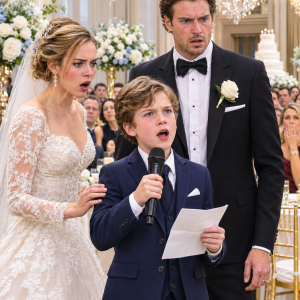
After Preston dropped his whiskey glass, several guests hurried forward to help, while his girlfriend, Vanessa, attempted to clean the splashes from her expensive evening gown.
Russell approached us calmly, handing Benjamin the strawberries he had promised before Bridget, who was also attending the wedding, offered to take our son to wash his hands.
Once Benjamin was safely out of earshot, Preston stepped toward me.
“What exactly are you trying to accomplish, Natalie? Of all the men you could have married, you chose him?”
I looked at Preston, surprised that even after four years, he still believed my decisions revolved around him.
“I married Russell because he’s a wonderful man, not because he has anything to do with you.”
Preston lowered his voice.
“You deliberately went looking for my donor, didn’t you? You wanted some kind of leverage over me.”
“Russell contacted me after hearing one of your speeches. He remembered organizing the registration drive with me, and he knew the story you were telling wasn’t true.”