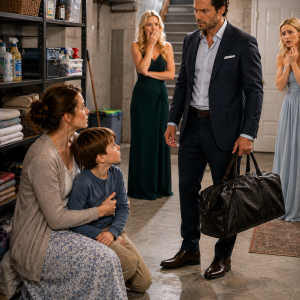
I looked at the sink.
Then at her.
“I would be upset if you believed you needed permission.”
She gave me a small smile.
“I’m trying.”
“So am I.”
I began counseling too.
I needed to understand why avoiding conflict had felt more important than listening to my wife.
I learned that peace and silence are not the same thing.
A quiet home can still be an unhappy one.
Maisie Asked the Question That Stayed With Me
We bought a dishwasher soon afterward.
The first time I loaded it, Maisie watched from across the kitchen.
“It washes all of them?”
“Every plate.”
“Even the big ones?”
“Even the big ones.”
She considered this seriously.
Then she asked:
“So I don’t have to stand on the stool anymore?”
I crouched in front of her.
“No, sweetheart.”
“Never?”
“Never like that.”
I took her hands.
“You’re five years old. Your job is to learn, play, make ridiculous drawings for the refrigerator, and help with little things that are safe.”
She smiled.
“Can I still feed Pickles?”
Pickles was our beagle.
I laughed.
“Absolutely. He would file a formal complaint if you stopped.”
Maisie giggled.
That sound filled the kitchen.
I hadn’t realized how much I had missed hearing it.
Six Months Later, Our House Was Messier—and Happier
There were toys under the coffee table.
Crayons appeared in places crayons had no logical reason to be.
Laurel played music while making breakfast.
Maisie sang loudly and usually incorrectly.
Sometimes I came home to unfolded laundry.
Sometimes we ordered takeout and ate from the containers.
And I loved it.
Because the disorder meant nobody was walking through the house afraid of making a mistake.
Then, one Saturday afternoon, we attended Maisie’s school spring festival.
She participated in a silly relay race and ran toward us afterward as though she had just won an Olympic medal.
“Daddy! Mommy! Did you see me?”
“Every second!” Laurel shouted.
I lifted Maisie into my arms.
Then I noticed someone beyond the school fence.
My mother.
She stood on the public sidewalk holding a small gift bag.
She did not approach.
There had been clear boundaries established, and she knew she could not simply walk back into Maisie’s life.
For months, Darlene had sent messages.
At first, they were defensive.
Then came explanations.
Then apologies that weren’t really apologies.
“I’m sorry Laurel misunderstood my intentions.”
“I only wanted to help.”
“Families should move on.”
I never answered.
Then, a week before the festival, she sent something different.
“I watched the recordings again. Hearing my own voice made me ashamed. I kept telling myself I was helping, but I wasn’t. If Laurel and Maisie ever want to hear an apology from me, I will give one without asking them for anything in return.”
That was the first message that sounded like responsibility.
Still, responsibility did not automatically create access.
Forgiveness Is Not the Same as Opening the Door
Maisie touched my cheek.
“Daddy, what are you looking at?”
I turned back toward her.
“You.”
I didn’t tell her that her grandmother was nearby.
That decision belonged to Maisie’s healing process, not Darlene’s guilt.
Laurel slipped her hand into mine.
She had noticed too.
“You okay?”
she asked.
“Yeah.”
And surprisingly, I was.
I felt sad looking at my mother.
But sadness was no longer enough to make me abandon a boundary.
We walked toward the food stands.
Maisie chose an enormous piece of chocolate cake.
She stared at it eagerly, then hesitated.
“Can I eat it now?”
Laurel and I both became still.
That old fear was still there.
I crouched beside my daughter.
“Maisie, listen to me.”
She looked into my eyes.
“In this family, you never have to earn your meals by making adults happy.”
Her face relaxed.
“Never?”
“Never.”
She pointed at the cake.
“Then I want the corner with the most frosting.”
Laurel laughed.
So did I.
And that simple laugh meant more to me than I can explain.
The Door I Finally Learned to Close
For most of my life, I believed being a good son meant keeping my mother happy.
I believed family loyalty meant tolerating uncomfortable behavior.
I believed avoiding an argument was the same as protecting peace.
I was wrong about all three.
Family is not a permanent debt.
A title like mother, father, spouse, sibling, or grandparent does not give anyone unlimited authority over another person.
And boundaries do not always destroy families.
Sometimes boundaries are what finally allow a family to become healthy.
I still hope my mother changes.
Maybe one day Laurel will choose to hear her apology.
Maybe one day Maisie will decide she wants some carefully supervised relationship with her grandmother.
Or maybe she won’t.
That decision will never again be forced by guilt.
That evening, we returned home from the festival.
Maisie ran inside and left her shoes in the middle of the hallway.
Laurel looked at them.
Then she looked at me.
For a second we both smiled.
Six months earlier, something that small might have caused tension.
Now they were just shoes.
I closed the front door behind us.
From the living room came Maisie’s laughter.
Laurel leaned against my shoulder.
And I finally understood what home was supposed to feel like.
Not perfect.
Not silent.
Not controlled.
Safe.
Loving a parent does not require allowing that parent to control your marriage, your children, or the emotional atmosphere inside the home you have built with your spouse.
When someone you love repeatedly tells you that something feels wrong, listening carefully is far more important than finding the quickest explanation that allows you to remain comfortable.
Silence inside a family should never automatically be mistaken for peace, because sometimes people become quiet only after they have learned that speaking honestly changes nothing.
Children should learn age-appropriate responsibility, but they should never grow up believing that affection, meals, rest, or emotional safety must be earned by pleasing adults.
Setting a boundary with a relative is not necessarily an act of rejection; sometimes it is the most responsible way to protect the people who depend on you.
An apology becomes meaningful when it acknowledges what happened without excuses, blame shifting, guilt, or an expectation that forgiveness must immediately restore the relationship.
Being a good son or daughter should never require becoming a distant spouse or an unavailable parent, because the family you create deserves the same loyalty as the family you came from.
When we realize that we ignored warning signs, the strongest response is not to defend our past choices but to accept responsibility and make different choices consistently from that moment forward.
A healthy home is not measured by perfect floors, empty sinks, expensive furniture, or constant obedience; it is measured by whether the people inside feel free to rest, speak, laugh, make mistakes, and still know they belong.
Sometimes closing one door is not the end of a family story at all—it is the moment the people who have been living in fear finally discover what safety, dignity, and genuine love are supposed to feel like.