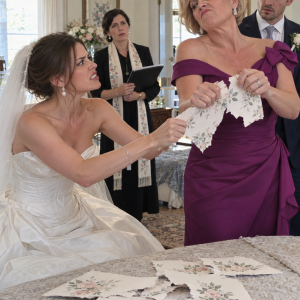
She stayed on her feet. Victor had promised her she would never be tied to a company, she said, and now he needed another person to carry the blame. He had picked the next name he could use.
The investor put down his pen. Victor stood, but I clicked the fountain pen twice. Agent Carver came through the door with investigators, and uniformed officers waited in the hall. She told Victor the transfer had been frozen and that he was being taken into custody over the false guarantee, diverted funds, and forged records.
As officers led him away, Victor looked at me with something close to curiosity.
“You would have lost the house, the company, and your family anyway,” he said. “I only would have made it faster.”
“I had already lost them,” I replied. “Just not to you.”
Marla began asking for a lawyer and saying she would cooperate. The investigators listened, then took her into custody too. I stayed behind facing stacks of documents and a cup of cold coffee. Martin Bell said the investigators recommended no charges against me because I had cooperated and the signatures could be proven false. The bank would still pursue the guarantee until a court set it aside, Bellweather was finished, and the investors would expect me to face them one by one.
“Investigators can take a criminal out of the room,” Bell said. “They can’t make you stop being careless.”
I told him I understood. Then Laura called. Miles had a fever and was breathing too quickly; she was taking him to the children’s hospital in Richmond. She did not know who else to call. I was already moving toward the door when I answered.
Staying

Doctors said Miles had a common respiratory infection that could be difficult for a baby his age. When I reached the hospital, Laura sat by his bed while a nurse fitted a small oxygen tube beneath his nose. His chest rose with effort, and the monitors made a soft sound that seemed to fill the room. Laura looked up as I came through the curtain, then shifted just enough to make space at the edge of the bed.
We stayed through the night. I helped the nurse, learned the monitor numbers, and brought Laura a sandwich from the cafeteria. I left my phone in my pocket. By dawn, Miles’s breathing eased, and Laura pressed her face to his hair and cried.
She fell asleep sitting up. I carried Miles carefully into the hallway and stood by a window while he rested against my chest. When Laura woke and found us, she said I had stayed.
“I answered,” I told her.
I would not ask her to come home or bring another bouquet as if a gift could settle a debt. I asked for a chance to be Miles’s father in the ordinary ways that mattered: every appointment and every promise kept.
Laura looked at our son before answering.
“You don’t get to come home to the life we had,” she said. “That house was built on things that weren’t true.”
“I know.”
“But if you keep showing up, really showing up, I won’t keep you from being his father.”
It was more grace than I had earned, and I accepted it without asking for more.
I sold the house and repaid Bellweather’s investors as much as I could. The court set aside the false guarantee, and investigators recovered much of the missing money.
Victor was convicted and sentenced to federal prison. Marla pleaded guilty and testified against him; Neil Garrison was sentenced for stalking and conspiracy. In North Carolina, a judge cleared Wesley Price, who later sent Laura a letter she framed as a reminder of why her work mattered.
Laura opened Bennett Risk & Compliance in Richmond, with June at the front desk twice a week. I moved to a modest apartment and managed renovation projects for a housing nonprofit. Counseling taught me that accountability is a calendar of small promises kept.
I had Miles every Tuesday and every other weekend, and I was never late.
The First Steps
On Miles’s first birthday, I stood outside Laura’s door holding a small wooden bookshelf I had made in the nonprofit’s workshop, with smooth corners and a brass level carved on the side, like my father’s tool that sat on my shelf while Victor planted the papers.
Laura opened the door in jeans and a frosting-marked sweater, looking more rested than she had after Miles was born. Family and birthday decorations filled the house. Her sister nodded to me; her aunt offered lemonade and watched me drink it as though trust were still under review.
Then Miles saw me. He stood at the coffee table, both hands gripping its edge, a paper crown slipping over one ear. He looked at me, let go, and took three uncertain steps across the carpet before landing against my knees. The room filled with laughter. Laura covered her mouth, and I looked up at her over our son’s head.
“Those were his first steps,” she whispered. “He’s been holding on to everything for weeks.”
“I didn’t miss them,” I said, my voice breaking.
“No,” she answered softly. “You didn’t.”
After cake and candles, after Miles fell asleep with frosting in his hair and tissue paper around his feet, I walked onto the porch. Laura followed and closed the door behind her. She invited me to Sunday dinner, adding that I must not mistake one meal for a promise about our future.
“I won’t,” I said.
She watched me, then nodded. “I know. That’s why I asked.”
I drove home with no flowers on the passenger seat and nothing rehearsed. For years I believed love could be bought back with a bracelet, a weekend away, or a bouquet. I mistook patience for a well that could never run dry and expected the people I loved to carry what I refused to face.
Laura taught me that forgiveness is not weakness, and that self-respect can sound as quiet as one small word in a text message. Miles taught me something simpler. A family is not the house you return to with roses in your hands. It is the call you answer when the people you love need you, then the next one, and the one after that.
The first ring is only a beginning. The rest of your life is what you do after you answer.