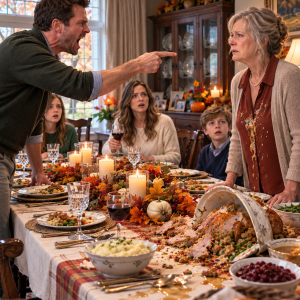
That question finally awakened something inside me.
I turned toward him.
“I tried.”
He stared at me.
“What?”
“I called you.”
“I never got those calls.”
“Your mother did.”
The silence that followed felt heavier than anything that had happened in the operating room.
The Truth Behind Five Lost Years
Nate sat down slowly.
I told him everything.
The pregnancy test.
The ultrasound.
My phone calls.
Patricia answering his phone.
Her warning.
My decision to disappear rather than spend years fighting a family powerful enough to make fabricated evidence look genuine.
Nate listened without interrupting.
When I finished, he looked devastated.
“Claire, I didn’t know.”
“I know.”
“I would have been there.”
I looked directly at him.
“Would you?”
He flinched.
I continued.
“Because when I stood in front of you five years ago and told you those documents were fake, you didn’t believe me.”
He lowered his eyes.
“I was wrong.”
“You were.”
“I should have investigated.”
“Yes.”
He nodded slowly.
There was nothing else to say.
Then he whispered:
“I’m sorry.”
It wasn’t enough to repair five years.
But it was the first honest thing between us in a very long time.
The File Patricia Never Expected Him to Find
Nate didn’t confront his mother immediately.
Instead, he investigated.
This time, he refused to accept appearances.
Within three weeks, a private forensic accountant discovered irregularities in the original financial records.
The transfers supposedly made to me had never reached any account belonging to me.
The photographs had been taken during legitimate catering events.
Several messages had been assembled from unrelated conversations.
Then Nate discovered something worse.
A former Mercer family employee had kept copies of instructions sent from Patricia’s personal office.
The truth became impossible to deny.
His mother had created the entire story because she believed I wasn’t suitable for the Mercer family.
When Nate finally confronted her, I wasn’t present.
He later told me only part of what happened.
Patricia initially denied everything.
Then she defended it.
“I was protecting your future.”
Nate answered with a sentence she apparently never forgot.
“You didn’t protect my future. You stole five years of it.”
For the first time in his life, Nate walked away from his family’s control.
What Came Next
Lucy and Miles spent several weeks in the hospital.
Nate visited every day.
At first, I hated it.
Then I tolerated it.
Eventually, I understood something important.
My anger toward Nate belonged to me.
But Lucy and Miles deserved the opportunity to know their father.
So I established boundaries.
No expensive gifts designed to erase guilt.
No lawyers.
No attempts to control my decisions.
No promises he couldn’t keep.
He agreed to everything.
And then he did something I hadn’t expected.
He showed up.
Again.
And again.
At 2 a.m. feedings.
At pediatric appointments.
During difficult nights.
During quiet mornings.
He learned how Miles liked to be held.
He discovered Lucy settled faster when someone hummed softly beside her.
He didn’t try to buy their affection.
He earned their familiarity one ordinary day at a time.
Months passed before Nate ever mentioned us.
One evening, after the twins were finally home, we sat on my apartment balcony while both babies slept inside.
He looked toward me.
“I don’t expect you to forgive me.”
I remained silent.
“And I’m not asking you to forget.”
I finally looked at him.
“Then what are you asking?”
He smiled sadly.
“Nothing tonight.”
That answer surprised me.
For once, Nathaniel Mercer wasn’t trying to fix the past.
He was simply accepting responsibility for it.
A Different Kind of Beginning

Nearly a year after the night he delivered our twins, Nate asked me to walk beside Lake Michigan.
The same lake where he had proposed years earlier.
We stopped near the water.
He didn’t bring a ring.
He didn’t make a speech.
He simply said:
“I loved you badly when we were younger because I trusted evidence more than the person standing in front of me.”
I felt tears gather in my eyes.
He continued.
“I can’t change what happened. But if you’ll let me, I’d like to spend the rest of my life proving that I’ve learned from it.”
I looked at him for a long time.
Then I smiled.
“Start with tomorrow.”
He smiled back.
“Tomorrow I can do.”
And that was how we began again.
Not with promises of forever.
Not with wealth.
Not with dramatic declarations.
Just tomorrow.
Then another tomorrow.
And another.
Sometimes the strongest relationships aren’t the ones that never break.
Sometimes they are the ones where people finally understand why they broke, accept what their choices cost, and patiently build something more honest from what remains.
Sometimes the most painful misunderstanding is not created by a lack of love, but by allowing someone else’s carefully constructed version of events to become louder than the person we once promised to trust.
When someone you love asks you to hear their side of the story, taking the time to verify the truth can prevent a single emotional decision from becoming years of regret.
Money, influence, and family reputation may open countless doors, but none of them can replace the ordinary moments lost when pride and manipulation separate people who genuinely cared for one another.
An apology cannot return the years that disappeared, but sincere accountability can become the first step toward building a healthier future when it is supported by consistent actions rather than beautiful words.
Children should never be treated as tools for repairing an adult relationship, because they deserve love, stability, and dependable parents regardless of whether those parents eventually choose to be together.
Forgiveness does not mean pretending that betrayal or abandonment never happened; sometimes it simply means refusing to let yesterday’s pain control every decision you make tomorrow.
Trust rarely returns because someone asks for another chance; it returns slowly when that person continues showing up during ordinary days when there is no audience, reward, or recognition waiting for them.
Before judging someone from documents, photographs, rumors, or another person’s accusations, remember that convincing evidence can still hide an incomplete story, while patient questions may reveal the truth that anger overlooks.
Some mistakes cannot be undone, yet people can still choose whether those mistakes become the final chapter of their lives or the painful lesson that teaches them to live differently afterward.
The most meaningful second chances are not built by recreating the life people once imagined together, but by accepting what was lost, respecting what has changed, and creating something new one honest day at a time.