PART 1
Seventeen Places at the Table
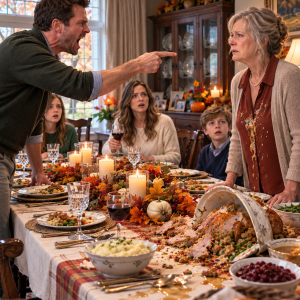
At 8:40 on Christmas night, I was standing beside a dining table set for seventeen people, watching twelve candles burn lower around a turkey nobody had touched. I had spent two days preparing the meal my family used to build Christmas around: honey-glazed ham, mashed potatoes with too much butter, roasted vegetables, cranberry sauce, spiced cider, and the walnut bread my husband Richard had made every December before he died. Whenever headlights moved across the curtains, my fingers went automatically to the pearl necklace he had given me on our thirtieth anniversary, and I waited for the sound of a car turning into the driveway.
None did.
My name is Elena Morales, and I was sixty-eight that Christmas. Richard had been gone for ten years, but I still lived in the house outside San Antonio where we had raised our three children, and I had kept many of our old traditions because I liked believing traditions could hold a family together after the person who created them was gone. That evening I had put on an emerald velvet dress, filled eight stockings for my grandchildren, wrapped gifts in separate piles beneath the tree, and written seventeen place cards by hand.
Weeks earlier, I had made the invitation deliberately simple. “I don’t want presents. I don’t need anybody to bring food. I just want one Christmas dinner together, like we used to have.”
Laura, my oldest daughter, had answered, “We’ll see, Mom. David’s family has something earlier, so I can’t promise.” Michael told me not to plan the evening around him because the children had other things going on, while Fiona smiled during our video call and said, “It sounds nice. I’m sure we can work something out.”
None of those answers had actually been promises, although I treated them as if they were. That was something I would understand only later: I had become very skilled at taking whatever little bit my children offered and enlarging it until it looked enough like affection to keep me from admitting how little was actually there.
At nine, I called Laura and reached voicemail. Michael’s phone went straight there too, while Fiona let hers ring twice before declining the call. I sent one message to our family group saying dinner was ready whenever they arrived, then returned to the kitchen and stirred the gravy while telling myself there might be traffic, someone might have lost track of time, or the grandchildren might still be opening presents somewhere.
Richard’s walnut-bread recipe was propped against the backsplash. The index card had softened around the edges after decades of use, and an old butter stain sat beside his slanted handwriting: Don’t overmix. I touched that stain while listening for a car outside because it was easier to focus on something familiar than to admit what the silence in my house meant.
By ten, I had reheated the gravy twice. By eleven, I stopped reheating anything and began putting foil over the food. Shortly after midnight, I carried my untouched plate into the dining room and sat at the head of the table, facing sixteen empty chairs beneath candles that had burned almost to their holders.
The stockings I had filled for my grandchildren still hung beside the fireplace, and their gifts remained arranged beneath the tree so carefully that no child could have accused me of favoring another. I had spent weeks making sure everybody would have a place in that room, yet not one of them had spent five minutes making sure I had a place in their Christmas.
What happened next surprised me because I didn’t cry or become furious. Instead, I began removing the place cards, stacking Laura’s, Michael’s, Fiona’s, their spouses’, and finally the grandchildren’s beside Richard’s recipe card until the table stopped looking as though seventeen people might arrive at any moment.
For the first time in years, I allowed an empty chair to mean exactly what it looked like.
The Things I Had Explained Away
After Richard died, my children had promised I would never be alone. Laura held my hands after the funeral and said, “We’re getting through this together, Mom.” Michael promised to handle the lawn and the repairs Richard used to manage, while Fiona cried against my shoulder and told me I could call her at any hour.
For a while, they tried. Laura brought food after work, Michael mowed the lawn on Saturdays, and Fiona arrived with the children often enough that the house would fill with toys, spilled juice, and the kind of noise I had once found exhausting and later missed. Gradually, however, visits became phone calls, phone calls became texts, and birthdays and Mother’s Days became online flower deliveries or messages containing a heart emoji.
I defended them because mothers can become remarkably inventive when turning neglect into understandable circumstances. They had jobs, children, mortgages, school schedules, and obligations of their own, and whenever somebody suggested they should visit more often, I usually explained their absence before they had to.
Then the small humiliations became harder to explain.
Three years before that Christmas, I drove almost two hours to Michael’s house carrying the chocolate cake I had made for his birthday since he was six. When I reached his street, balloons were tied to his mailbox and cars lined both sides of the road, so I assumed he had planned a larger celebration and simply forgotten to mention it.
Michael opened the door, saw the cake, and immediately glanced over his shoulder.
“Mom, what are you doing here?”
I laughed because I thought he was joking. “It’s your birthday. I brought your cake.”
Behind him, I could hear music and conversation. Michael lowered his voice and said, “It’s mostly Anna’s family. I didn’t know you were coming.”
“I don’t have to stay long. I’ll just come in and say hello.”
His face tightened. “Mom, please don’t make this awkward. We’re already in the middle of everything.”
I handed him the cake because there was nothing dignified left to do with it, then drove until tears blurred the highway badly enough that I had to stop at a gas station. By the following morning, however, I was already telling myself he had been surprised, Anna had probably arranged the party, and he hadn’t intended to embarrass me.
Later, I learned about my granddaughter Emily’s graduation through Facebook. When I fractured my wrist in the garage, Laura promised she would come after work but never arrived. The worst came when my doctor found a lump in my breast and I spent four days waiting for biopsy results without telling any of my children, not because I considered myself brave but because I couldn’t bear asking someone to sit with me and discovering they had something more important to do.
The result was benign. I folded the report and put it in the kitchen drawer beside old warranties, insurance papers, and birthday cards from years when my children still wrote more than their names.
Christmas had been my attempt to try once more.
By the time I removed those seventeen place cards, I could no longer pretend my children had simply forgotten me, especially because there was one subject they never seemed to forget.
My property.
The Blue Folder
Richard and I had been careful with money. We owned our home outright, had a lake property he had purchased years earlier, and had accumulated investments that I rarely touched because my pension and retirement income covered most of my needs. My children knew I was financially comfortable, although Richard had always believed adult children didn’t need access to their parents’ statements, so they had never known the exact figures.
Their questions had nevertheless become increasingly practical.
Laura once asked, “Have you updated your will since Dad died? I’m only asking because we don’t want everything becoming complicated later.” Michael wanted to know who would eventually take the lake house, while Fiona had suggested I organize my accounts so the family could find everything “if something happened.”
Nobody asked whether I wanted to sell the lake property, travel, move somewhere smaller, or spend more of the money Richard and I had spent forty years earning.
On January 8, I walked into attorney Martha Salazar’s office carrying a blue folder containing deeds, account summaries, beneficiary forms, and the estate documents Richard and I had prepared years earlier. Martha had handled a property matter for us before his death, and after nearly an hour of reviewing everything, she removed her glasses and rested her hands on the folder.
“Elena, before we change anything, I need to ask you plainly whether you’re sure you want to change what your children currently expect to receive.”
I touched the pearls around my neck. “I don’t want to punish them.”
“That isn’t what I asked.”
Her directness startled me, but I appreciated it. “Then yes. I’m sure.”
“Tell me why.”
I looked at the folder between us and thought of my empty Christmas table. “Because I’ve spent years acting as though everything Richard and I built is something I’m temporarily holding for them. I don’t want to live like that anymore.”
Martha nodded. “That’s different from revenge.”
“I don’t want revenge. I want to stop rewarding people for waiting.”
She began explaining my options. The house, investments, and lake property belonged to me, and as long as I was capable of making my own decisions, I could sell, retain, spend, donate, or reorganize them without permission from my adult children.
Before she finished, my phone began vibrating.
Laura.
I let it ring, and less than a minute later a message appeared.
Mom, do you still have the paperwork for the lake house? David wants to look at a few things.
I read it twice.
There was no apology for Christmas, no question about why I had stopped calling, and not even a casual How are you? Two weeks after leaving me alone with a dinner for seventeen people, my daughter had finally reached out because her husband wanted paperwork concerning property neither of them owned.
I turned my phone facedown and pushed the blue folder toward Martha.
“Go ahead.”
She kept one hand on it. “If we’re doing this, I want everything documented carefully enough that nobody can later claim you didn’t understand your decisions.”
“Then document everything.”
For once, I didn’t ask myself how my children would feel.
I Made an Inventory Instead of an Argument
During January and February, Martha and I reviewed my finances carefully rather than making one dramatic change overnight. The house was worth considerably more than I had realized, the lake property had appreciated even more, and Richard’s investments had grown because I had spent very little of the principal.
The first decision was easy. I listed the house quietly because four bedrooms, a formal dining room, and a large yard had become expensive spaces I maintained for people who rarely entered them. I wanted something smaller where I could lock the door, travel for a week, and return without worrying about an aging roof or a yard nobody used.
The rest required more thought. I arranged my finances so they would support my living expenses, medical care, travel, and whatever else I chose while I was alive, while most of what remained afterward would fund scholarships in Richard’s name and help families struggling with cardiac-care costs.
When Martha asked about my grandchildren, I hesitated.
“They didn’t make all these decisions,” I said. “Especially the younger ones.”
“Then you can treat them separately from their parents.”
The next morning, I asked her to establish protected educational funds that could help the grandchildren with college or vocational training without putting the money under their parents’ control. That distinction mattered because I wasn’t trying to make children pay for their parents’ behavior, but neither was I willing to disguise an inheritance for my own children as a gift to the grandchildren.
Martha also recommended an independent evaluation documenting my capacity to make these decisions. I initially bristled, but she explained that a clear record would protect my choices rather than question them, so I completed the evaluation, answered every question, explained my reasoning, and signed the necessary documents before witnesses.
By early March, the house had sold.
I donated clothes, dishes, books, and boxes I had kept for years because I assumed one of the children might someday want them. As the rooms emptied, I realized how much of my home had become storage for an imaginary future in which everybody eventually returned.
On my final night there, I opened the kitchen drawer containing my old biopsy result. I held the paper for a while, remembering those four days when I had waited alone for news that might have changed my life, then tore it into four pieces because I no longer needed to preserve evidence of everything I had survived without witnesses.
Behind it lay Richard’s walnut-bread recipe.
The butter stain was still there.
I slipped the card into my purse, and the following morning I handed the new owners the keys.
Three days after moving into a furnished apartment in Austin, Laura called.
“Mom, where are you?”