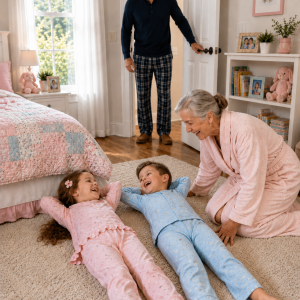
Bear immediately stopped.
Lucy touched his neck.
“Sit.”
The animal sat.
Molly sat beside him.
Robert came down the path behind them carrying a cardboard box.
“Sarah, I can explain.”
“Start with those animals.”
He set down the box.
“They’re wolf-dog mixes. Rescues.”
He took me inside and opened a drawer.
Veterinary records.
Vaccination records.
County paperwork.
Everything.
I looked through every page.
Then I put the papers down.
“Now tell me about Mary.”
Robert went completely still.
Lucy looked between us.
Finally, he said:
“All right.”
The Woman Who Had “Disappeared”
His living room was full of photographs.
Mary in a red sweater.
Mary beside a lake.
Mary laughing at a kitchen table.
Then the photographs changed.
Mary wearing a scarf over her head.
Mary in a hospital chair.
Mary thinner.
Robert pulled out a folder.
“Cancer.”
I looked at him.
“She was sick?”
“Almost two years.”
He showed me the records.
Treatment appointments.
Hospice paperwork.
A death certificate.
Mary Harris had died at home.
“She didn’t disappear?”
Robert looked tired.
“No.”
“Why wasn’t there a funeral?”
“There was. Just not here.”
Mary had grown up in eastern Tennessee. Her parents were buried there, and she had asked for her ashes to be placed beside them.
Robert had taken her home.
The service had been small.
Family only.
When he returned, he didn’t explain himself to anyone.
“People started talking,” I said.
“I know.”
“Why didn’t you stop them?”
He looked toward one of Mary’s photographs.
“At first I thought it was too ridiculous to answer.”
He rubbed his thumb along the edge of the folder.
“Then I didn’t care enough to answer.”
I looked toward the back window.
The shed was visible through the trees.
“What’s in there?”
Robert almost smiled.
“Come see.”
Inside were books.
Hundreds of them.
There were desks with loose legs, boxes of crayons, wooden puzzles, old lamps, shelves and children’s chairs.
Robert had taught elementary school for thirty-seven years.
Since retiring, he had collected discarded school supplies and repaired them for rural schools and community programs that couldn’t afford replacements.
The brass globe Lucy carried had been sitting on his workbench for three months.
Then he opened a metal cabinet.
Inside was an envelope.
On the front, in Mary’s handwriting, were the words:
For whoever someday needs to know what kind of man my husband really was.
“She wrote that?”
Robert nodded.
“A few weeks before she died.”
He handed it to me.
Mary wrote that Robert had cared for her through every stage of her illness.
For the last six months, she wrote, he slept in a chair beside her bed because she was afraid she would die while he was asleep somewhere else.
Near the end was one sentence I read twice.
Mary worried that after she was gone, Robert would withdraw from people.
And she worried that people would mistake that loneliness for something darker.
I folded the letter carefully.
Then we heard voices outside.
Not one voice.
Many.
Twenty People at the Gate
There were almost twenty people near Robert’s driveway.
Linda was among them.
Someone had apparently seen me run toward the property and assumed something had happened to Lucy.
One man called out:
“Where’s the little girl?”
Lucy stepped onto the porch.
“I’m right here.”
The crowd quieted.
Another man pointed toward Bear and Molly.
“Those animals need to be removed.”
Robert started toward the steps.
I stopped him.
“Wait.”
Then I walked down instead.
Linda came closer.
“Sarah, are you okay?”
“I’m fine.”
“What happened?”
I held up Robert’s folder.
“I finally asked him.”
Nobody spoke.
“Mary Harris died of cancer.”
Someone shook his head.
“That’s what he says.”
“No. That’s what her medical records say.”
I pulled out the death certificate.
“And this.”
Then the cremation paperwork.
“And this.”