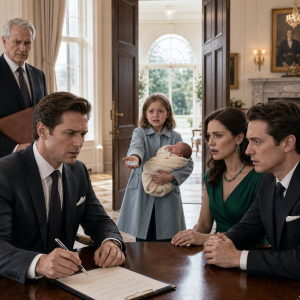
The morning it happened, the city looked almost unreal. Sunlight spilled through the glass walls of the top-floor boardroom at Hargrove Industries, tinting everything gold and sharp. Below us, Chicago glimmered with movement, but inside that room, the air was so heavy that even breathing felt like rebellion.
At the head of the table sat Leonard Hargrove, my father-in-law, founder of a multibillion-dollar empire and a man who believed control was the only form of respect. He stared at me with the steady calm of someone who had already decided how the story would end.
“Caleb,” he said, his tone steady but cold, “your position as Chief Operations Officer is terminated effective immediately.”
The words floated through the air like shards of glass. Around me, a dozen executives stared at the polished table, unwilling to meet my eyes. I had known for weeks that Leonard disliked my proposal to launch an employee profit-sharing system. He thought it was sentimental. I thought it was survival. To me, loyalty could not be bought through fear. It had to be earned through fairness.
I stood slowly, the leather chair groaning beneath me. “If believing people deserve to share in what they build makes me unfit for this company,” I said quietly, “then maybe this company no longer knows what it stands for.”
No one spoke. The city lights below seemed to flicker in rhythm with my heartbeat.
Then, from across the table, Maria Delgado, our finance director, rose from her seat. Her voice was steady. “If he goes, I go.”
It was as if her courage cracked the glass of silence. Tom, our head of engineering, stood next. Then Leila from HR. Then two more. Within moments, nearly two dozen people were on their feet, gathering their laptops, their notebooks, their dignity. The sound of chairs scraping the marble floor echoed like thunder.
Leonard’s jaw tightened, but he said nothing. I looked at him one last time. “You cannot buy loyalty,” I told him. “You can only earn it.”
The elevator doors closed behind us, and in that moment, the fear that had clung to me for months was replaced by something fierce and alive. Maria turned to me and said softly, “You built trust he will never understand.”
I did not yet realize that being fired would be the best thing that ever happened to me.

The next few weeks were chaos. Headlines called it a corporate exodus. Investors panicked. My wife, Amelia, Leonard’s daughter, could barely look at me. She loved me but had grown up in her father’s shadow, and standing against him meant betraying the world she knew.
I rented a small workspace in a converted factory on the south side. The floors were cracked concrete, the walls smelled of dust and old paint, and the only furniture was a collection of mismatched chairs we found on Craigslist. But by the end of the first week, the people who had walked out with me began to arrive one by one.
We decided to build something new and called it Bridgepoint Collective. No private offices, no executive titles that separated worth, no decisions made behind closed doors. We would invest in companies that treated employees as partners, not as property.
The beginning was brutal. We worked sixteen-hour days surrounded by takeout boxes and the hum of old computers. Some nights I fell asleep on the floor, half dreaming, half planning. There were days we doubted ourselves completely. But there was also a strange joy in the struggle, a sense of purpose I had never felt in the polished halls of Hargrove Industries.