I’m not giving it to you. You already have a say. I forgot that, and so did you.
He left without asking what the papers meant for our marriage. That mattered more than any speech could have. For years, I had arranged my days around what Andrew wanted; now he was giving me room to find out what I wanted for myself.
A few months later, the foundation’s board elected me chair. I restored neighborhood advisory groups, visited local programs, and worked with Emily and Marcus to make grant decisions more transparent. Andrew stayed off the board.
When I was strong enough for longer walks, he called and asked if I would have coffee with him. He promised not to bring up lawyers, the foundation, or the penthouse.
One coffee, I said.
One coffee, he agreed.
Before that Saturday arrived, a certified envelope from the company’s legal office reached my desk. Inside was an old property agreement from before our wedding, along with a note from Marcus saying Andrew did not know he had sent it.
The document concerned a four-story building in Boston’s South End. Years earlier, I had dreamed of turning it into a community arts and education center, but I believed another buyer had purchased it before we could make an offer. The papers showed that Andrew had bought it through a trust in my name.
A Place of My Own

Andrew was waiting at the café on Saturday morning, early enough that I suspected he had walked around the block to keep from arriving too soon. We talked about the foundation, Emily’s plans with Mateo, and the kind of bagels New York had made us both unnecessarily opinionated about.
Then I placed the agreement on the table.
He looked down at it.
Why did you buy the building?
He said he had planned to give it to me as a wedding present. A few weeks after the purchase, I had told him I was relieved the project had fallen through, because I worried that running a community center would make it harder for us to build a life together. He decided that giving me the building would feel like asking me to choose between the life I had imagined and the one we were beginning.
So he kept it, and said nothing for eight years.
Why is the trust in my name?
Because it was always yours.
His answer stirred old tenderness, but I reminded him that the building could not undo the affair, or turn his choices into a misunderstanding.
I know, he said.
Then why do you sound relieved?
Because you’re asking me questions.
We began with coffee, then lunch, then walks. I refused to call it reconciliation, and Andrew did not ask me to. We started couples counseling with a clear understanding that we were there to find out whether our marriage was worth rebuilding, not to pretend it had never been damaged.
There were painful sessions and ordinary ones, and no grand apology that made everything right. Instead, trust began to return through small choices: Andrew stepping outside a meeting to answer when he had promised he would be available, telling me when he was upset instead of hiding behind work, and accepting that sometimes I wanted time alone.
The South End building became my project. We called it Harbor House. The ground floor remained a bookstore, while the upper floors became classrooms, nonprofit offices, and a bright studio for art and writing programs. Andrew learned to ask before offering advice.
Do you want my opinion? he would say.
Sometimes I did. Sometimes I didn’t.
He learned that either answer was survivable.
Eighteen months after my hospitalization, we opened Harbor House. Emily, Mateo, Lucy, Marcus, Andrew’s mother, and neighbors filled the sidewalk. Lucy, now nearly ten, cut the ribbon after worrying she might do it crooked.
Then it’ll still be cut, I told her.
She considered that and nodded as if I had given her something worth keeping.
That evening, after everyone had gone, Andrew found me on the rooftop terrace. He had brought my wedding ring, which I had removed after leaving the hospital and later given to him because I no longer wanted it sitting in a drawer.
He did not kneel. He asked whether I wanted it back.
I held out my hand, though I told him I was not completely sure.
I think being completely sure about another person was one of our problems, I said.
He set the ring in my palm, and I slid it onto my finger myself. We did not renew our vows or pretend that love alone had repaired us. We simply kept choosing honesty, patience, and room for one another to become more than the roles we had fallen into.
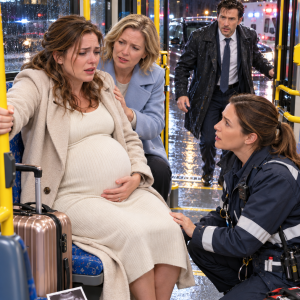
Two years after the night I collapsed, Dr. Morgan told me my heart was doing well. Andrew had come with me because I had asked him to. As we walked through the hospital lobby afterward, I stopped near the emergency entrance, remembering the woman I had been when I woke there, certain that the life I knew was gone.
Maybe the marriage we had before that night had ended. What we built afterward was different, and it required more than forgiveness; it required change that could be seen on an ordinary Tuesday, when no one was watching and no alarm was sounding.
We eventually sold the penthouse and moved into a smaller apartment overlooking Riverside Park. Our evenings were not always spent together, and neither of us treated constant closeness as proof of love. Some nights Andrew traveled; some nights I stayed late at Harbor House; when we were together, we tried to give each other our attention instead of merely sharing the same room.
One rainy evening, Andrew made pasta and his phone rang while we were setting the table. He glanced at the screen, then at me.
You can answer it, I said. Healthy marriages don’t require ignoring every call to prove devotion.
He picked up, listened to Marcus for a moment, and told him the problem could wait until morning. Then he put the phone down and sat beside me.
I used to think being alone in a room meant I had been forgotten. Now it simply meant the person I loved was nearby, living his own life, and would come back when he said he would.
Andrew reached for my hand.
I wish I could change that night, he said.
I told him I wished he had made different choices before it, but I did not want to erase the woman I had become after I finally chose myself. He kissed my palm, and I smiled at him across the table.
We ate before the food had time to grow cold, and when I spoke, Andrew listened—not because he feared another emergency, and not because guilt demanded it, but because he had finally learned that loving someone meant being present while there was still time to hear them.