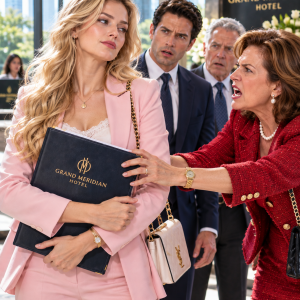
Camille slowly slipped the engagement ring from her finger and placed it on the table among the documents.
Conrad turned toward her.
“Camille, please. This happened years before we met.”
“What happened before we met is showing me who you are now.”
“I made a mistake.”
“A mistake happens once. You repeated this choice for eight years.” Her voice trembled, but she did not look away. “I’m not troubled because you have children. I’m troubled because you could see them, walk away, and then tell people their mother had invented them.”
Conrad reached for her hand, but she stepped back.
“You wanted Lydia here so everyone could admire your kindness. Instead, you brought her into the one room where your story could finally be questioned.”
Camille left the ring on the table and walked out.
Evelyn approached Lydia with tears moving freely down her face.
“I failed you, even if I didn’t know the whole truth. I should have searched for you. I should have questioned why you disappeared so completely. I accepted the explanation that required the least courage from me.”
Lydia shook her head gently.
“You were deceived too, but the boys cannot become trophies used to repair anyone’s guilt. If you know them, it must happen at their pace.”
“I understand.”
“They may not want a relationship.”
“Then I will respect that.” Evelyn looked toward the four children. “I won’t demand a place in your lives. I would only like permission to earn one.”
Before anyone could answer, Henry lifted his head as the scent of cinnamon drifted from the kitchen.
“Can she try while we eat?”
Evelyn released a tearful laugh.
“There are cinnamon rolls, turkey, cookies, roasted potatoes, and hot chocolate.”
Henry considered the offer.
“We can listen while we eat. Listening isn’t the same as forgiving.”
“That seems completely fair.”
A Dinner Without Performances
The elegant Christmas dinner Conrad had planned never took place.
Most of the guests gradually departed, carrying with them a story very different from the one they had expected to hear. The musicians packed away their instruments, the formal announcement was canceled, and trays of carefully arranged appetizers remained untouched in the great room.
The immediate family moved into the kitchen, where the light was warmer and no Ashby portraits watched from the walls.
Evelyn sat across from the boys and listened as they described their lives.
Owen loved astronomy, read books several years above his grade level, and became quietly irritated whenever someone confused a planet with a star. Caleb played soccer with an intensity that seemed to gather every injustice he could not yet name. Miles drew maps, collected tickets from places he considered important, and wanted to visit every state in the country. Henry planned to become a chef, an astronaut, or the owner of a bakery where customers could bring their dogs.
“Can you do all three?” Evelyn asked.
“Probably,” Henry replied. “I have time to organize it.”
Evelyn listened like a woman receiving eight years of family history in a single evening and knowing she could never ask anyone to repeat what she had missed.
Conrad remained in the doorway, uncertain whether he was permitted to enter.
Finally, Owen looked toward him.
“You can come in, but don’t sit beside our mother.”
Conrad obeyed, choosing a chair at the far end of the table.
There were no embraces, no sudden declarations of love, and no miraculous holiday reconciliation. There were only four boys examining a man whose face appeared faintly in their own but whose presence had to be treated as that of a stranger.
Conrad folded his hands.
“I want to tell you something without making excuses.”
Caleb crossed his arms.
“Don’t say you didn’t know.”
“I won’t. I knew enough. I saw you. I received information. I chose to believe what protected my comfort and my career.”
Lydia felt something loosen inside her. It was not forgiveness, but the simple relief of hearing the truth spoken without her having to prove it again.
Conrad looked at each child.
“I was selfish and afraid. I thought about my father, the company, and what people would say. I did not think about what my choice would do to you. I have no right to ask you to call me Dad.”
Miles answered first.
“Then don’t ask.”
“I won’t.”
Owen held the hospital photograph between his hands.
“If Mom hadn’t brought us here tonight, would you ever have looked for us?”
Conrad closed his eyes.
His answer took too long, but when it came, it was finally honest.
“I don’t know.”
Owen nodded with a maturity no child should have needed.
“Then we don’t trust you.”
“I understand.”
“No,” Owen replied. “You’re only beginning to understand.”
Conrad lowered his head, and no one tried to rescue him from the truth.
The Right to Choose

The following morning, Lydia prepared the boys for the return journey to Boston.
Evelyn filled several bags with food, books, scarves, and a box of photographs showing Conrad as a child. Before placing the box in the car, Lydia stopped her.
“Only if the boys want to see them.”
Evelyn nodded.
“Only if they want to.”
In the courtyard, she knelt before the four children.
“I won’t ask you to care about me quickly. I won’t ask you to forget what happened. I’m only asking for a chance to show up properly from now on.”
Henry hugged her first, partly because he liked her and partly because she had given him a container of cinnamon rolls.
Miles allowed her to touch his shoulder. Caleb accepted a bag of food with the solemn expression of someone signing a cautious peace agreement.
Owen studied her longest.
“You can come to my science fair in February. But if you promise and don’t come, there won’t be another invitation.”
Evelyn smiled through her tears.
“I’ll be there.”
Conrad appeared in the courtyard without his tailored suit. In plain trousers and a dark sweater, he looked smaller than he had the night before.
“Lydia, I’m going to acknowledge the boys legally. I’ll establish education funds with no conditions, and I’ll fulfill every financial responsibility I avoided.”
“That will not purchase forgiveness.”
“I know.”
“It will not allow you to enter their lives whenever it suits you.”
“I know that too.”
Lydia looked at him with the clear sadness of someone who had finally stopped waiting.
“For years, I believed I needed you to admit the truth before I could rest. I thought your acknowledgment would prove that I had not imagined everything I survived. But my peace never belonged to you. What matters is that our sons will never again wonder whether they were something I invented.”
She joined the boys in the waiting vehicle without asking Conrad for another response.
The evening before, she had arrived as the woman everyone expected to pity—the lonely former wife invited out of charity, the uncomfortable chapter Conrad intended to display beside his successful new life.
She left as the mother of four boys who had entered a house where they had been denied and made an entire family confront the cost of its silence.
The Christmas That Came After
The months that followed were neither easy nor perfectly arranged.
Evelyn kept her promise and attended Owen’s science fair, arriving forty minutes early because she was afraid snow might delay her. She stood beside his model of a lunar research station and listened as he explained every section twice.
She returned for Caleb’s soccer matches, Miles’s school exhibition, Henry’s birthday baking project, and dozens of ordinary afternoons that would never appear in a family photograph.
She did not arrive with demands or insist that the boys call her Grandmother. She brought consistency instead. Over time, they began calling her Grandma Evelyn without anyone asking them to.
Conrad also completed the legal process, established the funds, and began counseling. He wrote each boy a separate letter without requesting an answer. When Lydia permitted visits, they met in public places where the boys could leave whenever they wished.
Some weeks, they agreed to see him. Other weeks, they refused.
Lydia never pressured them in either direction.
Conrad learned that responsibility was not one dramatic apology but a series of unremarkable choices made when no audience was present. It meant arriving on time, listening without defending himself, and accepting that progress could not be measured according to his wishes.
Nearly a year later, the boys returned to Wintermere for another Christmas, this time because they had chosen to go.
The large portrait of Harrison Ashby no longer hung above the fireplace. Evelyn had moved it to a private hallway and replaced it with a photograph taken in her garden. In the new picture, she was laughing while Owen, Caleb, Miles, and Henry tossed autumn leaves around her.
Conrad stood before the photograph for a long time.
He had finally begun to understand that a family name could not be protected by hiding the truth. It could only be made worthy through honesty, responsibility, and the courage to repair what could still be repaired.
Lydia no longer searched for justice in Conrad’s expression. She had built a life in which her sons did not have to beg for a place at anyone’s table—a life filled with homework, mismatched shoes, Sunday hot chocolate, crowded grocery trips, science projects, arguments about planets, and difficult questions answered without fear.
In the end, that first Christmas at Wintermere had never truly been about the helicopter, the estate, or the public collapse of a powerful man’s carefully maintained story.
It was about four children entering a house where their existence had been denied and leaving with something no document, fortune, or family name could ever grant or take away.
They were real.
They mattered.
And they did not need the approval of an absent father to understand their worth.