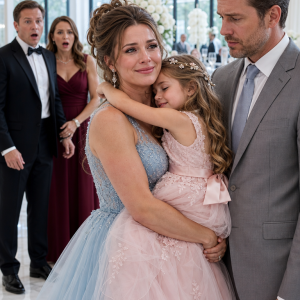
Marlene entered behind her.
“Where is everyone?” she demanded. “Where are the guests? Where is the wedding party?”
No one answered.
Then a large screen lowered behind the altar.
The first image showed Margaret entering the boutique with her cane.
The next showed her approaching the fitting area.
Then came the moment she was knocked off balance.
Finally, Kinsley’s voice filled the empty church.
“Get up and hold my dress. You came here to help, not to create problems.”
Taryn covered her mouth.
Marlene rushed toward the controls, but Clark stepped between her and the equipment.
He did not touch her.
He simply said, “Please remain where you are.”
The screen changed.
Emails appeared.
The altered prenuptial attachment.
The proposed trust.
Messages about separating Reid from his mother.
Plans to transfer ownership interests after the wedding.
Dana Mercer entered from a side room carrying a sealed folder.
“Every recording shown here was obtained through systems that clearly disclosed their recording policies,” she explained. “Every document displayed was submitted through the company portal by authorized user accounts. Copies have been provided to the appropriate legal representatives.”
Grant Weller appeared near the back entrance.
Two investigators from his employer’s legal compliance team were waiting for him.
He stopped walking.
At that moment, Reid entered the church.
He wore a dark suit without a wedding flower pinned to his jacket.
His hands were steady.
Kinsley stared at him as though one command could still restore everything.
“You planned this to embarrass me.”
Reid’s voice remained calm.
“I did not create what happened. I only stopped covering it.”
She took a step toward him.
Clark moved between them before the argument could become more intense.
Kinsley pointed toward the empty pews.
“Three hundred people are waiting for me at the estate.”
Reid shook his head.
“They are not waiting for you.”
A Different Celebration
Earlier that morning, every invited guest had received a formal notice.
The wedding had been canceled because of documented misconduct and serious concerns regarding altered legal documents.
The reception, however, had not been wasted.
At the Savannah estate, the tables remained decorated. The food was served. Musicians performed beneath the oak trees.
But the event had been transformed into a private fundraising luncheon for older adults who had been mistreated, abandoned, or financially exploited by people they trusted.
Margaret arrived in a simple blue dress with a small support wrap around her wrist.
When she entered the garden, the guests stood.
Most of them had never heard her full story.
They did not need every detail to understand the meaning of that moment.
For most of her life, Margaret had stepped aside so others could move forward.
That afternoon, the room made space for her.
The deposits were not returned to Marlene because they had never belonged to her.
The civil case began that same day.
Grant was placed on leave. A deeper audit later connected him to altered documents involving other elderly clients at the legal office. His professional future ended, and the matter was turned over for formal legal review.
Marlene eventually agreed to cooperate, provide messages, and help restore part of the financial damage connected to the attempted transfer.
Kinsley filed a claim accusing Reid of damaging her reputation.
By doing so, she introduced the boutique recording and digital documents into the official court record.
Her case was dismissed, and she was required to cover a portion of the legal expenses.
The brands that had offered her free clothing withdrew their support.
The borrowed wedding jewelry was returned.
The photographs she had expected to appear in society magazines became evidence of a day that never became a wedding.
The Center Named After Margaret
One year later, Margaret walked without her cane at the opening of the Margaret Ellison Support Center.
The building was bright and welcoming, with wide windows, quiet bedrooms, flower-filled courtyards, and offices where older adults could receive legal and financial guidance.
Reid stood beside his mother as she prepared to cut the ribbon.
Margaret touched his cheek.
“Did losing Kinsley break your heart?”
Reid looked toward the residents drinking coffee beneath the afternoon sun.
“For a while, yes.”
Then he smiled gently.
“But closing the door on cruelty was not revenge. Staying silent would have been the greater loss.”
Margaret nodded.
Together, they cut the ribbon.
Reid finally understood that peace did not come from watching another person’s life collapse.
Peace came from building something better in the space left behind.
Sometimes the most painful truth arrives through the way someone treats a person who has no power to benefit them, because kindness shown only to the wealthy, attractive, or influential is not kindness at all.
A loving parent may remain silent during humiliation to protect a child’s happiness, but true love asks us to notice that silence before it becomes a wound they are forced to carry alone.
Walking away from a relationship does not mean every shared memory was false; it means the future can no longer be built safely on what the present has revealed.
Revenge focuses on making another person suffer, while justice focuses on protecting people, restoring what was harmed, and preventing the same behavior from hurting someone else.
Money can hide a person’s intentions for a while, but the way they speak to employees, older relatives, and vulnerable strangers often reveals what expensive clothes and charming smiles cannot conceal.
A calm response should never be mistaken for weakness, because some people become quiet not because they are afraid, but because they are collecting the courage and clarity needed to make the right decision.
Family loyalty should never require a person to accept disrespect, manipulation, or cruelty, because protecting someone you love sometimes means refusing to normalize the behavior that is slowly harming them.
The end of an engagement, friendship, or dream can feel like failure, yet it may actually be the moment a person finally chooses dignity over appearances and truth over temporary comfort.
The strongest answer to humiliation is not always a public argument; sometimes it is the patient decision to preserve the truth, protect the innocent, and build something meaningful from the pain.
A closed door can feel devastating when we are still looking backward, but once we begin creating a safer and more compassionate life, we may realize that the door was not blocking our future—it was protecting it.