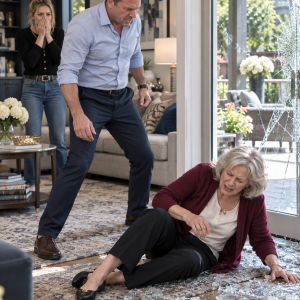
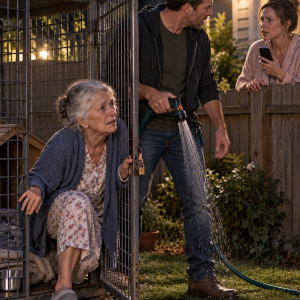
“You never asked him anything because you wanted to know him. You asked questions so you could decide whether you were above him.”
Evan learned the truth that evening.
He called me repeatedly.
I watched his name appear on my phone and disappear again.
I did not answer.
Instead, I was sitting beside my mother at a nonprofit called Second Light, a community center in Cambridge that taught assistive technology, mobility skills, career preparation, and music to people with limited or no vision.
My parents had quietly supported the organization for years.
That afternoon a seventeen-year-old named Hannah Pierce sat at a piano in one of the practice rooms, reading raised musical notation with her fingertips before playing a piece from memory.
My mother stood motionless outside the door.
Before she lost her sight, Grace had taught piano lessons from our home.
She had not touched her own piano in almost four years.
I heard her inhale when Hannah began playing.
And suddenly the restaurant felt very far away.
“Mom,” I whispered, “I think I want to work here.”
Grace turned toward me.
“Don’t redesign your life because you’re angry.”
“I’m not.”
I looked through the glass at Hannah’s moving hands.
“I think last night made me understand how often people like you must be judged before you’ve even said a word.”
My mother reached for my hand.
“Then don’t do it because you want to fight Vivian.”
“Why should I do it?”
“Because you want to stand beside people.”
That distinction changed everything.
What Silence Costs

Three weeks later, Robert Carlisle’s accountant placed a folder on his desk and told him that without new capital, the company would have to sell equipment, reduce operations, and renegotiate several obligations.
Vivian cried for nearly an hour.
Then she said the only thing she could think of.
“We need to see Daniel.”
Robert looked at her.
“Would you be asking to see him if you had known who he was before dinner?”
She wiped her face.
“What is that supposed to mean?”
“You know exactly what it means.”
Eventually, through one of Alder Ridge’s attorneys, they received a ten-minute appointment.
Robert, Vivian, and Evan arrived together.
When they entered my father’s office, he was standing near the window with Boston Harbor spread behind him.
Vivian stopped.
For once, she had nothing ready to say.
My father turned.
“Robert. Vivian. Evan.”
Vivian stepped forward.
“Mr. Whitmore, I owe you an apology.”
“I’m not the person you humiliated.”
“I want to apologize to Grace too.”
My father studied her.
“Would you?”
She nodded eagerly.
“Of course.”
“If you had known who I was that evening, would you have treated my wife differently?”
Vivian’s mouth opened.
Nothing came out.
“You would have retrieved her cane,” he continued. “You would have complimented her dress. You probably would have spent dinner telling us how delighted you were that our families were joining.”
Vivian began to cry again.
“I behaved terribly.”
“Yes. But the money isn’t the point. The point is that you believed we had less influence than you, and that made you feel free to treat my wife as though her dignity mattered less.”
Robert stepped forward.
“Daniel, I won’t defend what happened. But hundreds of people depend on our company. Please don’t let one evening cost them their livelihoods.”
My father nodded.
“It won’t.”
Robert looked confused.
Daniel opened the contract review.
“Your company isn’t losing business because your wife threw wine. You’re losing preferred treatment because several agreements no longer meet our ordinary standards.”
He slid the report across the desk.
Missed service benchmarks.
Insufficient reserves.
Delayed vendor payments.
Contracts renewed without competitive review.
A debt structure that depended heavily on future Alder Ridge work.
“For nearly two years, we made exceptions because our children were planning a life together,” my father said. “When that relationship ended, the exceptions ended too.”
Robert looked through the pages.
There was nothing fabricated.
Nothing exaggerated.
The company he had presented to the world as powerful had quietly become dependent on another man’s willingness to make things easier.
Vivian clasped her hands.
“Let me speak to Grace. I’ll get on my knees if I have to.”
My father shook his head.
“My wife doesn’t need you on your knees.”
Vivian looked up.
“She needed you to respect her when you thought she had nothing to offer you.”
Evan stepped forward then.
“Mr. Whitmore, I love Claire.”
My father looked at him for a long moment.
“When your mother pushed Grace’s cane under the cabinet, what did you do?”
Evan’s eyes lowered.
“I told her to stop.”
“Quietly.”
Evan said nothing.
“When your mother suggested Grace was a burden, what did you do?”
Silence.
“And when the wine hit her face?”
Evan swallowed.
“I told Claire not to make things worse.”
My father nodded.
“That’s why Claire walked away.”
“I was trying to keep everyone calm.”
“No. You were trying to keep yourself comfortable.”
Evan’s eyes filled.
“I know that now.”
My father’s expression softened slightly.
“Good. I hope you remember it.”
“Just let me talk to her once.”
“That’s Claire’s decision.”
“I can change.”
“I hope you do.”
Daniel closed the folder.
“But becoming a better man does not create an obligation for my daughter to wait while you learn how.”
There was no satisfaction in his voice.
That mattered.
He was not enjoying their fear. He did not want revenge.
He simply refused to protect them from realities they had previously been spared.
On the elevator down, nobody spoke until Vivian whispered:
“We’re going to lose the house.”
Robert kept his eyes on the changing floor numbers.
“We didn’t start losing things this week.”
She turned toward him.
“What does that mean?”
“We started losing something years ago, when we decided having more money meant we were worth more than other people.”
For the first time in their marriage, Vivian had no answer.
Learning the Ground
The Carlisles did not become destitute.
Life was not that theatrical.
But life did become smaller.
Robert sold several vehicles and two vacation properties. Carlisle Facilities gave up expensive office space and moved into a modest building outside Worcester. Equipment was sold. Some contracts went to competitors. Robert and Vivian eventually sold their large house and moved into a two-bedroom condominium.
The dinner invitations slowed.
The acquaintances who used to answer within minutes became harder to reach.
Vivian discovered how many friendships had actually been arrangements between people who enjoyed standing close to influence.
Evan took a job managing inventory and purchasing for a regional home-supply warehouse.
He hated the first month.
The work began early. Nobody cared where he had attended college. Nobody knew his parents’ former address. His coworkers judged him mostly by whether he showed up on time, helped when shipments were late, and treated people fairly when something went wrong.
One afternoon, while they were unloading a delayed truck, a coworker named Matt laughed and said:
“Come on, college boy. Boxes don’t care what your business card used to say.”
Evan laughed despite himself.
It was the first time he had done so in weeks.
Several months later, a new employee entered the wrong code into a large order. Evan felt irritation rise immediately.
He opened his mouth.
Then he remembered his mother snapping her fingers at a restaurant server.
He closed it.
“Come here,” he said instead. “I’ll show you how we fix it.”
The change was small.
But real change usually was.
He continued thinking about me, although he stopped calling.
Eventually he understood something I wish he had understood at that dinner: an apology is not a transaction. You cannot insert regret on one side and expect a relationship to come back out the other.
Sometimes apologizing means accepting that the person you hurt has every right to continue without you.
Vivian’s education took longer.
A family friend helped her find administrative work at a neighborhood bakery and café.
For the first time in decades, she had a manager.
She wore practical shoes.
She sold nearly all her designer handbags.
Customers sometimes spoke impatiently to her, and each time she felt offended, she remembered how easily she had once spoken that way to others.
One rainy morning, an older woman entered wearing dark glasses and using a white cane.
Vivian froze.
The woman stopped near the entrance.
“Excuse me. Could you tell me where the counter is?”
Vivian walked around from behind the register.
“About ten feet ahead and slightly to your right. I can walk with you if you’d like.”
“That would be kind. Thank you.”
Vivian guided her forward.
Later she went into the employee restroom, locked the door, and cried.
Not because the woman reminded her of Grace.
Because the woman was not Grace.
She was a complete stranger, someone with no connection to money, business, marriage, or influence.
And Vivian finally understood that this was exactly why kindness mattered.
Respect that depends on knowing someone’s bank account is not respect.
The Piano