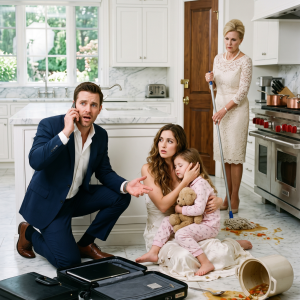
“Then why are you still in this house? Elsie arrived eleven days ago.”
“The transfer became final four days ago. Dad told me only yesterday that she’d come early and needed special care. He wouldn’t say which hospital. I was preparing to search every facility in the region.”
The claim was possible, but it could not erase the simplest truth. “You had my phone number.”
“I should have called.”
“You had my email.”
“I know.”
“You knew where I lived.”
His voice dropped. “I know.”
That repeated answer finally revealed the deepest injury. The money was not the heart of it, nor was Conrad’s manipulation. “You decided for me,” I said. “You decided I would rather be abandoned for months than included in a difficult choice.”
Adrian said nothing.
I thought of my mother, Grandpa, Adrian, and Conrad—four people acting from very different mixtures of affection, fear, pride, and control, yet all reaching for the same power.
“Your father decided what my mother was allowed to refuse and punished her when she chose for herself. Grandpa decided which parts of my childhood I was strong enough to know. And you decided when I deserved the truth about my own relationship.”
Conrad looked away. Adrian’s shoulders folded inward.
“You called it protection,” I continued, “but protection without honesty becomes control. You cannot take away another person’s choices and then expect gratitude for your plan.”
Elsie stirred against me and opened her eyes. Adrian saw them fully for the first time, and his breath caught.
“She has my eyes,” he whispered.
“Yes. She also has a mother who will not allow her life to be arranged through secrets.”
He stepped closer but stopped well beyond arm’s reach. “May I be part of her life?”
It was the question I had wanted him to ask for months, yet the answer no longer belonged solely to the woman who loved him. It belonged to Elsie’s mother.
“You may have the chance to become a dependable father,” I said. “But you and I are not resuming our relationship.”
Pain crossed his face. “Lydia, please—”
“I understand why you were afraid. I even understand why the trust looked like freedom. But I cannot build a partnership with someone who disappears whenever he believes his private plan is wiser than our shared decision.”
“I will never leave like that again.”
I shook my head. “Do not offer me another promise. Offer Elsie proof.”
What Staying Looked Like

Proof arrived slowly, without dramatic speeches or easy forgiveness. Three months later, I watched from Grandpa’s porch while Adrian wrestled with Elsie’s car-seat straps, corrected a twisted buckle, and discovered the diaper bag was still inside.
“You can ask for help,” I called.
He looked over his shoulder with a sheepish smile. “Give me thirty seconds before I surrender.”
He retrieved the bag, secured the seat, and stood beside his car waiting for my instructions rather than assuming them.
“You’ll have her back at six?” I asked.
“At six.”
“If traffic is bad?”
“I call.”
“If she seems unwell?”
“I call, and we decide together.”
That final phrase mattered more to me than any apology.
Adrian rented an apartment near the museum, left his father’s company, and took an engineering position with the county. He reserved much of the trust for Elsie’s future, but never presented those decisions as reasons I should welcome him back.
Instead, he learned to care for our daughter, attending appointments, memorizing feeding schedules, and learning what each cry meant. When uncertain, he asked. When plans changed, he called. When I said no, he listened without turning my boundary into a debate.
Grandpa also had work to do. One rainy evening, I carried my mother’s letters to his kitchen and spread them between our cups of tea. We read Adrian’s childhood words together, and when Grandpa reached the note my mother had written on the final page, he removed his glasses and pressed his fingers to his eyes.
“I truly thought I was protecting you,” he said.
“I know you did.”
“After we lost June, I couldn’t bear the thought of that family bringing more pain into your life. I suppose I began believing that loving you gave me the right to choose which truth you could handle.”
I reached across the table. “You were afraid.”
“So was Adrian.”
“Yes. Fear explains both of you. It doesn’t make the choices right.”
He nodded and held my hand. “I’m sorry, Lydia. You deserved the whole story long ago.”
His apology did not return the missing years or restore the memories I might have understood differently, but it opened space between us where honesty could live. Sometimes healing begins not with erasing what happened, but with finally naming it without excuses.
One Sunday, Adrian returned Elsie at precisely six. I watched through the window as he lifted her carrier with one hand and balanced the diaper bag against his shoulder. When I opened the door, he gave me a careful report.
“She ate at five-fifteen. The clean bottle is in the side pocket. She has one spare outfit left because the other one lost a disagreement with mashed sweet potato.”
I raised an eyebrow. “The outfit started it?”
“I wasn’t there at the beginning, so I can’t assign blame.”
I laughed, and the sound surprised us both. Adrian smiled, but he did not treat my laughter as an invitation to ask for more.
“Good night, Lydia.”
“Good night, Adrian.”
Upstairs, I rocked Elsie beside the nursery window while rain tapped softly against the glass. She opened her eyes—one blue-gray, one brown—and for months those colors had seemed to contain every question I could not answer: why Adrian had gone, why Grandpa had kept silent, why my mother had packed us out of a beautiful house, and why a little boy had remembered a green wagon for almost three decades.
Now they were simply my daughter’s eyes.
Her inheritance did not have to become her destiny, and neither did mine. My mother had lived among decisions made around her. Grandpa had confused silence with safety. Adrian had sacrificed trust because he believed a favorable ending would justify secrecy. Conrad had spent much of his life assuming that money and influence entitled him to arrange everyone else’s choices.
That pattern ended with me.
Adrian would be allowed to earn a place in Elsie’s life through patience and consistency, but affection would never exempt him from accountability. Grandpa would remain the man who had raised me with devotion, but devotion would no longer give him ownership of truths that belonged to me. Conrad would have no voice in my home or authority over my future. As for Elsie, she would grow up understanding that real love does not hide necessary truths behind noble intentions. It speaks honestly, listens humbly, and remains present when the conversation becomes uncomfortable.
I brushed a curl from her forehead and felt, for the first time since the morning Adrian vanished, that I was no longer waiting for someone else to reveal the next chapter of my life. I knew the history now—not Conrad’s edited version, not Grandpa’s protective silence, and not Adrian’s delayed explanation, but the whole complicated story.
And for the first time across three generations, the woman standing at its center was the one who would decide what came next—and who had truly learned how to stay.