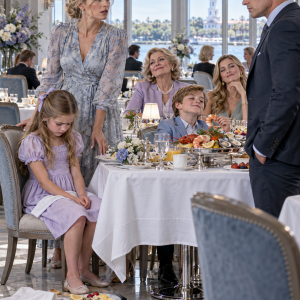
Diane began crying.
“You can’t throw away a family over this.”
I turned toward her.
“I’m not ending a healthy family tonight. I’m simply refusing to keep pretending it’s healthy.”
The First Place That Still Felt Like Home
That night, I stayed at a small hotel.
Reid called repeatedly.
Diane sent messages telling me to think carefully before I “destroyed” three years of marriage.
That word stayed with me.
Destroyed.
As though the person finally responding to the secret was somehow responsible for creating it.
The next morning, I drove to my parents’ house.
My mother opened the door.
One look at my face was enough.
“Can I stay here for a few days?”
She didn’t demand an explanation.
She simply stepped aside and hugged me.
“Your room is still yours.”
That was when I finally cried.
Not because I wanted Reid back.
I cried because I had spent years trying so hard to earn my place in his family that I had forgotten what it felt like to be loved somewhere I didn’t have to earn it.
He Finally Understood Too Late
The separation moved forward.
Eventually, Reid agreed that the shared money he had used without discussing it with me had to be addressed as part of our financial settlement.
A few weeks later, Owen called.
He told me Brooke insisted there had never been a physical relationship between her and Reid.
Whether that was true or not, Owen said he had discovered hidden conversations, visits, gifts, and other things she had never told him.
They were living separately.
Before hanging up, he said something I never forgot.
“Mom keeps saying we should have protected the family.”
I sighed.
“She said the same thing to me.”
Owen was quiet for a moment.
Then he said, “I think she confused protecting a family with protecting a secret.”
He was right.
The Last Conversation
About a month later, Reid asked to meet me at a coffee shop.
By then, most of the separation agreement had been settled, so I agreed.
He looked tired when he arrived.
“Everything is different now,” he said.
I waited.
“Brooke moved out. Owen barely speaks to us. Mom says you never visit anymore.”
“Why would I?”
He lowered his eyes.
“Everything fell apart.”
I studied him for a moment.
“No, Reid. Everything became visible. That isn’t the same thing.”
For once, he didn’t argue.
After a long silence, he said, “I should have set boundaries.”
“Yes.”
He explained that it had started with helping Brooke while Owen traveled.
Then she began sharing personal problems.
Reid liked feeling needed.
I nodded.
“And while you enjoyed being needed by her, you stopped noticing me.”
He looked down.
“I think I assumed you would always be there.”
That was probably the most truthful thing he ever told me.
I had become dependable to the point of invisibility.
I worked.
I cooked.
I helped his mother.
I solved problems.
I rarely complained.
And because Reid believed I would never leave, he stopped treating my presence as something valuable.
Finally, he said, “I want another chance.”
I shook my head.
“I hope you change, Reid. I really do.”
His expression brightened for half a second.
Then I continued.
“But you don’t need me beside you to prove you can become better. Change because you don’t want to repeat this with anyone else.”
“Do you still love me?”
I thought carefully.
“I don’t hate you.”
He waited.
“But I don’t want to become the woman I was with you again. She accepted too much because she was afraid of losing her family. Now I understand that losing herself was the greater risk.”
Reid looked down.
“I understand.”
For the first time, I believed he actually did.
The Shrimp Were Never the Reason
Months later, the divorce was finalized.
There was no dramatic final confrontation.
Just signatures, separate accounts, boxes moved from one house to another, and a life slowly becoming mine again.
I reconnected with friends I had neglected.
I started taking a Wednesday evening cooking class.
One afternoon, our instructor placed a tray of shrimp on the counter.
For a moment, I just stared at them.
The woman beside me laughed.
“You don’t like shrimp?”
I smiled.
“Actually, I do.”
I peeled one slowly.
Then I placed it on my own plate.
It was such a small thing.
But I smiled anyway.
Because I finally understood something.
I hadn’t left my marriage because my husband peeled four shrimp for another woman.
Those four shrimp simply made me look closely at everything I had spent years trying not to see.
The money.
The hidden conversations.
The changed password.
The gifts.
The excuses.
The people who knew and remained silent.
And most of all, the countless small moments when I had been told not to make something “bigger than it was.”
Sometimes, something is already big.
We have simply spent too long convincing ourselves that it is small.
Sometimes the smallest uncomfortable moment is not the real problem; it is simply the moment that finally gives us enough courage to examine all the larger problems we have been quietly excusing.
Trust is rarely lost because of one conversation, one purchase, or one secret; it disappears through repeated choices that slowly teach another person they can no longer feel secure beside you.
Protecting a family should never require one person to stay silent while everyone else protects behavior that has already damaged the very relationships they claim to be saving.
Being dependable is a beautiful quality, but when people become so accustomed to your patience that they stop appreciating your presence, love can slowly turn into an expectation that you will tolerate anything.
Setting a boundary does not create the problem that came before it; sometimes a boundary simply reveals how long the problem has existed without consequences.
You should never have to become an investigator, password checker, or constant questioner just to feel secure in a relationship that is supposed to be built on honesty.
Forgiveness can be meaningful, but forgiveness does not always require reconciliation, and someone can genuinely hope another person changes without volunteering to remain beside them during that change.
A peaceful ending does not mean the relationship was unimportant; sometimes walking away quietly requires more strength than staying and repeating the same painful argument for another year.
The people who truly care about you should not make you continually earn your place by cooking more, giving more, tolerating more, and asking for less until you barely recognize yourself.
Sometimes rebuilding your life begins with something surprisingly small: choosing yourself without anger, reclaiming the things you once enjoyed, and finally understanding that your own needs deserve a place at the table too.