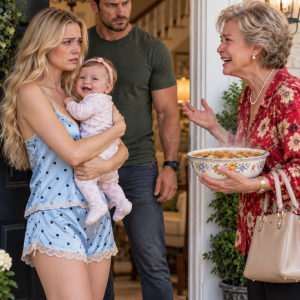
“Dad, you told me not to tell because Mom would get upset.”
Grant froze.
I froze too.
I had never heard that before.
The judge asked Callum gently:
“Your dad asked you to keep it secret?”
“Yes.”
“Did he ask you to keep anything else secret?”
Callum nodded.
“He said if I told people I wanted his house, I could get my Jeep. And Mom could visit us later.”
Maisie moved closer to her brother.
“I don’t want another mommy,” she whispered. “I want my mommy.”
Grant suddenly accused me of coaching them.
His own attorney tried to calm him.
The judge firmly instructed him to sit down.
As the twins were escorted out, Callum turned toward me.
“Mom, can we go home now?”
My throat tightened.
“Soon, sweetheart.”
The Case He Thought He Had Won
After additional review, Grant’s attorney requested a private conversation with him.
When they returned, the confidence was gone.
His attorney informed the court that Grant was no longer pursuing exclusive custody and would follow the court’s determination regarding parenting arrangements.
Grant looked stunned.
“That’s not what I agreed to.”
His attorney spoke quietly.
“I’m advising you to focus on what is best for your children.”
Eventually, the decision came.
The twins would primarily remain with me.
Grant would continue meeting his financial responsibilities, while his parenting time would follow conditions designed to protect the children’s stability as the situation was further evaluated.
When I heard that Callum and Maisie were coming home with me, I lowered my head.
That was when I finally cried.
Not because I had defeated Grant.
Because for weeks I had imagined two empty beds.
I had imagined waking up without hearing small feet running down the hallway.
I had imagined my children becoming decorations in somebody else’s carefully planned life.
Now I could breathe again.
What Grant Lost
Outside, Callum and Maisie were coloring with Paige.
Callum ran toward me.
“Did we win?”
I knelt beside him.
“This wasn’t about winning.”
He frowned.
“Then what happened?”
I pulled both children close.
“We’re going home.”
Behind us, Diane approached.
She looked at Maisie’s arm.
Then at her son.
“Grant, did you know about this?”
He avoided answering.
Diane’s eyes filled.
“She’s your daughter.”
For the first time since I had known her, Diane had nothing cruel to say to me.
A few days later, Paige called.
Sloane had ended the relationship.
Once the custody dispute and Grant’s plans became known to her family, the perfect future he had promised no longer looked perfect.
Then Grant’s professional life began unraveling too.
His employer reviewed several questionable decisions and relationships connected to his pursuit of Sloane’s family business.
Eventually, he lost the position he had once treated as proof that he was more important than everyone around him.
I didn’t celebrate.
I didn’t need to.
Grant had spent years chasing an image.
When the image disappeared, he finally had to face what remained.
The Home We Built Afterward
I rented a small studio several months later and expanded my design business.
I called it C&M Creative after Callum and Maisie.
I didn’t become rich overnight.
There was no mansion.
No luxury car.
No dramatic new life.
There was simply freedom.
One afternoon, Callum drew a picture of three people holding hands.
“That’s us,” he said.
I smiled.
“Why did you draw us so big?”
He considered the question seriously.
“Because we have more room now.”
His answer stayed with me.
For years, I thought keeping a family together meant enduring everything quietly.
I thought love meant compromising until there was almost nothing left of me.
I thought being a good wife meant hiding my success so my husband would never feel threatened by it.
I was wrong.
Sometimes protecting your family doesn’t mean keeping everyone beneath the same roof.
Sometimes it means creating a home where nobody has to become smaller just to keep somebody else comfortable.
Grant eventually began following the parenting arrangement.
Whether he truly changed, I can’t say.
Eventually, I stopped needing that answer.
His regret was no longer necessary for my peace.
Months later, I was cooking dinner while Maisie colored at the table and Callum worked on a preschool activity beside her.
Toys covered the living-room floor.
My laptop was open because a client project was due the following morning.
It wasn’t an extraordinary life.
But it was ours.
The night Grant placed those divorce papers on our kitchen table, he believed he was taking everything away from me.
Instead, he opened a door I had been afraid to walk through.
I lost a marriage.
But I found my voice again.
I found my confidence.
I stopped hiding the work I was proud of.
And most importantly, Callum and Maisie learned something I wished I had understood years earlier.
A family isn’t simply a group of people forced to remain in the same house.
It is the place where you can be loved without being afraid to be yourself.
Sometimes the moment that feels like the end of your life is actually the first moment you are finally being given permission to build a life that respects who you have become.
Never make yourself smaller simply to protect another person’s pride, because a relationship that requires you to hide your strengths will eventually teach you to forget that those strengths ever existed.
Financial independence cannot solve every problem, but having your own skills, income, and choices can become incredibly important when the future changes without warning.
Children may not understand adult arguments, legal documents, or complicated relationships, but they understand remarkably well which people make them feel safe, heard, and genuinely loved.
Expensive gifts can create excitement for a moment, but they cannot replace the security a child feels when an adult consistently shows up during the moments that matter.
Keeping a household together at any cost is not always the same thing as protecting a family, because sometimes the healthiest home begins only after someone finds the courage to leave an unhealthy pattern behind.
Silence can preserve peace for an afternoon, but when silence becomes a permanent habit, it can allow other people to write a version of your life that has very little to do with the truth.
You do not have to prove your worth by humiliating the person who underestimated you; sometimes the strongest answer is simply to stand firmly