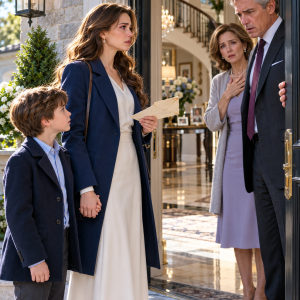
Grant had signed every page.
“I didn’t understand that was happening this soon,” he said.
“You didn’t read it.”
“Claire, come on.”
“No.”
I wasn’t angry when I said it.
That seemed to bother him more.
“You told me this morning to take the girls because you had a son coming.”
“I was upset.”
“You were smiling.”
He had no answer.
“Maisie made you a card,” I continued. “She thought you might be sad today.”
Silence.
“She did?”
“Yes.”
His voice softened.
“Can I talk to them?”
For a moment, I looked toward my daughters.
Then I asked them.
Tessa wasn’t ready.
Maisie hesitated before finally taking the phone.
“Hi, Dad.”
I moved away so she could have privacy.
Their conversation lasted less than three minutes.
When she returned the phone, she didn’t cry.
She simply handed it back to me and said:
“I’m ready to go now, Mom.”
What He Had Really Lost
Before I ended the call, Grant asked me one final question.
“Why didn’t you ever tell me how important your job was?”
I thought about that carefully.
“I did tell you about my work.”
“Not like this.”
“You heard what interested you, Grant.”
That was the difference.
I had never hidden my life from him.
He had simply reduced it until it fit the version of me that was easiest for him to understand.
Quiet wife.
Mother of daughters.
Government employee.
Someone dependable enough to manage the home but apparently not interesting enough to ask deeper questions about.
He hadn’t lost me because I had suddenly become someone important.
He had lost me because he had never valued the person standing beside him when he had the chance.
Six Months Later
Our new life was not perfect.
Real life rarely is.
There were difficult mornings, homesick evenings, missed friends, new routines, and plenty of video calls with relatives back home.
But the girls adjusted.
Maisie joined a school science club.
Tessa discovered that she loved photography.
They filled our apartment with drawings, books, shoes, backpacks, and the ordinary chaos that made a place feel like home.
Grant called more often than he had during the final year of our marriage.
Some conversations with the girls went well.
Others were awkward.
I never tried to turn them against him.
Whatever had happened between Grant and me, my daughters deserved the freedom to decide what relationship they wanted with their father.
As for Brianna and the baby, I eventually learned that Grant’s doubts had become serious enough that he wanted definite answers before making any long-term plans.
I didn’t ask for details.
That was his life now.
Mine had moved forward.
The Question My Daughter Asked
One evening, several months after we moved, Maisie found me standing on our balcony.
She leaned against the railing beside me.
“Mom?”
“Yeah?”
“Did Dad really think having a boy was better than having us?”
There are questions mothers wish their children never had to ask.
I could have lied.
Instead, I chose something gentler than a lie and more useful than anger.
“Your dad confused an expectation with what really matters.”
She looked at me.
“What really matters?”
I put my arm around her.
“The people who love you for who you are.”
She rested her head against my shoulder.
A few seconds later, Tessa opened the balcony door.
“Are you two having a secret meeting without me?”
Maisie laughed.
“Maybe.”
Tessa squeezed between us anyway.
Standing there with both girls beside me, I understood something I hadn’t been able to see clearly during the divorce.
I had spent years worrying about what was ending.
But sometimes an ending is simply the moment when you finally have enough space to recognize what deserves to continue.
Grant had wanted an heir.
I wanted my daughters to grow up knowing they never had to earn their place in anyone’s life.
And that was a future worth choosing.
Sometimes the most painful sentence someone says to you becomes valuable later, because it finally reveals a truth that years of excuses allowed you to avoid seeing clearly.
A child’s worth should never depend on gender, expectations, family traditions, or whether that child fits the future an adult once imagined for themselves.
Quiet people are often underestimated because others mistake restraint for weakness, when sometimes silence simply means they no longer feel obligated to prove themselves.
Never assume you understand someone’s career, sacrifices, responsibilities, or achievements simply because they have never felt the need to display them in front of you.
Relationships rarely fall apart because of one dramatic moment alone; sometimes they fade through years of unanswered questions, missed conversations, careless assumptions, and ordinary moments when one person stops paying attention.
Children remember far more than adults realize, which is why the way we speak about them and the way we make them feel can remain with them long after a family changes.
Respect is not measured by how proudly someone introduces you after discovering your title; it is measured by how they treated you before they knew that title mattered.
Reading carefully, listening carefully, and asking questions may seem like small things, but ignoring them can eventually cost someone relationships they assumed would always remain available.
Moving forward does not always require revenge, dramatic confrontation, or watching another person fail; sometimes the strongest response is simply building a peaceful life beyond the place where you were undervalued.
The people who truly belong in your future are not the ones who suddenly recognize your value when others recognize it too, but the ones who saw your humanity, your effort, and your heart long before anyone announced your accomplishments.