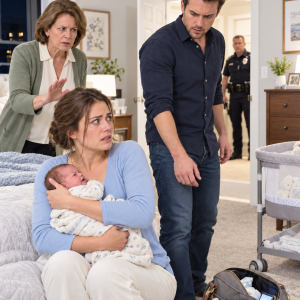
“We’re not moving in, Mom.”
Elaine stared at her.
“You packed your entire house.”
“Because you told us Megan agreed.”
“I told you what was best for everyone.”
Brooke wiped her cheek.
“That’s not the same thing.”
There was no dramatic explosion after that.
In some ways, the absence of one made the moment more powerful.
Mom simply seemed smaller.
Not physically, but somehow stripped of the certainty she had worn into my house.
Martin touched her elbow.
“Come on, Elaine.”
She pulled away at first, then stopped.
Her eyes moved toward Lily.
For a second, the anger softened.
“I came because I thought you needed me.”
I believed her.
That was perhaps the hardest part.
My mother was not pretending to care. She cared enormously. She simply had never learned that love could stand outside a closed door and wait to be invited inside.
“I do need you,” I said quietly. “I just don’t need you to take over.”
She looked down.
Then she walked out.
Martin followed.
Brooke remained on the porch.
When Mom’s SUV pulled away, my sister turned toward me.
“I’m sorry.”
I stepped outside and hugged her carefully around Lily.
“Me too.”
Brooke and Ryan spent that night at an inexpensive extended-stay hotel. Over the following week, I helped them find a two-bedroom apartment twenty minutes away and quietly covered their security deposit. Ryan found temporary work soon afterward, and several months later he accepted a permanent position with a commercial supply company.
More importantly, Brooke and I began talking without our mother serving as interpreter.
We discovered how many misunderstandings between us had been built by sentences beginning with, “Mom said you…”
That realization hurt.
But it also freed us.
For nearly a month, my mother and I did not speak.
During that silence, life inside my little ranch house became wonderfully ordinary.
Lily developed a habit of waking just before dawn. I learned to make coffee one-handed. The sofa finally arrived, and on difficult nights Lily and I slept there together beneath the dim light from the hallway.
The blue-gray nursery became my favorite room.
Sometimes I would stand in the doorway while Lily slept and remember how casually my mother had assigned that room to someone else.
Then I would look at my daughter and understand why the confrontation had mattered so much.
I wasn’t only protecting a house.
I was changing an inheritance.
I did not want Lily to grow up believing that love required access to every room inside her.
I wanted her to know that she could love someone deeply and still close a door.
When My Mother Finally Knocked
Five weeks after the morning with the trailer, I called Mom.
She answered after several rings.
“Hello?”
Her voice was careful.
“I’d like you to come see Lily.”
Silence.
Then, “When?”
“Saturday afternoon.”
Another pause.
“Who else will be there?”
“Nobody. Just us.”
She seemed surprised.
“And you want me there?”
That question caught me off guard.
Beneath all the control, there it was: fear.
Perhaps my mother had spent her life forcing doors open because she was terrified that if she waited outside, nobody would invite her in.
Understanding that did not erase what she had done.
But it allowed me to see her as a complicated human being rather than merely the obstacle I had spent my life escaping.
“Yes,” I said. “I want you there. But things have to be different.”
She exhaled slowly.
“Different how?”
“You ask before making plans for me. You don’t use Brooke to get information about me. You don’t make decisions about Lily without talking to me. And if I say no, you don’t treat it like the beginning of a negotiation.”
She was quiet.
Then she said, “That’s a lot of rules.”
I smiled despite myself.
“It’s four.”
Another silence.
Finally, she said, “I’ll come Saturday.”
At two o’clock that Saturday, rain was tapping softly against the front windows when I heard a knock.
Not the door handle turning.
A knock.
I stood in the hallway for a moment, almost overwhelmed by how much meaning could fit inside such an ordinary sound.
When I opened the door, my mother was standing beneath a navy umbrella holding a covered casserole dish.
“I brought chicken pot pie,” she said.
No suitcase.
No boxes.
No plans.
Just dinner.
I stepped aside.
“Come in.”
She wiped her shoes carefully on the mat before entering.
That detail nearly made me cry.
Mom held Lily for almost an hour. She rocked her beside the living-room window while rain traced crooked paths down the glass, and for once she did not tell me how to arrange the nursery, which bottle warmer to buy, when Lily should sleep, or what I was doing incorrectly.
We talked about small things.
The weather.
A neighbor’s enormous Halloween decorations.
The rising price of groceries.
Brooke’s new apartment.
At one point Lily began fussing, and Mom automatically started to stand.
Then she stopped.
“Do you want her?” she asked.
Four simple words.
Do you want her?
She was asking instead of deciding.
I nodded.
“Yeah. Thanks.”
She handed my daughter back to me.
Neither of us mentioned the significance of what had just happened.
We didn’t need to.
Our relationship did not transform overnight. There were still arguments. There were moments when Mom offered advice that sounded suspiciously like instructions, and moments when I had to remind her that a boundary was not an insult.
But slowly, she began knocking.
And slowly, I stopped feeling guilty for making her wait until I opened the door.
Months later, on a bright spring morning, I sat on the back steps with Lily in my lap while sunlight moved across the lawn. The maple tree had begun filling with new leaves, and through the open kitchen window I could smell coffee brewing.
The house was still modest.
The carpet already had a stain near the hallway.
One cabinet door refused to close properly.
The backyard needed work.
It was not the kind of house anyone would photograph for a magazine.
But I had chosen it.
I had painted its walls.
I had signed every page at closing.
And on one difficult morning, when people I loved arrived believing that loving me entitled them to take possession of the life I had built, I had finally learned to say no without running away afterward.
For years, I believed independence meant needing nobody.
I know better now.
Independence means being able to choose whom you let close, what help you accept, and where love ends and control begins.
My mother is still my mother.
Brooke is still my sister.
We are still imperfect people carrying old habits into new rooms.
But now, when my mother visits, she walks up the path beneath the maple tree and knocks.
Sometimes I open the door immediately.
Sometimes Lily is sleeping and I make her wait.
Sometimes I tell her it isn’t a good day and suggest another weekend.
And somehow, the world keeps turning.
That may sound like a very small victory.
To someone who grew up believing every closed door could be opened by somebody else’s hand, it is enormous.
Because this house gave me something far more valuable than an address.
It taught me that a boundary does not mean I love my family less.
Sometimes a boundary is precisely what allows love to remain love.
And every evening, after Lily is asleep and the dishes are put away, I check the front door before turning off the lights.
The lock gives a soft, familiar click beneath my hand.
Nobody else has a key.
For the first time in my life, that does not feel lonely.
It feels like home.