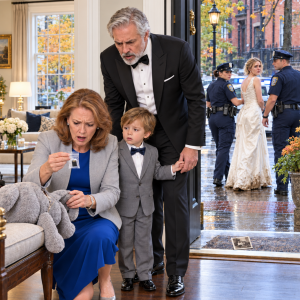
Then she slowly placed the frame back into the little gift bag.
That simple movement hurt more than anything else that afternoon.
My father finally stepped outside.
“Nate, let’s talk about this privately.”
I looked through the doorway at the relatives watching us.
“This became public when my children were turned away in front of everyone.”
He lowered his voice.
“Don’t leave like this.”
I almost laughed, but there was nothing funny about it.
“Dad, we’re not the ones who decided how this evening would end.”
We Chose Our Children
I closed the folder.
Then I turned toward Wyatt.
“Ready, buddy?”
He nodded.
Lila reached for Audrey’s hand.
We walked toward our car.
Behind us, my father called my name.
“Nate!”
I stopped but didn’t turn around.
“Please. We can fix this.”
For years, those words would have been enough to pull me back.
Not anymore.
I turned halfway.
“Maybe someday. But not tonight.”
My mother stood silently in the doorway.
The confident expression she had worn when we arrived was gone.
Mallory was still holding the deed.
Audrey opened the passenger door for Lila while I helped Wyatt into the back seat.
Once we were inside the car, nobody spoke for several minutes.
Then Wyatt asked the question I had been dreading.
“Dad, did Grandma mean we’re not really family?”
I looked at him through the rearview mirror.
“No, son. She said something she never should have said.”
“But does she think that?”
I took a moment before answering.
“I don’t know what she thinks. But I know this: being family isn’t something you prove by sitting at somebody’s dinner table.”
Audrey looked at me.
I continued.
“Family is the people who make you feel safe, wanted, and loved. You and your sister never have to beg anyone for that.”
Lila leaned against her brother.
Audrey reached across the center console and took my hand.
For the first time that afternoon, I felt calm.
What Happened After Sunday
My father called six times that evening.
I didn’t answer.
Mom sent a long message explaining that everything had been a misunderstanding.
I didn’t answer that either.
Mallory sent only one sentence.
“Are Mom and Dad going to lose the house?”
That message told me more than she probably intended.
Audrey read it and looked at me.
“Interesting first question.”
I nodded.
We had no intention of putting my parents out on the street.
The house had never been leverage.
But things were going to change.
For years, Audrey and I had confused helping people with allowing them to take us for granted.
Those were not the same thing.
The following week, my father came to our home alone.
He didn’t bring excuses.
He brought Lila’s picture frame.
Apparently, she had accidentally left the gift bag beside the porch.
He placed it on our kitchen table.
“I should have opened that door wider,” he said.
I didn’t respond immediately.
Then he looked at Wyatt and Lila playing in the backyard.
“I should have stood up for them.”
That was the first apology that felt real.
Not because it fixed everything.
It didn’t.
But because he finally understood what needed fixing.
A Different Kind of Strength
People sometimes assume that military service teaches you to endure anything.
In some ways, it does.
You learn patience.
You learn discipline.
You learn to keep moving when circumstances are difficult.
But endurance can become a dangerous habit when you carry it into relationships.
For years, I had endured my mother’s favoritism because confronting it felt harder than ignoring it.
I had endured disrespect toward Audrey because she was strong enough to handle it.
And without realizing it, I had begun teaching my children to endure the same treatment.
That was my mistake.
Strength isn’t always remaining at the table.
Sometimes strength is recognizing that the table was never prepared for you with love in the first place.
That Sunday, Audrey and I didn’t lose a family.
We stopped begging for permission to belong to one.
And when I looked at my wife and children sitting around our own dinner table that evening, laughing over takeout pizza while Lila’s unfinished gift sat safely on the counter, I understood something I should have learned years earlier.
Home isn’t the house whose mortgage you paid.
It isn’t the address where you grew up.
And it isn’t the place where relatives gather simply because they share your last name.
Home is where your children never have to ask whether they are wanted.
Never allow years of loyalty to convince you that you must continue accepting a relationship in which your children are repeatedly made to feel less important than everyone else.
Helping relatives through difficult times can be an act of love, but genuine love should never require you to purchase respect with money, sacrifice, silence, or endless forgiveness.
Sometimes the strongest response to humiliation is not an argument, but calmly presenting the truth, protecting the people who depend on you, and walking away with your dignity intact.
Children may forget the food served at a family gathering, but they can remember for years whether the adults around them made them feel welcomed, valued, and safe.
Sharing blood, a surname, or childhood memories may create a connection, but everyday kindness, loyalty, respect, and consistent care are what give that connection real meaning.
There comes a point when keeping peace at any cost stops being kindness and begins teaching other people that they can continue crossing your boundaries without consequences.
A person can be brave in demanding situations and still struggle to confront the people they love, because emotional boundaries sometimes require a different kind of courage.
Protecting your children does not always mean shielding them from every disappointment; sometimes it means showing them that they never need to remain where they are deliberately made to feel unwanted.
Forgiveness can be meaningful when someone accepts responsibility and changes their behavior, but forgiveness does not require pretending that painful choices never happened.
The most valuable home you can give your family is not the largest house or the most expensive property, but a place where every person knows they belong without having to prove their worth.