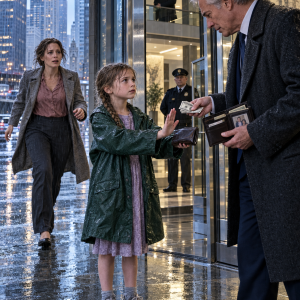
“Did Lily make it?”
“She’s improving every day.”
A faint smile touched his face.
“Good. Then don’t let anyone call this a waste.”
Those were the last clear words my son spoke to me. Before sunrise, despite every effort made around him, Owen quietly slipped beyond our reach.
He was thirty years old.
At the memorial service, people called him brave, selfless, and heroic, while I stood beneath the church’s pale stained-glass windows accepting embraces from people whose names I barely heard. I appreciated every kind word, but I would have traded all of them for one more ordinary Sunday, one more cup of coffee across the kitchen table, one more chance to hear him walk through my door and call out for me.
The Woman on the Porch
The morning after the service, someone knocked just after nine.
I had spent the night in Owen’s old room, sitting on the edge of his childhood bed with one of his sweaters folded across my lap, and when I opened the front door, I was too exhausted to understand at first why Claire Bennett was standing beneath the gray November sky.
She was a slender white woman in her early thirties, with auburn hair gathered at the back of her neck and eyes swollen from crying. Beside her stood Lily, recently released from the hospital, wearing a lavender coat and holding the stuffed fox from the photograph.
The little girl looked healthier than she had before the procedure, although she still seemed fragile, and the sight of her awakened two opposing feelings within me: gratitude that Owen’s sacrifice had helped her, and an ache so sharp that I had to grip the doorframe.
“Mrs. Mercer, I’m sorry to come without calling,” Claire said. “I know this is a terrible time.”
“I’m afraid I’m not ready for visitors.”
“I understand, but there’s something you need to know, and I can’t let you continue without knowing it.”
I stiffened, suddenly defensive.
“If this is about the operation, no one in this house blames you. Owen made his own decision.”
Claire covered her mouth as a sob escaped, then crouched beside Lily.
“Sweetheart, would you sit on the porch swing for a few minutes? I need to talk privately with Owen’s mother.”
Lily glanced at me before obeying. When she settled on the swing, hugging her fox against her chest, Claire reached into her handbag and removed a large cream envelope that had been folded and unfolded so many times that its edges had softened.
“Owen made me promise I wouldn’t tell you unless he couldn’t do it himself,” she said. “He planned to come here next Sunday and explain everything.”
My pulse began beating heavily in my ears.
“Explain what?”
Claire looked toward her daughter, and something in that glance made me notice details I had overlooked—the dimple in Lily’s left cheek, the slight arch of her eyebrows, and the way she pressed her lips together when she was worried, exactly as Owen had done since childhood.
“Your son didn’t volunteer because I was merely an old classmate,” Claire said. “He helped Lily because she is his daughter.”
The porch seemed to tilt beneath me.
“No,” I whispered. “Owen never had a child.”
Claire handed me the envelope. Inside were copies of a private paternity report, a legal agreement signed six years earlier, and records of monthly payments sent through an attorney. At the bottom of the medical report, the probability of parentage was listed as 99.98 percent.
I read Owen’s name three times before the words made sense.
“He knew?”
“From before she was born.”
The question that rose from my pain sounded harsher than I intended.
“Then where was he for five years?”
Claire flinched, yet she did not retreat from the truth.
Six years earlier, she explained, she and Owen had briefly been involved while completing a professional training course in Philadelphia. Their relationship ended when he accepted a position in another state, and several weeks later, Claire discovered she was expecting a child.
When she told Owen, he panicked—not because he doubted her or wished her harm, but because the thought of loving a child awakened every fear he had buried after losing Caleb. He told her that he felt damaged, that he believed building a family merely gave sorrow another door through which to enter, and that he was afraid he would spend every day waiting for something to go wrong.
He arranged full financial support through an attorney, established an education fund, and received photographs and school reports each month, yet he refused to meet Lily because he believed distance would protect him.
“I was angry with him for years,” Claire admitted. “There were birthdays when Lily asked why other children had fathers at school events, and I wanted to drive to his apartment and force him to look at what he was missing. Still, he never ignored his responsibilities, and I could tell from his questions to the lawyer that he cared more than he allowed himself to show.”
When Lily became seriously ill, Claire contacted Owen’s attorney out of desperation. The waiting list was long, none of her relatives were a match, and Lily’s health was weakening.
Two days later, Owen appeared at Claire’s apartment.
“He stood in the hallway for nearly ten minutes before he could make himself knock,” she continued. “When I opened the door, he asked only one question.”
“What did he ask?”
“He said, ‘Where is my daughter?’”
Claire invited him inside, where Lily was building a castle from wooden blocks on the living-room floor. Owen sat down beside her without introducing himself as her father, and for nearly three hours, they built towers, invented stories about invisible dragons, and argued cheerfully over where the castle’s kitchen belonged.
That evening, after Lily had gone to sleep, Owen called Claire from his car.
“He told me, ‘I stayed away because I thought fear was keeping me safe, but all it did was make me miss five years of her life. I cannot recover those years, but I can be here now.’”
The following morning, he began testing. When the doctors confirmed that he was an excellent match, he sat on Claire’s sofa and cried with relief.
“He said helping her was the first thing he had ever done that made him feel completely useful,” Claire told me. “He wasn’t trying to become a hero. He was trying to become her father before it was too late.”
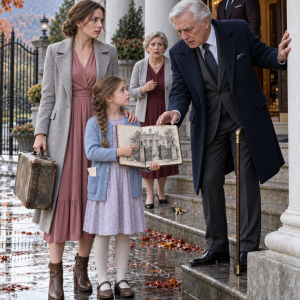
I lowered myself onto the porch bench because my knees would no longer support me. Every strange detail of Owen’s final weeks suddenly aligned: the family albums, the questions about the garden, the repairs around my home, and his promise to correct the worst choice of his life.
“Why didn’t he tell me?”
“He was ashamed, and he wanted to earn the right to introduce her to you. If the surgery went well, he planned to bring us here for dinner next Sunday.”
Across the porch, Lily pushed one foot against the floorboards, making the swing move gently beneath her. She looked toward us, and when our eyes met, I saw not a stranger but the unmistakable expression Owen had worn whenever he was patiently waiting for adults to finish a conversation.
Claire knelt in front of me.
“He didn’t want you to remember him only by his mistake. He wanted to tell you when he had finally become the man he should have been.”
I pressed the papers against my chest and wept, not only because my son was gone from my reach, but because a whole hidden chapter of his life had opened before me after I no longer had the chance to ask him about it.
Yet on that porch, only a few yards from the little girl carrying his eyes and his shy smile, I also understood that Owen had left behind more than absence.
He had left me a granddaughter.
The Letter in the Wooden Box

After Claire and Lily departed that afternoon, I entered Owen’s old room and began searching, although I could not have explained what I expected to find. In the back of his closet, beneath a stack of engineering journals, there was a small wooden box I had never seen before.
Inside were dozens of photographs arranged by year.