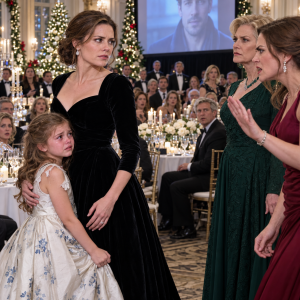
When my father’s voice filled the courtroom, my mother turned toward him.
“Douglas, tell me that isn’t what it sounds like.”
He did not answer.
Caleb pushed back from the defense table.
“Dad designed the transfers!” he shouted. “He said Amelia would never come back and no one would question the records!”
My father stood.
“You signed every application, Caleb. Don’t place this on me now.”
The judge ordered everyone to remain quiet while federal officers approached my father. Caleb began asking his attorney about a new agreement with prosecutors, but Everett no longer looked confident.
I sat with my hands folded, listening as the family alliance that had excluded me for years collapsed beneath the weight of its own words.
The Steps Outside the Courthouse
By afternoon, news crews crowded the front entrance, so two Air Force security officers escorted me through a side exit. I had nearly reached the waiting vehicle when I heard my mother call my name.
She stood beside a black sedan without her coat, her face pale in the cold rain. My father had been released under strict conditions and sat behind the tinted window, looking down at his hands.
“Amelia, please wait.”
I stopped several feet away.
My mother moved toward me and reached for my sleeve, but I stepped back.
“You must explain that your father was confused,” she said. “Tell them the recording lacked context. Our accounts are frozen. They may take the house. Caleb could spend decades away from us.”
“Those are consequences of decisions I did not make.”
Her fear briefly gave way to the familiar anger I had known since childhood.
“We are still your family.”
“You told a federal jury I invented my career. You helped Caleb use my absence as proof that I could not be trusted.”
“We were protecting your brother.”
“That is what you have always called it. When you took my property, you called it protecting him. When you accepted false records, you called it protecting him. When forty-two people were left carrying debts created in their names, you still protected him.”
Her shoulders lowered.
“But you are our daughter.”
For years, I had imagined hearing those words. I thought they might repair something inside me, but standing there, I realized that being called their daughter only when they needed rescue was not reconciliation. It was another transaction.
I looked through the car window at my father. He finally raised his eyes, and neither of us looked away.
“You taught Caleb that my life was available for his use,” I said. “You taught him that if he spoke confidently enough, you would help him replace me with a story. Now the truth belongs to the court, and I will not alter it for you.”
My mother began to cry.
“Is there anything we can do?”
“Tell the truth without asking what it will cost you.”
Then I turned and walked toward the waiting vehicle.
The Family I Chose

Caleb later received a lengthy federal sentence for financial fraud, identity misuse, and the exploitation of former service members. My father accepted responsibility for conspiracy and unlawful transfers, while my mother admitted signing documents she knew contained false information. Their property and investments were sold to fund restitution, and the social circle they had worked so hard to impress quietly disappeared.
I did not see them again.
Nine months after the trial, I stood on a flight line at an Air Force base in coastal South Carolina, watching the evening light settle over rows of aircraft. A young captain approached with two cups of coffee and handed one to me.
“Long day, Major?”
I smiled.
“Long eleven years.”
She did not ask for an explanation. The people who had become my real family rarely demanded that I prove my worth before offering kindness. They knew me through ordinary things: shared meals after late shifts, quiet rides back from difficult assignments, remembered birthdays, and the simple certainty that if one of us needed help, the others would arrive.
For years, I believed the insignia on my uniform would finally convince my parents that I mattered. After the trial, I understood that no title could persuade people who benefited from denying the truth. My rank was not proof that I deserved to exist. I had never needed such proof.
Caleb had borrowed my name because he believed a name was merely another asset. My parents had allowed it because preserving their favored son mattered more than knowing their daughter. Yet the part of me they tried to erase had continued growing beyond their sight, strengthened by every honest choice they insisted was foolish.
As the sun lowered beyond the runway, I thought about the forty-two people whose names had finally been cleared and whose restitution payments had begun arriving. That mattered more than the house my parents lost, the reputation Caleb could no longer protect, or the apologies that came only after the evidence became impossible to dismiss.
My family had spent eleven years telling the world I was lost.
In truth, I had simply stopped waiting for them to find me.