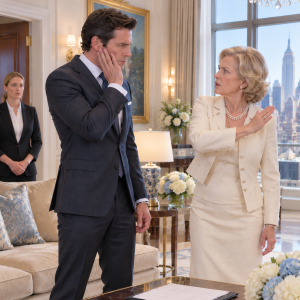
“I don’t know, Mom. I can’t promise something I’m not ready to give.”
My father nodded.
“That’s fair.”
Then he said something that surprised me.
“If you let us, we’d like to start by learning who you became.”
I looked down at my uniform.
They had missed almost my entire adult life.
They knew nothing about the people I loved, the places I had lived, or the person I had become.
“You can start by listening,” I answered.
My mother nodded.
For once, neither of them tried to explain away the past.
What the Court Could Decide—and What It Could Not
The proceedings continued over the following days.
After reviewing the evidence and hearing testimony, the court found Grant responsible for knowingly submitting false certifications.
The final sentence would be determined at a later hearing.
The consequences for his career were immediate.
His employer suspended him, and his professional future became uncertain.
I felt no satisfaction watching him leave the courtroom.
He was still my brother.
I remembered the boy who taught me to ride a bicycle and helped me study for my first difficult mathematics exam.
I also remembered the man who had allowed our parents to believe I was a disgrace for fourteen years.
Both versions belonged to the same person.
Outside the courthouse, Grant approached me.
He looked exhausted.
“Caroline, I know I don’t deserve another chance.”
I waited for him to continue.
“I was afraid of losing everything, so I let you lose your family instead.”
His voice shook.
“I’m sorry.”
For the first time, I believed he understood what he had done.
But understanding was not the same as repairing it.
“I hope you learn to live differently, Grant,” I told him. “But I can’t be responsible for making you feel better about the past.”
He nodded.
We parted without an embrace.
And that was enough for that day.
The First Dinner in Fourteen Years
Three weeks later, my mother sent me a handwritten letter.
It was six pages long.
She did not ask me to forget anything.
Instead, she described the moments when she had almost contacted me and admitted that pride and fear had stopped her.
My father included a short note.
“I cannot return the years we lost, but I would be grateful for the chance to spend the years ahead knowing my daughter.”
I read both letters twice.
Then I called them.
My mother answered on the second ring.
For a moment, neither of us spoke.
“Would you like to have dinner next Saturday?” I asked.
She began crying.
“More than anything.”
We met at a small restaurant in Ogden, not far from the neighborhood where I grew up.
My parents arrived early.
My father stood when I approached the table.
My mother smiled nervously.
We talked about ordinary things.
My apartment.
My work.
My father’s garden.
The books my mother had been reading.
They asked questions and listened to the answers.
When my father learned that I had been promoted several years earlier, his eyes filled with tears.
“I wish I’d been there,” he said.
I placed my glass on the table.
“I wish you had, too.”
He nodded without making excuses.
It wasn’t a perfect evening.
There were uncomfortable silences and moments when the past seemed to sit between us like another person.
But nobody pretended those fourteen years had never happened.
And nobody asked me to move faster than I was ready.
When dinner ended, my mother asked whether she could hug me.
I hesitated.
Then I opened my arms.
It was a brief embrace, but it was real.
The Family I Chose to Rebuild
Six months after the trial, I visited my parents for the first time since I was twenty-three.
The house looked smaller than I remembered.
The old fireplace was still there.
So was the wall where Grant’s military photograph had once hung alone.
Now there were several new frames.
My parents had printed photographs from my promotions and assignments, including pictures I had sent them years earlier.
My mother showed me a small wooden box.
Inside were every unopened letter and returned envelope she had managed to keep.
“I don’t expect you to be grateful that I saved these,” she said. “I just wanted you to know I finally read them.”
I picked up one envelope.
My handwriting looked younger.
So did the hopes I had carried when I wrote it.
I placed it back inside the box.
“Thank you for telling me.”
Later, my father and I sat on the back porch.
He looked across the yard.
“For years, I told people that loyalty meant standing beside your family.”
He paused.
“I never understood that loyalty also means being willing to hear something difficult about someone you love.”
I looked at him.
“I think that’s something we both understand now.”
He smiled sadly.
We stayed outside until the sun began to set.
Nothing could give me back the birthdays, holidays, or ordinary afternoons we had lost.
But I had stopped waiting for the past to change.
I could decide what happened next.
Grant and I remained distant. He eventually sent another letter accepting responsibility without asking me to defend him or intervene in his case.
I replied with a few honest sentences.
I wished him well, but I made no promises.
My parents continued making an effort.
They called when they said they would.
They asked about my life.
And when I disagreed with them, they listened instead of turning away.
One evening, my father told me he had finally understood the meaning of the silver oak leaves on my uniform.
“I used to think those leaves meant you’d earned authority,” he said.
I smiled.
“That’s part of it.”
He shook his head.
“To me, they mean you became someone honorable even when we weren’t there to see it.”
I looked toward the garden and felt tears gathering in my eyes.
For fourteen years, I had imagined that proving the truth would finally make me whole.
But standing there beside my father, I understood something different.
I had already built a whole life.
The truth had not given me my dignity back.
It had simply allowed my family to recognize the dignity I had never lost.
Ten Lessons About Truth, Family, and Second Chances
1. Family loyalty should never require someone to ignore the truth, because protecting a loved one from accountability can eventually cause far more damage than allowing that person to face the consequences of their own decisions.
2. The deepest disappointments often come from the people whose understanding we need most, but their inability to recognize our worth does not diminish the person we are or the life we are capable of building.
3. A lie can change the way an entire family sees someone, especially when people choose the most comfortable explanation instead of asking difficult questions and listening carefully to every side.
4. Doing the right thing does not always bring immediate peace or appreciation, but personal integrity becomes a lasting source of strength when circumstances change and other people’s opinions no longer control our choices.
5. Parents can love their children and still make serious mistakes, and genuine reconciliation begins when they acknowledge those mistakes without excuses, comparisons, or demands for immediate forgiveness.
6. An apology becomes meaningful when it is supported by changed behavior, because words alone cannot restore years of broken trust, missed opportunities, and emotional distance.
7. Forgiveness should never be treated as an obligation, since every person deserves the freedom to decide whether rebuilding a relationship is healthy, possible, or something they genuinely want.
8. Success is not measured only by professional recognition or public achievement, but also by the courage to remain compassionate, responsible, and honest when life gives us every reason to become bitter.
9. Lost years cannot be recovered, but future relationships can still be shaped with care, provided everyone involved is willing to accept responsibility, respect boundaries, and demonstrate trustworthiness over time.
10. Sometimes the greatest victory is not watching someone who wronged us face consequences, but reaching a place where their choices no longer define our happiness, our identity, or the future we choose for ourselves.