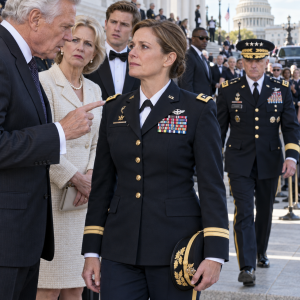
Grant actually laughed.
“There was quite a lot to tell.”
Then he mentioned the part I had hoped he had forgotten.
One member of the stranded crew, a flight mechanic named Ryan Fletcher, had become separated from the others during the storm. By the time we realized exactly where he might be, most of the group was already moving toward a safer extraction area and the weather window was narrowing again.
My supervisor told us to reassess before sending anyone back.
That was reasonable.
It was also clear that waiting much longer would make finding Ryan considerably harder.
A field medic named Holly Mercer came with me.
Together we followed a locator signal downslope until we found him sheltered beneath a section of damaged equipment and deep snow.
He was barely responsive, but he was there.
We stabilized him and brought him back.
That was the entire story as far as I was concerned.
Grant apparently disagreed.
“Most of us thought Ryan wasn’t coming back with us that night,” he said. “Claire and the medic went looking anyway.”
“Together,” I emphasized.
“Yes. Together.”
Mom’s hand had moved to her chest.
“Were you hurt?”
I sighed.
Of course that would be her question.
“Nothing serious.”
“Claire.”
“Mom, I’m standing here.”
“That isn’t an answer.”
Dad made a quiet sound that might have been a laugh, and some of the tension around us loosened.
Then another guest approached.
He was an older man with silver hair whom Madison had introduced earlier as Rear Admiral Stephen Caldwell.
He studied me for a moment.
“Bennett?”
“Yes, sir.”
His expression warmed.
“I thought I recognized you.”
Madison looked as if the evening had stopped obeying the laws of nature.
“You know her too?”
The admiral smiled.
“Ms. Bennett briefed our regional command after Granite Pass.”
Madison turned slowly toward me.
“You briefed an admiral?”
I took another sip of iced tea.
“There were forms involved.”
Dad laughed first.
Then Grant.
Even the admiral smiled.
Madison didn’t.
What Hurt More Than the Insult
Grant eventually showed my family a photograph taken after the operation, with the rescued crew sitting inside a hangar wrapped in blankets while our team stood behind them.
I was almost impossible to recognize beneath winter gear.
Madison stared at the photograph.
“That’s really you?”
That question hurt more than her hallway insult.
Not because she doubted the photograph.
Because suddenly she was looking at me as though I had become somebody else.
Somebody valuable.
“Yes.”
“Why didn’t you ever tell me?”
“You never really asked.”
Her face reddened.
“I asked about your job.”
“Mom asked. Dad asked. You made jokes.”
Before she could answer, one of our cousins chose the worst possible moment to contribute.
“This makes what Madison said earlier pretty funny.”
Madison spun toward him.
“Don’t.”
Grant looked between them.
“What happened earlier?”
Nobody answered.
Then our other cousin, who had clearly enjoyed too much champagne, supplied the missing information.
“She asked Claire not to talk about her low-level government job because she thought you and your officer friends wouldn’t be impressed.”
The silence that followed felt heavier than the one after Grant recognized me.
He turned toward Madison.
“You said that?”
“I didn’t know what she actually did.”
I finally spoke.
“That’s the problem.”
Madison looked at me.
“You could have told me.”
“And then what?”
“Then I wouldn’t have said it.”
“Exactly.”
She frowned.
“What does that mean?”
I kept my voice low because I wasn’t interested in humiliating her, even though she had been willing to humiliate me.
“It means you think the mistake was not knowing my job was impressive enough. The mistake was deciding I deserved less respect when you thought it wasn’t.”
She had no answer.
Grant lowered his eyes for a moment.
Then he said, “She’s right.”
Madison’s expression tightened.
“Everybody is making me sound awful.”
“Nobody has to,” I said. “What you said already did that.”
Her eyes filled.
She turned and walked into the house.
The Front Porch

I found Madison about half an hour later sitting barefoot on the front porch, her heels beside her and her arms wrapped around her knees.
I considered leaving her alone.
Then I sat beside her.
For a while we watched cars pass beneath the streetlights.
Finally she asked, “Do you hate me?”
“No.”
“Maybe you should.”
“That sounds like too much work.”
She laughed once, weakly.
Then she wiped her cheek.
“I really didn’t know.”
“I know.”
“I thought you weren’t ambitious. You never talked about promotions or awards. You always made your job sound so ordinary.”
I looked toward the dark street.
“My job isn’t what bothered me.”
“Then what did?”
“You were embarrassed by me before you knew what I did.”
She looked down.
“You don’t have to understand my career to respect me, Madison. Even if I spent forty hours a week scheduling trucks in a warehouse, you still wouldn’t have the right to treat me like I was beneath you.”
She nodded.
After a long silence, she said, “I think I liked being the successful sister.”
That was more honest than I expected.
She explained that she had spent years thinking of herself as the ambitious one, the social one, the sister who was going somewhere. Then she met Grant, whose career came with uniforms, commendations and stories people immediately respected, and she began using his accomplishments as proof that she had entered an important world too.
“I wanted everyone to look at us and think I’d done well,” she whispered.
“Including at my expense.”
“Yes.”
Her voice was barely audible.
Then she said, “I’m sorry.”
I believed her.
But believing an apology and pretending nothing happened are different things.
“I love you,” I told her. “But don’t ever do that again.”
“I won’t.”
“Not because you know about Granite Pass.”
She nodded.