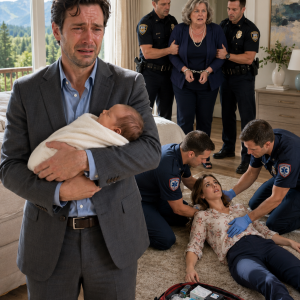
“He is stable because his cousin called for help and his mother arrived quickly. Waiting longer could have changed the outcome.”
Paige stood behind her mother with her arms wrapped tightly around herself. When Mallory walked away with one of the officers, I crouched beside my niece.
“Paige, none of this is your fault.”
She looked at the floor.
“I should’ve called sooner.”
“You called when Owen needed you. You were brave, and you did exactly the right thing.”
Her lower lip trembled.
“Mom kept saying he was pretending. She told me he wanted attention.”
I waited until she looked at me.
“Did you see what she gave him?”
Paige nodded.
“She poured fruit punch into two paper cups. Then she took a little bottle from the zippered pocket in her purse and mixed some into Owen’s drink.”
“Did she put it in your drink too?”
Paige’s eyes widened, and for one brief moment I saw something beyond fear—a recognition she did not yet know how to explain.
“Not today,” she whispered.
The answer stayed with me.
“What happened to the bottle?”
Paige glanced toward her mother, who was speaking sharply to Nathan at the other end of the hallway.
“After I called you, Mom wrapped it in napkins and put it in the trash can near the bridge.”
I immediately told the officer.
A patrol team returned to Hawthorne Park and searched the bin Paige had identified. Less than an hour later, they recovered a small amber prescription bottle concealed beneath several paper napkins and an empty juice carton.
When Mallory learned that the bottle had been found, her story changed again.
She first claimed Owen must have taken the medication from her purse without her knowledge. When an officer reminded her that Paige had watched her mix the drink, Mallory insisted that the bottle belonged to me and that I had prepared Owen’s beverage before they left my house.
“Nora must have forgotten what she put in it,” she said. “She’s always distracted. I panicked because I knew she would blame me.”
I stared at her, unable to speak.
It was painful enough to understand that she had treated my son’s lively spirit as a problem requiring medication. Watching her try to place responsibility on me revealed something colder: she was not confused, and she was not remorseful. She was searching for the version of events most likely to protect herself.
The following morning, while Owen remained asleep under observation, Detective Aaron Bell from the county investigations unit asked Nathan and me to meet him in a small consultation room.
He placed a photograph of the recovered bottle on the table.
“The label was partially removed,” he said, “but the pharmacy was able to trace the prescription number.”
Nathan rubbed both hands over his face.
“Was it prescribed to Mallory?”
Detective Bell shook his head.
“No.”
I looked at the photograph. Beneath the torn edge of the white label, one name remained visible.
PAIGE WHITFIELD.
For several seconds, neither Nathan nor I spoke.
“The medication belonged to Paige?” I finally asked.
“The prescription was issued in her name.”
Nathan leaned forward.
“Why would an eight-year-old be prescribed something that strong?”
The detective closed the folder, but he did not remove his hand from it.
“That is what concerned us. Pharmacy records show that this prescription was filled three times during the last five months.”
“Three bottles?” Nathan asked.
“Yes.”
I thought of Paige sitting silently at family gatherings, her eyelids growing heavy before dessert. I remembered how easily she fell asleep on my parents’ couch and how Mallory would smile whenever someone praised her daughter’s behavior.
“She’s such an easy child,” Mallory always said. “She knows better than to make a scene.”
At the time, those words had sounded like pride.
Now they carried an entirely different meaning.
Nathan’s face had gone pale.
“Who prescribed it?”
Detective Bell was quiet for a moment before answering.
“We contacted Paige’s pediatrician this morning. He has treated her since she was a toddler, and he confirmed that he never authorized this medication.”
A heavy silence settled over the room.
Through the narrow window in the door, I could see Paige sitting in the hallway with a hospital social worker, her small hands folded in her lap as she waited for an adult to tell her what would happen next.
Until that moment, I had believed the story began when Mallory offered to take Owen to the park.
As I watched my niece carefully studying the faces around her before allowing herself to speak, I understood that Owen had not been the beginning of the story at all.
He was simply the first child who had been able to lead us toward the truth.