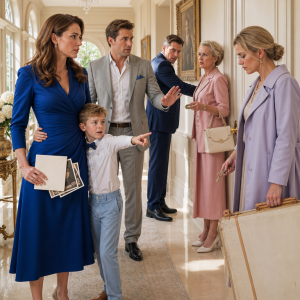
Inside, the living room smelled of lavender candles and furniture polish. Framed photographs covered the mantel: Grant at college, his sister at her wedding, his parents on vacation, and one silver-framed portrait of Wesley.
There was not a single photograph of me.
Dad noticed, though he said nothing.
After placing Wesley in the portable crib, he turned toward Elaine.
“Where is Brooke’s vehicle?”
“In the garage.”
Grant stared at his mother.
“You told me you needed it for errands.”
“I did.”
“All day?”
Elaine folded her arms.
“I don’t appreciate being questioned in my own home.”
Dad remained calm.
“Then I’ll make the question simple. Why was Brooke walking on an injured ankle with an infant while the car she pays for sat in your garage?”
Elaine gave a small, dismissive laugh.
“The vehicle belongs to Grant legally, and Brooke has become careless with money. They are living here because they cannot support themselves. Someone has to provide structure.”
My face grew warm.
“I use the car for groceries, medical appointments, and job interviews.”
“You also met a friend for lunch last Thursday.”
“It was her birthday.”
“And you bought coffee.”
“It cost three dollars.”
Dad turned to Grant.
“Do you believe your wife should require permission to leave the house?”
Grant opened his mouth, but no answer came.
His silence wounded me more than Elaine’s criticism.
Then, perhaps because Dad did not speak for me, I found my own voice.
“I sold most of our furniture when we moved here. I stopped working weekend events because Elaine said Wesley needed a stricter routine. I cook, clean, care for him, and write museum grant proposals during his naps. Meanwhile, I listen while your mother tells her friends I don’t understand sacrifice.”
Elaine’s eyes widened.
“I have never said that.”
“You said it yesterday. Grant was standing in the kitchen.”
I looked directly at my husband.
“You heard her.”
Color faded from his face.
“I did,” he admitted. “I should have stopped her.”
“Yes, you should have.”
The Truth No One Wanted to Say

Dad suggested that I sit and elevate my ankle. When he returned from the kitchen with ice wrapped in a towel, he handed it to Grant.
“Take care of your wife.”
Grant knelt before me and placed the compress gently against the swelling.
“I’m sorry,” he whispered.
I loved him enough to want to forgive him immediately, but quick forgiveness had allowed too many things to remain unchanged.
“I need more than an apology.”
“I know.”
Elaine watched us with open frustration.
“Daniel, surely a man with your background understands that a home needs discipline.”
Dad looked at her evenly.
“I understand that rules exist to protect people. They should never be used to make one adult dependent upon another adult’s approval.”
The door to the study opened, and Grant’s father, Walter, stepped into the hall. A retired pharmacist with thinning white hair and reading glasses hanging from his collar, he had spent months avoiding every disagreement by quietly leaving the room.
“What’s happening?”
“Brooke’s father came here to accuse me of taking something that belongs to my son,” Elaine said.
Grant stood.
“Dad, did you know Mom kept Brooke’s car today?”
Walter looked genuinely confused.
“I thought she took her own sedan.”
Elaine glanced away.
Walter’s shoulders sank.
“You left Brooke here without transportation?”
“I didn’t know she would walk.”
“How else was she supposed to bring home groceries?”
Elaine had no answer.
Walter looked at my ankle, then at the crib.
“You carried Wesley all that way?”
I nodded.
Shame passed over his face.
“Brooke, I am deeply sorry. I should have paid attention.”
Elaine turned toward him.
“Walter, please don’t encourage this.”
For once, he did not retreat.
“No, Elaine. This has gone too far.”
Wesley began to fuss, and when I tried to rise, pain traveled through my ankle. Grant reached the crib first, gathered our son into his arms, and murmured until he settled.
Elaine watched him with tenderness.
“I love that child,” she said.