“Can I still sit by the window?” she asked.
Emily’s expression softened.
“Of course you can. That seat is yours.”
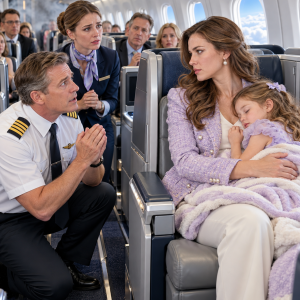
I helped Sophie settle back into 2A, placed Oliver beside her, and fastened her seat belt.
Captain Bennett returned briefly before departure to make sure we were comfortable, and when I thanked him for his assistance, he shook his head.
“Catherine, you don’t need to thank me. My crew should have a safe, respectful cabin for every passenger, regardless of who they are.”
I appreciated his words more than he probably realized.
Once he returned to the cockpit, Sophie leaned against my arm and stared out the window at the airport vehicles moving across the pavement.
For several minutes, neither of us spoke.
Then she asked a question that made my heart ache.
“Mommy, did that man think we were poor?”
I considered how to answer without making her feel that wealth was something shameful or that having money somehow made a person unkind.
“I think he made assumptions about us because of how we were dressed,” I explained. “And he decided those assumptions mattered more than being polite.”
She looked down at her pink cardigan.
“But I like my clothes.”
I smiled and smoothed a loose curl away from her forehead.
“I like them too. Especially those sneakers.”
She studied the tiny silver stars on her shoes.
“Then why was he so mean?”
There are questions children ask that adults can answer with facts, and there are others that require us to admit the world is not always as fair or gentle as we wish it were.
“Sometimes people forget that everybody has feelings,” I said. “And sometimes they think having more money makes them more important than other people. But that isn’t true.”
Sophie thought about that for a while.
“Is being a general important?”
I glanced toward the cockpit, where Bennett had recognized me so quickly, and wondered how much of the earlier conversation she had understood.
“It’s an important responsibility,” I answered. “But it doesn’t make me a better person than the woman serving us drinks, or the man loading our suitcases, or the people sitting in the back of the plane.”
She nodded slowly.
“So everybody matters?”
“Everybody matters, sweetheart.”
She rested her head against my shoulder.
“Even him?”
That question took me longer to answer.
“Yes,” I finally said. “Even him. But everybody also has to be responsible for the way they treat other people.”
Sophie seemed satisfied with that explanation, and as the aircraft began moving away from the gate, she opened her coloring book again.
I watched her choose a lavender crayon and begin filling in the wings of a butterfly.
The ordinary sound of wax moving across paper had never seemed so comforting.
What Happened After We Landed

The rest of our flight passed peacefully, although several passengers approached us after landing to express their concern.
An older woman who had been sitting across the aisle gently touched my arm.
“I raised three daughters,” she said. “I couldn’t stand watching him speak to your little girl that way. You handled yourself with remarkable patience.”
I thanked her, but I also told her that patience had not come easily.
“I wanted to say a great deal more than I did,” I admitted.
She smiled knowingly.
“That’s usually when saying less takes the most strength.”
Before leaving the aircraft, Emily provided me with the information needed to follow up on the incident, and I later submitted a written account to the airline. The crew had documented the disturbance, and the airport authorities had their own report.
I made clear that I did not want preferential treatment because of my rank, nor did I want anyone pressured into an outcome simply because I held a senior military position.
I wanted the same thing I would have wanted for any mother traveling with a child: a fair review of what had happened and reasonable steps to prevent it from happening again.
Several days later, an airline representative contacted me to confirm that Caldwell’s behavior had been reviewed and that appropriate restrictions had been placed on his future travel with the carrier.
I was relieved, although I had already decided that whatever happened to him afterward was less important than helping Sophie feel comfortable traveling again.
During our visit to Colorado, she spent long afternoons making pancakes with her aunt, chasing her cousins around the backyard, and collecting smooth stones beside a nearby creek.
By the third day, she was laughing as freely as she always had, and I began to hope that the memory of the airplane would gradually become a small, unpleasant moment rather than something that stayed with her.
Then, on our last evening, while we were packing our bags for the journey home, Sophie climbed onto the bed beside me.
“Mommy, can I ask you something?”
“Always.”
She held Oliver against her chest.
“If you weren’t a general, would the captain still have helped us?”
I looked at her, surprised by how carefully she had been thinking about everything that happened.
“He should have,” I answered. “And I believe he would have, once he understood what that man had done.”
She frowned slightly.
“But he knew you.”
“Yes, he did.”
I drew her closer.
“And that’s why we have to remember something important. We should never depend on being famous, wealthy, or powerful to be treated fairly. We should expect people to do what’s right because it’s right.”
She was quiet for a moment.
Then she asked, “When I grow up, can I be brave like you?”
I kissed the top of her head.
“You already are, sweetheart. Being brave doesn’t mean you never get scared. Sometimes it means telling the truth even when your voice is shaking.”
She smiled and wrapped her arms around my neck.
The Lesson I Carried Home
I have worn four stars on my shoulders, stood before rooms filled with senior officials, and made decisions that demanded years of preparation and discipline, but the moment that has stayed with me most from that afternoon was not when an old colleague recognized me.
It was when my daughter, still trembling, looked into my eyes and asked whether she had done something wrong.
I realized then that children learn far more from the way adults behave in difficult moments than from the advice we give them afterward, and that my responsibility as her mother was not simply to protect her from unkindness, but to show her that dignity can remain intact even when someone tries to take it away.
I never wanted Sophie to believe that my rank made her more deserving of kindness than another little girl traveling with a mother who worked two jobs, wore secondhand clothes, or had saved for years to buy a special ticket.
Nor did I want her to believe that standing up for herself required becoming cruel in return.
There is a difference between humility and allowing someone to mistreat you, just as there is a difference between authority and the need to prove you possess it.
I had spent most of my adult life learning those distinctions, but that afternoon, seated in an airplane with my frightened daughter in my arms, they became more personal than ever before.
A few weeks later, Sophie brought home a drawing from school. It showed an airplane floating beneath a bright yellow sun, with two smiling figures visible through one of the windows.
Above them, in the uneven handwriting of a second grader, she had written, Everyone Deserves A Good Seat.
I laughed when I saw it, then asked her what she meant.
“It means nobody should have to move just because somebody thinks they’re better,” she explained.
I placed that drawing in a frame on my desk, beside photographs from my years of military service, and I still look at it whenever the demands of my work begin to feel overwhelming.
The people who visit my office sometimes notice the photographs of ceremonies and official gatherings, but the little airplane drawing usually attracts the most questions.
And whenever someone asks about it, I tell them that my daughter taught me something important on a flight to Colorado.
Four stars may command a salute, and a great fortune may purchase a comfortable seat, but neither can purchase character.
That is something we reveal in the way we treat people who have absolutely nothing to offer us in return.
And if there is one lesson I hope my daughter carries into adulthood, it is that a person’s worth is never determined by the seat they occupy, the clothes they wear, or the title attached to their name, but by the kindness and dignity they extend to others.