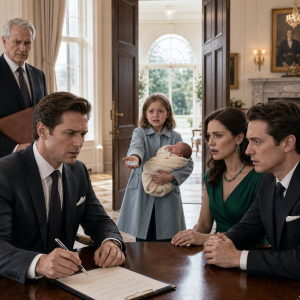
The older one cleared his throat. “Sir, we apologize. It was a misunderstanding.”
David looked at him sharply. “A misunderstanding is when you forget an appointment. This was an assumption built on prejudice. You humiliated a young girl in front of a crowd without evidence.”
The manager stammered. “We will make this right, Mr. Carter. We can offer compensation.”
David shook his head. “You cannot buy back dignity. You can only learn from what you did.”
Ariana stood beside her father, trying to stay composed. For a moment she felt both fragile and strong. The people who had whispered earlier now stared with guilt in their eyes.
That evening a video of the incident spread online. The clip showed the officers shouting, Ariana’s frightened face, and David’s calm defense. Within hours, the story exploded across social media under the hashtag #StandWithAriana. Thousands of people demanded accountability.
At home, Ariana sat on the couch, her father beside her. The glow from her phone reflected in her eyes.
“I am sorry you had to experience that,” David said softly. “You did nothing wrong.”
Ariana whispered, “I just wanted them to see me for who I am, not for what I look like.”
The next morning reporters waited outside their house. At first David refused to speak, but when online rumors began to twist the story, he decided to set the record straight. Standing beside his daughter, he told the cameras, “This is not only about Ariana. It is about how easily bias replaces truth when judgment comes before facts.”
The two officers were placed on administrative leave while the department reviewed the case. The police chief promised anti-bias training for the entire force.
When Ariana returned to school, whispers followed her again. Some students hugged her. Others avoided eye contact. During English class, her teacher asked gently if she wanted to talk about what happened.
Ariana nodded. “I was scared that day,” she said. “But what scared me more was that no one questioned what they saw. People believed an accusation before they looked for the truth. That is how injustice begins.”
Her words were later quoted in local news articles and shared widely online. Invitations arrived for her and her father to speak at community events. David hesitated at first, not wanting his daughter to relive the pain, but Ariana said, “If we do not talk about it, nothing will change.”
Months later, Ariana stood on a stage at a youth conference. The auditorium was filled with students, teachers, and police officers. She held the microphone tightly but spoke with confidence.
“I used to think staying quiet was safer,” she said. “But silence protects the problem. Speaking up gives others courage to do the same. I was afraid that day in the mall, but fear does not have to end a story. It can start a better one.”
Applause erupted. Among the crowd was the police chief who had promised reform. After the speech he approached her and said, “Thank you for your courage. You reminded us that authority means nothing without accountability.”
Ariana smiled politely. “I just wanted to be treated fairly.”
When she stepped off the stage, her father was waiting for her at the bottom of the steps. He hugged her tightly. For the first time since that awful day, Ariana felt the weight of shame and fear lift from her shoulders.
That night she looked out the window at the city lights and realized that something good had grown from the pain. People were finally listening.
If you had been there that day, would you have spoken up? Silence is not always neutral. Sometimes it stands on the wrong side of truth.