I remembered that phone call.
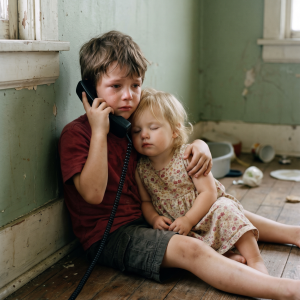
I’d been at a truck stop in Georgia, trying to get back on the highway before traffic got worse.
“You said maybe next summer,” Kaylee continued. “I was trying to tell you I was already sleeping in it.”
I pressed my hands together beneath the table.
“I didn’t understand.”
“I know.”
She reached into her backpack and removed a blue notebook.
It was the same notebook I’d bought her for algebra at the beginning of the school year.
Inside, she’d written dates and short descriptions of what happened.
November 29 — Melissa said I couldn’t use my room anymore.
December 3 — Heater stopped working.
December 8 — Dad called. Melissa stayed next to me.
December 12 — Travis moved the rest of my things into the garage.
The entries continued through December.
Between the pages were photographs she’d printed at school. They showed the camper, the extension cord, and her former bedroom filled with exercise equipment.
“I started writing things down because Melissa kept saying I remembered everything wrong,” Kaylee explained.
Melissa scoffed.
“Teenagers exaggerate. You all know that.”
I looked at the notebook.
“These are dates and photographs, Melissa. Not exaggerations.”
“She’s been collecting things to use against me.”
“Because she was afraid nobody would believe her,” Rachel replied.
Kaylee began crying.
I put my arm around her shoulders.
“I believe you,” I said.
She leaned against me.
I wished I’d said those words weeks earlier.
The Decision Melissa Didn’t Expect
Melissa tried to turn the conversation back to the residential program.
“You don’t understand what she’s like when you’re gone,” she insisted. “She’s difficult, Wade. She challenges everything I say. I’ve spent months trying to help her.”
“By taking away her bedroom?”
“By teaching her responsibility.”
“And the heater?”
Melissa looked toward Travis.
“I wasn’t trying to hurt her. I wanted her to take the situation seriously.”
“She was cold enough to sleep in two coats.”
“She could’ve apologized.”
I stared at her.
That was the moment I stopped looking for an explanation that might make her actions understandable.
She wasn’t denying that Kaylee had suffered. She was arguing that the suffering had been justified.
I picked up the folder she’d given me that morning.
“I’m not signing these papers.”
Melissa’s expression changed.
“Wade, don’t be ridiculous. You can’t make that decision because of one argument.”
“This isn’t one argument.”
“You’re choosing her over your wife.”
I looked at Kaylee, who was sitting with her hands folded tightly in her lap.
“She’s my daughter.”
Melissa pushed back her chair.
“And I’m your wife. I’m the one who’s been here taking care of everything while you’re off driving around the country.”
“I trusted you to care for her.”
“I did care for her!”
“Then why was she sleeping in a camper while your brother used her bedroom?”
She had no answer that didn’t return to the same accusation: Kaylee hadn’t obeyed her.
I told Rachel I wanted to contact the appropriate authorities and get advice about protecting my daughter. I also wanted Kaylee examined by a medical professional, given the cold exposure and the weight she’d lost.
Melissa shook her head.
“You’re making a huge mistake.”
“Maybe,” I said. “But I already made a bigger one by ignoring what my daughter was trying to tell me.”
Rachel helped Kaylee gather her belongings.
Emily’s parents stayed with her while I documented the camper and preserved the notebook, photographs, and the original recording Rachel had made.
I didn’t try to resolve everything that night.
There were legal questions about the house and my marriage, and I wanted professional guidance before taking steps I might regret.
But one thing was settled.
Kaylee would not spend another night outside.
What It Meant to Come Home
The following weeks were difficult.
There were interviews, appointments, and conversations with professionals who needed to understand what had happened. Kaylee was tired of repeating herself, and I tried to make sure she had support throughout the process.
I also began speaking with an attorney about separating from Melissa.
She continued insisting that she’d only been trying to discipline a difficult teenager.
Sometimes she blamed Travis for encouraging the bedroom changes. Other times she accused Kaylee of manipulating me because she’d never accepted having a stepmother.
But I had seen the camper.
I’d seen the unplugged heater, the missing bed, and the notebook my daughter had kept because she didn’t trust anyone to remember what happened.
I couldn’t pretend those things were normal family disagreements.
With legal guidance, we worked through the arrangements necessary for Melissa and Travis to leave the house. The official process continued separately, and I understood that there wouldn’t be an instant resolution.
During that time, Kaylee stayed close to Rachel and her grandparents.
I began making changes to my work schedule.
For years, I’d taken the longest routes because they paid better. I thought every extra dollar meant I was giving Kaylee a better future.
Now I asked my dispatcher whether I could move to shorter regional routes.
It meant less money.
It also meant I could be home more often.
“You don’t have to quit driving because of me,” Kaylee said when I told her.
“I’m not quitting. I’m changing how I do it.”
“But you like your job.”
“I do. I also like being your dad.”
She smiled a little.
It wasn’t enough to tell her things would be different. I needed to make those differences visible.
Rachel helped me arrange reliable support for the days I still had to work. Kaylee would have several adults she trusted and could contact directly, without needing permission from anyone else.
I also met with her school counselor to discuss how we could help her feel comfortable returning to her normal routine.
Some evenings, she wanted to talk about what happened.
Other evenings, she wanted to watch television without discussing anything serious.
I learned not to force either one.
The Bedroom by the Window
After Melissa and Travis left, we began restoring Kaylee’s room.
The treadmill was the first thing to go. Then the weight bench, the enormous mirror, and the shelves Travis had installed for his equipment.
Beneath everything, we found scratches in the floor where Kaylee’s old bed had stood.
She watched from the doorway as Rachel and I moved the last boxes.
“Do you want to repaint?” I asked.
She looked around.
“Maybe. But can we put my bed back first?”
“Of course.”
We brought it in from the garage, cleaned the frame, and placed it beside the window where it had always been.
Kaylee found a box of photographs among her belongings.
One showed Emily teaching her to throw a softball in our backyard.
She held it for a long time.
“I thought Melissa threw this away.”
“I’m glad she didn’t.”
Kaylee placed the photograph on her bedside table.
Then she looked at me.
“Dad, can I ask you something?”
“Anything.”
“If I tell you something’s wrong again, will you listen before you decide I’m being dramatic?”
I sat on the edge of her bed.
There wasn’t an answer that could erase the previous five weeks.
“Yes,” I said. “And if I don’t understand, I’ll keep asking until I do.”
She nodded.
“Okay.”
That was all she said.
But later that evening, she left her bedroom door open while she did homework.
It was a small change.
I noticed.
Sixteen Candles, One More Time
A few weeks later, Kaylee asked whether we could have another birthday dinner.
The original strawberry cake had gone uneaten. We’d thrown it away after everything happened.
“I don’t need a big party,” she told me. “Just Aunt Rachel, Grandma, Grandpa, and maybe two friends.”
I bought another strawberry cake.
We put sixteen candles on it, even though her birthday had already passed.
This time, there were no arguments, no tense glances toward the garage, and no adults trying to convince her that her feelings were wrong.
Her grandfather told embarrassing stories about her first softball game. Rachel brought a photo album, and Kaylee laughed so hard at one picture that she nearly knocked over her lemonade.
When it was time to blow out the candles, she looked at me.
“Dad?”
“Yeah?”
“Can I tell you what I wished for last year?”
“Sure.”
“I wished Mom was still here.”
I swallowed.
“I know, sweetheart. I wish that too.”
She looked down at the cake.
“This year, I just want things to stay okay.”
I put my hand over hers.
“I’m going to work hard to make sure they do.”
She studied my face for a moment, then nodded and blew out the candles.
Later that night, I walked down the hallway to check on her.
Her bedroom door was partly open. The heater was running, her softball trophies stood on the shelf, and Emily’s photograph rested beside the bed.
Kaylee was already under the covers.
“Everything okay?” I asked.
She looked up.
“Yeah, Dad.”
I hesitated.
She must have understood what I was thinking, because she smiled.
“Really. I’m okay.”
I turned off the hallway light and went back to the living room.
The old baby monitor was sitting in a box on the coffee table, beside the notebook and photographs we’d preserved.
For weeks, that little device had been the only way my daughter felt she could prove what was happening to her.
I closed the box and placed it on the shelf where we kept our important family records.
Then I returned to the hallway and listened for a moment.
There was no frightened whisper coming from the camper, no heater cord trailing across the yard, and no little girl waiting for someone to believe her.
Just the quiet sound of my daughter sleeping safely in her own room.