She looked at me.
“I know that now. But I didn’t know it when I was living there.”
We sat together quietly.
Then she asked something I hadn’t expected.
“Mom, why didn’t I leave sooner?”
I wanted to give her a simple answer.
Instead, I said, “I don’t know, sweetheart. But you don’t have to figure that out today.”
She rested her head against my shoulder.
“I don’t want him anywhere near the baby.”
“Then we’ll talk to Patricia about what protections are available.”
Chloe looked down at the blanket.
“I want to make those decisions myself.”
“You will,” I promised.
And this time, I understood how important that promise was.
The Case Against the Harringtons
The criminal proceedings took months.
Garrett and Evelyn hired experienced defense attorneys, who challenged the evidence and disputed parts of Chloe’s account. Their lawyers argued that the prosecution had misunderstood what happened inside the house.
But the evidence told a different story.
Chloe’s medical records, her statements, the forensic findings, and the available video footage were presented together. The prosecution also highlighted inconsistencies between Garrett’s initial explanation and the movements of the family vehicle.
I attended the hearings I could manage, sitting beside Chloe whenever her health allowed her to be there.
The hardest day came when she testified.
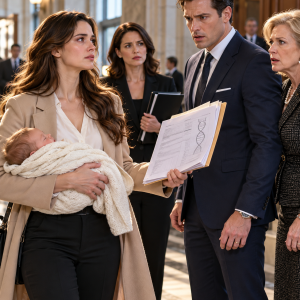
She wore a navy cardigan and carried the yellow baby blanket folded inside her purse.
When the prosecutor asked why she’d stayed with Garrett, she took a long breath.
“Because every time I tried to leave, he convinced me things would be different. And because his mother kept telling me I was lucky he put up with me.”
“What happened on the night of the assault?”
Chloe’s hands tightened around the edge of the witness stand.
She described the argument, the attack, and the terror she’d felt for her baby.
She didn’t raise her voice.
She didn’t exaggerate.
When she finished, the courtroom remained quiet.
I looked at Garrett.
He was staring at the table.
For three years, he’d had the advantage of speaking over Chloe whenever she tried to explain herself.
Now he had to sit still and listen.
The jury ultimately found both Garrett and Evelyn guilty of serious felony offenses. At sentencing, the judge considered the gravity of the attack, the medical evidence, and the harm Chloe had suffered.
Garrett received a lengthy prison sentence. Evelyn also received a substantial prison term for her participation.
I don’t remember every word the judge said.
I remember Chloe’s hand finding mine.
And I remember that, for the first time since the morning at the bus stop, she didn’t seem afraid to look directly at her husband.
What Money Couldn’t Fix
After the criminal case, Chloe decided to pursue civil claims.
Patricia Vance helped her seek compensation for medical expenses, lost income, future care needs, and other damages arising from the assault.
The Harringtons fought the lawsuit.
They had significant resources, but their wealth didn’t make the evidence disappear. After prolonged negotiations, Chloe reached a substantial settlement, funded through a combination of available assets and other agreed arrangements.
The settlement couldn’t restore everything she’d lost.
Her left leg remained weak, and she sometimes needed a cane. She continued attending medical appointments and rehabilitation sessions.
But it gave her financial security and control over her future.
One evening, while we were reviewing paperwork at my kitchen table, she surprised me.
“Mom, I’ve been thinking about nursing school again.”
I looked up.
“Really?”
“I know it’ll take longer than I planned. And I might have to start part-time.”
“There’s no deadline, sweetheart.”
She smiled.
“I know. That’s the nice part.”
Then she showed me a folder she’d been keeping.
Inside were nursing program brochures, application notes, and information about local organizations supporting survivors of domestic violence.
“I want to do something useful with part of the settlement,” she said.
“What did you have in mind?”
“A shelter. Or a fund that helps women get somewhere safe when they need to leave.”
I studied her face.
“That’s a big undertaking.”
“I know. I’ve been talking to people who actually run these programs. I don’t want to start something without understanding what it takes.”
I smiled.
“That sounds like my daughter.”
She laughed.
“The daughter who used to organize her crayons by color?”
“The very same.”
One Year Later
The following autumn, I was sitting on my front porch when a blue sedan pulled into the driveway.
Chloe stepped out carefully, using a black cane.
Her son, Oliver, was seven months old, healthy, and sleeping peacefully in a baby carrier.
She walked toward me with a thick white envelope in her hand.
“Mom, it came!”
I stood.
“What came?”
She held up the envelope.
“My acceptance letter. I got into the nursing program!”
I hugged her carefully, trying not to disturb Oliver.
“Oh, sweetheart. That’s wonderful.”
“I start in January. Just a couple of classes at first, but it’s a start.”
“I’m proud of you.”
She smiled.
“I know you are.”
We settled onto the porch swing. Oliver stirred briefly, then fell asleep again against his mother’s chest.
Chloe told me she’d also been working with a local nonprofit to establish a fund for women escaping abusive homes.
They’d decided to call it Hope Haven.
“We’re starting small,” she explained. “Emergency hotel rooms, transportation, basic supplies, and help connecting people with legal services. Eventually, I’d love to support a permanent shelter.”
“That sounds wonderful.”
She looked down at Oliver.
“I keep thinking about how many women don’t have somewhere safe to go. I had you. Not everyone does.”
I reached over and squeezed her hand.
For a while, we watched the leaves drift across the yard.
Then Chloe asked, “Mom, can I ask you something?”
“Of course.”
“Do you ever think about what you wanted to do to Garrett and Evelyn?”
She knew about the mansion.
I’d told her the truth after she was well enough to hear it, including the police report I’d made about my own actions.
I hadn’t wanted her to discover it from someone else.
“Sometimes,” I admitted.
“Does it scare you?”
I looked toward the driveway.
“Yes. I was so angry that I nearly made a decision that would’ve taken me away from you when you needed me most.”
Chloe was quiet.
Then she said, “I’m glad you came back.”
I looked at her.
“So am I.”
Oliver woke and began fussing softly. Chloe lifted him from the carrier, settled him against her shoulder, and kissed his forehead.
“He’s hungry,” she said with a laugh. “Somebody’s going to have to interrupt this serious conversation.”
I stood and opened the front door.
“Come inside. I made lunch.”
Chloe followed me into the kitchen, Oliver resting safely in her arms.
The yellow blanket I’d bought before his birth was folded over the back of the rocking chair.
She picked it up and wrapped it gently around him.
A year earlier, I’d sat beside a hospital bed wondering whether I’d ever hear my daughter laugh again.
Now she was standing in my kitchen, teasing me about how much food I’d prepared.
“Mom, there are only two of us eating. Did you cook for the whole neighborhood?”
“I made extra so you can take some home.”
“You always do.”
I set the plates on the table while Chloe settled Oliver into his infant seat beside us.
Outside, the autumn wind carried a few golden leaves across the porch.
Inside, my daughter unfolded her nursing-school acceptance letter one more time and laid it beside her plate.
Then she reached for her fork.
“Okay, Mom,” she said, smiling. “Tell me everything I’ve missed this week.”
I sat down across from her, with Oliver sleeping between us and the afternoon sunlight warming the table.
And I began.