Margaret started dropping by unexpectedly.
Grant told Lucy’s friends that she was “going through something.”
By the time Lucy understood what they were doing, several people around her had already been told not to believe her.
“Tonight I told Grant I was going to an attorney in the morning,” she said.
Her fingers tightened around mine.
“That’s when he hit me.”
Ruiz stopped writing.
“Once?”
Lucy looked at the floor.
“No.”
My grip tightened around the arm of the chair.
I wanted to get up.
I wanted to walk into the hallway.
Instead, I stayed where I was because Lucy needed one person in that room who didn’t turn her pain into another scene.
She continued.
Grant took her phone. Margaret arrived twenty minutes later with Dr. Keller. Lucy remembered being given something “to calm down.” When she woke more fully, she was in the hospital and they were arranging the transfer.
“I heard Margaret tell Grant that once I was admitted, they’d have time to find the files.”
Ruiz pointed toward the locket.
“And those are the files?”
“Some of them.”
“Where are the rest?”
For the first time that night, Lucy almost smiled.
“Somewhere they can’t reach.”
Ruiz asked if she could examine the card.
Lucy nodded.
The first file wasn’t financial.
It was audio.
The recording began with Lucy’s voice.
“I found the transfers, Grant.”
There was a pause, then a man’s voice.
“You went through accounts you weren’t authorized to access.”
“They’re my accounts to review. That’s my job.”
“You don’t understand what you’re looking at.”
“Then explain why Northstar Consulting received $840,000 and has no employees.”
Another voice entered.
Margaret.
Calm. Irritated.
“Give me the phone.”
“No.”
There was a scuffle, then Grant again.
“Lucy, stop making this worse.”
“You hit me.”
“Because you wouldn’t stop.”
No one in the examination room moved.
Then Margaret said the sentence that changed everything.
“Keller will sign what we need. Once she’s admitted, nobody is going to take financial accusations from her seriously.”
The recording ended twelve seconds later.
I looked at Lucy.
She wasn’t watching me.
She was watching the broken locket in her palm.
Outside the room, Margaret was still telling someone that her family was only trying to help.

PART 2 — WHAT THE LOCKET ACTUALLY HELD
By sunrise, Grant was no longer allowed near Lucy.
The hospital placed a security restriction on her room while police documented the injuries and questioned staff about the attempted transfer. Dr. Keller couldn’t be reached. Margaret left shortly after four in the morning with Evan, but not before telling me quietly in the hallway that I was destroying Lucy’s marriage over “a misunderstanding.”
“She’s frightened and confused,” Margaret said. “When this is over, she’ll have to live with what she’s done.”
“So will everyone else.”
She studied my face.
“You always did think being in the Army made you impossible to intimidate.”
“No. It taught me that people who keep talking about their power usually want you to forget to look at the paperwork.”
That was the last conversation we had for nearly five months.
The investigation moved much more slowly than television would have made it seem. There were no dramatic raids before breakfast, no handcuffs in the emergency room and no instant collapse of the Whitmore family.
There were interviews.
Subpoenas.
Account records.
Lawyers.
A temporary protective order.
Then a divorce filing.
Lucy moved into my guest room for six weeks because she couldn’t sleep alone. Some nights I heard her checking the locks at two in the morning. Other nights I found her at the kitchen table with the silver locket beside a cup of tea, going through spreadsheets she’d already reviewed ten times.
She refused to replace the broken chain.
“I like knowing where it broke,” she told me.
The financial investigation eventually confirmed that several questionable vendors had received millions from Whitmore Medical Systems. Two were linked indirectly to Evan. Another had been created by a longtime associate of Grant’s.
But the company’s attorneys attacked the evidence Lucy had copied.
They argued that some records were incomplete.
They disputed her authority to retain internal documents.
Most importantly, they claimed she had misinterpreted transactions approved by senior management.
That argument led back to one man.
Arthur Whitmore.
Margaret’s father-in-law.
Grant’s grandfather.
Founder of Whitmore Medical Systems.
Arthur was eighty-seven and had not appeared publicly in almost a year. According to Margaret, his health had deteriorated so badly that he no longer participated in corporate decisions.
That mattered because several disputed transactions had been entered under authorization codes associated with his office.
If Arthur had approved them, the defense could argue they were legitimate.
If he hadn’t, someone had been using his authority.
The answer seemed simple.
Ask Arthur.
Except Margaret’s attorneys produced medical documentation stating that Arthur suffered from significant cognitive impairment and could not reliably answer questions about corporate decisions.
When Lucy read the filing at my kitchen table, she became very still.
“That’s not true.”
I looked up from my coffee.
“How do you know?”
She touched the locket.
For months, I had assumed the locket mattered because of the memory card.
That wasn’t the whole story.
Lucy told me that Arthur had given her the modified backing.
Six months before the hospital incident, she’d visited him at his home in Virginia after discovering the first suspicious vendors. She hadn’t gone there expecting help. She only wanted to know whether his office had actually approved several unusual payments.
Arthur had listened.
Then he’d asked her one question.
“Who knows you’re checking?”
When Lucy said nobody, he told her to keep it that way.
He was the one who suggested she preserve copies.
He was the one who gave her the tiny encrypted card.
And he was the one who told her not to trust the company’s internal reporting system until they knew how far the problem went.
“Why didn’t you tell the investigators?” I asked.
“I did. They tried contacting him.”
“And?”
She pushed the court filing toward me.
“Margaret’s attorneys said he couldn’t communicate reliably.”
I read the physician’s name at the bottom.
Dr. Samuel Keller.
The same doctor who had signed the paperwork used to justify transferring Lucy.
That was the moment the story changed.
The false psychiatric paperwork wasn’t just about discrediting Lucy.
The same doctor had also been involved in declaring Arthur incapable.
Detective Ruiz referred the information to the investigators handling the financial case. Arthur’s attorneys were contacted separately rather than through Margaret.
Five days later, Arthur underwent independent neurological evaluations.
And three weeks after that, we sat in a federal courtroom while Margaret’s attorney argued that Lucy’s evidence should be treated with extreme caution because the company’s senior leadership could not authenticate several of the disputed records.
Grant sat behind him.
He looked healthier than he had in the hospital hallway. Expensive navy suit. Fresh haircut. No bruised knuckles.
For months he’d been telling mutual friends that his marriage had collapsed because Lucy became paranoid about work.
Some believed him.
Some didn’t.
Lucy had stopped asking which ones.
She wore a dark blue suit and the old silver locket on a plain black cord.
Margaret noticed it almost immediately.
Her gaze stayed on it for several seconds.
Then she looked away.
Her attorney began explaining Arthur’s supposed condition.
“Mr. Whitmore has unfortunately experienced substantial cognitive decline. He has not actively managed the company for nearly a year, and we believe attempts to attribute specific authorization decisions to him are inherently unreliable.”
The judge looked over the medical filing.
“And Dr. Keller performed the relevant evaluation?”
“Yes, Your Honor.”
Beside me, Lucy’s hand closed around the locket.
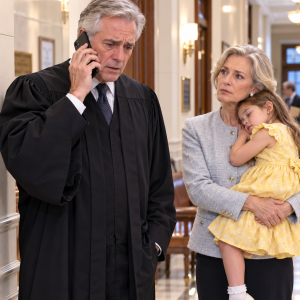
The courtroom doors opened.
An elderly man walked in with a black cane.
I had met Arthur only twice before. The first time was at Lucy’s wedding. The second was at a Christmas dinner where he spent most of the evening arguing with Grant about whether a seventy-dollar bottle of wine was actually better than a twenty-dollar one.