I watched June sleeping, one hand open beside her cheek. “I’m willing to talk, but I need you to understand what that means.”
“I do.”
“If someone insults me, I need you to speak up. I’m not asking you to choose sides in every disagreement, but I won’t sit quietly while you help them make me smaller.”
“You’re right.”
“You can’t carry messages from Mom or Dad, and you can’t use June to try to bring everyone together before I’m ready.”
“I won’t.”
“If you say you understand, I need you to show me over time.”
“I will.”
I didn’t tell her that everything was forgiven. I didn’t promise we would return to the way things had been. We talked for twenty minutes, and when we hung up, I felt neither relieved nor triumphant. I simply felt that one honest conversation had taken place.
That was enough for one day.
A Different Kind of Service
Several months later, my unit reassigned me to a broader leadership role in a joint cyber command. The work expanded, and the public announcement of my promotion appeared in military channels. Colleagues and senior officers sent congratulations. Some of them had worked beside me during long nights when our decisions mattered to people far beyond our office walls.
My family stayed quiet.
I did not chase their approval. I had spent too much of my life mistaking their understanding for proof that my work mattered.
June grew quickly. She began to smile when Elias leaned over her crib, and she liked the sound of my voice when I read to her. The first time she wrapped her fingers around mine, I understood how much of my old life had been built around being useful to people who were not careful with me.
I still cared about my family. That did not mean I had to give them immediate access to my home, my child, or my peace.
Paige kept her word. She did not ask me to make everything easier for our parents. She did not pass along private messages. When my mother once tried to steer a conversation toward the reception, Paige told her she would not help turn it into a story about my attitude. The news reached me only because Paige mentioned it herself, without asking for praise.
I was grateful. I was also cautious. Trust, I learned, is built in ordinary moments, not dramatic ones.
Then I was called to Washington to brief a congressional committee on cyber threats affecting military readiness. It was not the kind of assignment I had ever imagined discussing with my father, but it was a responsibility I took seriously. I would be speaking to elected officials, military leaders, and staff members who needed clear answers about complicated systems.
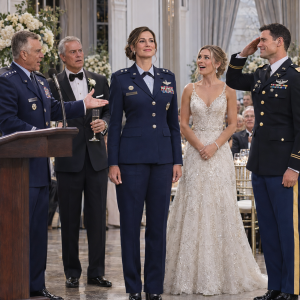
The morning of the hearing, I stood in a quiet room near the briefing hall and checked my notes. My Army service uniform was pressed, my insignia straight, and my voice steady when I rehearsed the opening.
When I entered the hall, the room was already full. Senior officers sat in the front rows. Staff members arranged folders and microphones. I took my place at the podium and began.
As I looked across the audience, my eyes moved toward the civilian gallery.
My parents were seated in the second row.
They wore visitor badges and sat very still. My mother held her purse with both hands. My father stared at the silver oak leaf on my collar. For a brief moment, I felt the old instinct to make things comfortable for him—to explain what he was seeing, to offer him a smile, to let him know that it was all right.
Then I remembered that I had not made it all right. I had simply kept going.
I turned back toward the committee and delivered the briefing.
The Last Conversation

The questions continued for nearly an hour. I answered what I could, kept the discussion within the limits of what could be shared, and explained the importance of protecting the systems people relied on in the field. I did not look toward the gallery again until the hearing had ended.
Afterward, I gathered my notes and folders near a side exit. The room gradually emptied, with the scrape of chairs and low voices drifting down the hall. I heard my father’s careful steps before I saw him.
He stopped a few feet away.
For a moment, neither of us spoke. He looked older than he had at the reception. His shoulders were not as square, and the certainty that had once filled his voice seemed to have left him.
“You were good up there,” he said at last.
“Thank you.”
He glanced back toward the chamber. “Your mother and I didn’t know you were doing all that.”
I kept my hands on the folders. “I know.”
He swallowed. “I wish you’d told us.”
There it was: an opening that could have become an apology, or a request, or another explanation of what he had meant to say years ago. I waited, but he did not add anything.
I had spent a long time wishing he would understand that his not knowing had not been my failure. He had never asked. I had tried more than once to tell him what mattered to me, and each time he had turned the conversation toward someone else’s accomplishments.
“You could have asked,” I said.
He looked down at the floor.
“I thought I knew what you did.”
“You knew what you decided I did.”
He pressed his lips together, absorbing the difference. I did not say it to hurt him. I said it because I was tired of softening the truth until it disappeared.
“I’m sorry,” he said.
It was the first time I had heard those words from him without an explanation attached. I let them sit between us.
“I hear you,” I said. “But I’m not ready to pretend the past didn’t happen.”
His eyes lifted to mine. He nodded once, slowly.
“I understand.”
I wasn’t certain he did. Perhaps he was beginning to.
I picked up my briefcase. My father stepped aside, leaving a clear path toward the corridor. For years, he had expected me to move around his expectations. Now he was the one who made room.
I walked past him and continued down the hall.
Outside, the November air was crisp. Elias’s car waited near the curb. He stepped out when he saw me, and the moment his eyes met mine, I felt the day loosen its hold on my shoulders.
June was awake in the back seat, making small sounds and reaching toward the window. I leaned in and touched her cheek.
“Hi, sweetheart,” I whispered.
Elias opened the door for me.
“How did it go?”
I looked once toward the entrance of the building, then back at my daughter.
“I said what I needed to say.”
As we drove away, I thought about the years I had spent hoping my family would recognize me. I still wished things had been different. But I no longer believed their recognition was the price of my own worth.
Sometimes respect arrives as a salute in a crowded room. Sometimes it begins with a sister’s honest letter or a father’s unfinished apology. And sometimes the most important thing you can do is return to the people who have loved you steadily, hold your child close, and build a life in which you do not have to earn your place at the table.