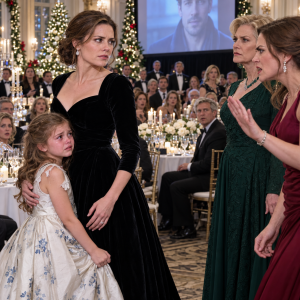
“The first time was at Douglas’s fortieth birthday. The second was outside your church three winters ago.”
Margaret remembered that Sunday: snow caught in the bare branches, a dark car across the street, and the strange feeling that someone had been watching as she carried poinsettias to the fellowship hall. For years, she had dismissed the memory as wishful thinking. Now she understood that Nathaniel had been less than a hundred feet away while she locked the church door and drove home alone.
Margaret struck his cheek with an open hand. Nathaniel did not move.
“You let me stand beside that empty box.”
“I know.”
“You let me wake up alone.”
“I know.”
“And now you arrive with a leather case as though papers can return twelve years to me?”
“They can’t,” he said quietly. “Nothing excuses what I chose.”
The simplicity of his answer left her with nowhere to send her anger. She turned toward the lake, now smooth and innocent beneath the late-afternoon light.
“I spent those twelve years afraid,” she said. “Afraid Douglas would stop visiting, afraid Cynthia would keep my grandchildren away, afraid that defending myself would make all of you call me difficult. So I cooked, smiled, paid tuition, covered mortgage bills, and pretended your jokes didn’t hurt.”
She faced her family.
“But when I needed one hand, not one of you reached for me.”
The words carried more than the lake. They held twelve years of birthday checks accepted without gratitude, holidays rearranged around Cynthia’s preferences, and Sunday telephone calls Douglas ended whenever Margaret asked him to visit. They held every moment in which she had mistaken being useful for being loved.
Even Deputy Holt looked away.
The Papers in the Leather Case

Douglas stepped closer, softening his voice in the way he always did before asking for something.
“Mom, Tyler made a foolish mistake. You’re not going to ruin his future over one prank.”
“You stood there smiling.”
“He didn’t mean for anything serious to happen.”
Margaret looked at Tyler.
“Did you?”
For the first time, he looked like a frightened teenager rather than a confident young man.
“I thought you’d grab the dock.”
“You knew I couldn’t swim.”
“I didn’t think. I don’t know.”
“That may be the first honest thing anyone has said today.”
As a paramedic wrapped Margaret in a thermal blanket, she told Deputy Holt that Cynthia had recorded everything. Cynthia clutched her phone, but Tyler muttered:
“Mom, erase it.”
The deputy heard him.
“Do not alter or remove that recording.”
Nathaniel then opened his case and removed a folder containing copies of Margaret’s earlier estate documents, recent loan records, property filings, and pages of unfamiliar transactions. Her signature appeared again and again, close enough to deceive a stranger but wrong in ways she recognized instantly.
One document listed a line of credit secured against her house in town. Another showed money withdrawn from an investment account Nathaniel had established during the first years of their marriage. There were payments to a luxury vehicle dealer, a private travel company, and a consulting business whose address matched a mailbox rented by Douglas. Margaret turned the pages slowly, remembering every time her son had offered to “simplify” her bills or take documents to the bank on her behalf.
Six months earlier, Douglas had brought her a stack of forms and placed yellow tabs beside several signature lines. He claimed they merely allowed him to speak to utility companies if she became ill. Margaret had signed two pages before noticing that the third referred to property authority, and when she asked about it, he laughed, tore the packet in half, and accused her of no longer trusting her own child. She had spent the rest of that evening feeling ashamed. Now she wondered whether the discarded pages had been replacements and whether the originals had already been carried away.
“How much?” she asked.
“Just under eight hundred thousand dollars,” Nathaniel said.
Douglas interrupted.
“Those papers could be fake.”
Nathaniel ignored him. Six months earlier, someone had contacted the accounting partnership where he once worked, asking for archived records related to Margaret’s estate. Then, the previous day, an authorization had been filed to place the lake house in a private trust controlled by Douglas and Cynthia.
“You tried to take my house?” Margaret asked.
“I was protecting it.”
“From whom?”
Douglas pointed toward his father.
“From men who vanish for twelve years.”
Nathaniel removed another copy.
“The sale agreement you signed yesterday triggered an automated conflict notice.”
Margaret frowned.
“I signed nothing yesterday.”
Everyone became still.
Earlier, after climbing out of the lake, she had pulled a document from a waterproof pouch and told the family it was a sale agreement. In truth, it was only an independent appraisal. Three weeks earlier, she had overheard Cynthia say that the lake house would soon belong to them, and some quiet instinct had prompted her to learn its value.
Deputy Holt reached for his radio. If Margaret had signed nothing, then someone else had submitted the authorization in her name.
Douglas took a step backward. Cynthia whispered:
“Doug, tell them.”
“Be quiet.”
Then he ran.
For a heartbeat, Margaret nearly called after him. A mother’s instincts did not vanish simply because the child had become a stranger; some part of her still saw the freckled boy who used to bring injured birds to her kitchen in shoeboxes. Then Douglas looked over his shoulder, not at her face but at the folder in Nathaniel’s hands, and whatever remained of that old image disappeared.
He raced down the marina walkway, jumped into a tied motorboat, and fought with the engine until it roared to life. Deputy Holt shouted for him to stop, but the boat pulled away and sped toward the opposite shore. A second patrol unit followed the shoreline road.
Tyler stared after his father.