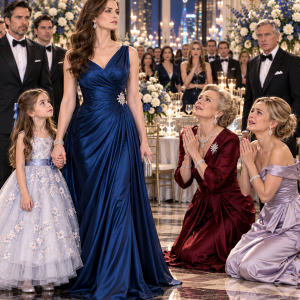
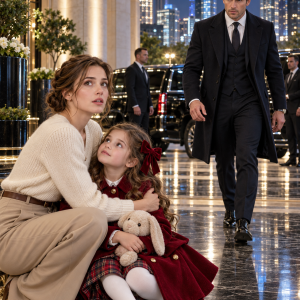
Nathan’s face lost its color.
He looked at me as if the crowded hotel lobby had disappeared around us.
“Were you pregnant when you left?”
There was no point lying.
“Yes.”
His lips parted, but nothing came out.
“That day?”
I nodded.
“I had the ultrasound pictures in my bag while you were giving me the papers.”
Nathan closed his eyes.
When he opened them, they were wet.
“They’re mine?”
For years I had imagined that question, and in every imaginary version I answered with anger.
But my children were standing there.
Revenge suddenly seemed childish.
“Yes.”
Grace looked between us.
“Mom?”
I took her hand.
“We’re going upstairs.”
Nathan stepped forward.
“Emily, please.”
That word stopped me because Nathan Hale rarely pleaded for anything.
“Not here.”
He nodded immediately.
“Okay.”
Benjamin studied him.
Then, with the terrible directness children possess, he asked, “Are you our dad?”
Nathan stopped breathing.
I had promised myself I would not lie.
“Yes,” I said.
Grace’s eyes widened.
Owen folded his arms.
Benjamin simply watched.
Nathan crouched so he was closer to their height.
“I didn’t know about you,” he said.
Owen frowned.
“Why?”
Nathan looked at me.
Then he looked back at our son.
“Because I hurt your mom before you were born, and she left before I knew you were coming.”
Owen narrowed his eyes.
“What did you do?”
Despite everything, I nearly laughed.
Nathan apparently considered several possible answers before settling on the truth.
“I made a very foolish decision.”
“How foolish?”
“Extremely.”
Owen nodded.
“Okay. That’s more specific.”
For the first time in five years, Nathan laughed.
The Father Who Had to Start at the Beginning
Nathan and I met alone that evening in the hotel café.
He asked about the pregnancy first.
Not about lawyers.
Not about custody.
Not even about why I had kept the children from him.
He wanted to know whether they had been healthy, whether I had been frightened, whether someone had been with me when they were born.
Eventually he asked, “Were you alone?”
“I had friends.”
“That’s not what I meant.”
I looked at him.
“Then yes. I was without you.”
His face tightened.
I refused to comfort him.
Nathan stared at his coffee for a long time before saying, “Rebecca and I lasted eleven weeks.”
I almost laughed.
“Eleven weeks?”
He nodded.
“I had spent years remembering what we’d been when we were young, and I confused an unfinished chapter with a great love story.”
“That’s an expensive lesson.”
“I know.”
“You ended a marriage for eleven weeks.”
“I know.”
He did not defend himself, and strangely, that mattered.
Then he told me something I had never known.
After things ended with Rebecca, he had tried to contact me. My number was blocked. My email had changed. My attorney had followed my instructions and refused personal messages.
“You could have found me,” I said.
Nathan nodded.
“Easily.”
“Then why didn’t you?”
He looked ashamed.
“Because of the way you left. You took the settlement, signed everything and made that joke about my money. I convinced myself you had never loved me as much as I loved you.”
I stared at him.
“You loved me?”
Nathan gave a sad little laugh.
“That’s what makes the whole thing so foolish.”
He explained that our marriage had become comfortable, dependable and safe, while his memories of Rebecca had remained dramatic precisely because they had never been completed.
He had mistaken turmoil for depth and peace for something ordinary.
“If I’d shown you those pictures,” I finally asked, “would you have stayed?”
He answered immediately.
“Yes.”
I looked away.
Then Nathan added, “But that’s not the answer you should have needed. I should have chosen our marriage before I knew about the babies.”
That was the sentence that reached me.
Not because it repaired anything.
It couldn’t.
But because for the first time he understood exactly where the wound had begun.
The next afternoon, I allowed him one hour with the children in a nearby park.
I gave him rules.
No expensive gifts.
No promises he couldn’t keep.
No rearranging their lives around his schedule.
Most importantly, the children decided how close they wanted to be.
Nathan agreed to everything.
Watching him meet them properly was almost painful.
This man who could command a room full of executives became nervous asking Owen about dinosaurs.
Benjamin asked what he actually produced at work and seemed disappointed to learn that Nathan mostly financed large building projects.
Grace climbed onto the bench beside him and asked why they had the same eyes.
Nathan’s voice softened.
“Because you got yours from me.”
She studied him carefully.
“What else did I get?”
I answered before he could.
“Stubbornness.”
Nathan looked offended.
“That could have come from you.”
“Absolutely not.”
All three children laughed.
By the end of the hour, Nathan was sitting on the grass listening to Grace explain why princesses should know how to fix cars while Owen corrected his dinosaur facts and Benjamin inspected his watch.
It was exactly the father I had imagined five years earlier while driving home from the doctor’s office.
That realization hurt more than anger ever had.
The Things Money Could Not Repair

Nathan kept his word after we returned home.
He did not sweep into our lives with lawyers, demands or extravagant presents.
He called when he said he would call.
He visited when invited.
He learned their routines rather than expecting them to learn his.
When Owen became sick the night before one scheduled visit, I told Nathan there was no reason to come.
He came anyway and spent most of Saturday on our couch watching nature documentaries with him.
When Benjamin had a school presentation and became nervous, Nathan rearranged two days of meetings just to sit quietly in the third row.
When Grace lost her first tooth, she called him immediately.
“Dad! I lost it!”
Nathan answered from what appeared to be a conference room.
“Are you all right?”
“Yes. I’m getting money.”
“For losing part of yourself?”
“From the tooth fairy.”
Nathan looked into the camera.
“Your mother is apparently operating an unlicensed financial institution.”
I laughed.
He heard me.
For a moment, neither of us spoke.
Something had changed.
Not quickly.
Not neatly.
But anger became harder to hold when I watched Nathan become the kind of father who showed up even when nobody was applauding.