The Invitation He Never Should Have Sent

The morning after my daughter was born, sunlight slipped through the blinds of my hospital room in pale silver lines, and for the first time in years I felt that my life belonged entirely to me. My body was sore, my thoughts floated somewhere between exhaustion and wonder, and three feet away, wrapped in a cream blanket, my little girl slept with one hand curled beneath her chin.
Then my phone rang, and the name on the screen pulled eight painful years into one small rectangle of light.
Nolan Prescott.
Eight months earlier, Nolan had ended our marriage after deciding that I was the reason we had never brought a baby home. We had endured two pregnancy losses, months of appointments, and more quiet sorrow than I knew a marriage could hold, but instead of standing beside me, he had gradually begun treating me as if grief were a flaw in my character. By the time I learned about Brielle Sutton, the polished fundraising director who worked beside him at the senior-living company he managed, Nolan had already rewritten our history for everyone we knew. In his version, he was a patient husband who had finally accepted that his wife could not give him a family.
I answered because curiosity sometimes arrives before wisdom.
“Erin, I’m getting married in three weeks,” he said, without asking how I was. “You should come to Providence. Brielle thought it might help you see that life moves on.”
I glanced toward the bassinet. “How considerate.”
He missed the meaning in my voice. Nolan had always heard admiration more easily than irony.
“She’s five months pregnant,” he continued, then allowed a little laugh to rest between us. “I suppose some things happen naturally when you’re with the right woman.”
My daughter sighed in her sleep. His daughter, though he did not know it yet.
Four days before our divorce became final, I had learned that I was pregnant. I had considered telling him, but at that point he was living with Brielle, his mother was telling mutual friends that I was unstable, and Nolan had demanded a signed statement suggesting that I had refused reasonable medical care. I did not disappear to punish him. I stepped away because I would not let my child begin her life as leverage in a family that had already turned my sorrow into gossip.
“Send me the address,” I said.
His amusement faded. “You’re actually coming?”
“You invited me.”
“Just don’t make a scene.”
I looked at the hospital bracelet that read BABY GIRL CALDWELL, bearing my family name rather than his, and reached for the leather portfolio my attorney had delivered the evening before.
“I won’t need to,” I told him. “The documents can speak for themselves.”
After the call ended, his invitation appeared by text. At the bottom was the name of the reception’s corporate sponsor, Harbor Crest Community Partners, and the sight of it made me sit upright despite the ache across my middle. Harbor Crest was connected to one of three shell companies my attorney had traced while investigating missing money from the trust my grandmother had left me. Brielle’s signature appeared on two filings. Nolan’s family accountant appeared on another.
Until that moment, I had believed the affair and the money were separate betrayals. The invitation suggested they belonged to the same story, and Nolan had unknowingly arranged for everyone who mattered to that story to gather beneath one roof.
The Child Beneath the Chandeliers
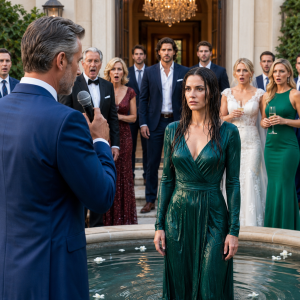
Three weeks later, I entered the Bellweather Hotel in Providence with my daughter, Lily, sleeping against my chest and the leather portfolio tucked beneath my arm. White roses climbed the marble columns, a string quartet played beneath crystal chandeliers, and waiters moved through the lobby carrying trays of champagne. It was exactly the kind of celebration Nolan loved: expensive, photographed, and crowded with people whose approval he valued.
His aunt recognized me first. Her gaze dropped from my face to the baby, and whispers traveled across the lobby faster than any formal announcement could have done. Guests who had heard that I was incapable of becoming a mother now watched me carry a three-week-old infant toward the ballroom.
Nolan’s mother, Lucinda, intercepted me near the doors. She was elegant in a pale gold gown, with diamonds at her throat and the familiar expression of a woman who believed discomfort was something that happened only to other people. Yet when she saw Lily, fear crossed her face before contempt covered it.
“Why are you here?” she demanded.
I showed her Nolan’s invitation. “Your son asked me to come.”
“Then he made a mistake. Leave before the ceremony begins.”
Lily stirred, and Lucinda studied the small portion of her face visible above the blanket.
“How old is she?”
“Three weeks.”
I watched Lucinda count backward. Her lips parted, but Nolan’s voice reached us before she could speak.
“Erin?”
He stood beneath an arch of ivory orchids in a black tuxedo, looking less like a joyful groom than a man who had just seen the past walk into the room carrying evidence. Brielle came up beside him in a fitted silk gown, one hand resting over her rounded stomach. She was beautiful, and I felt no need to deny it. Beauty had never been the problem.
“You brought a baby,” Nolan said.
“I wasn’t going to leave her alone.”
Brielle offered a careful smile. “Congratulations. I didn’t know you had remarried.”
“I haven’t.”
Nolan stared at Lily. “Then who is her father?”
“Would you prefer the answer privately,” I asked, “or in front of the people you told I could never have a child?”
His face tightened. “You have five minutes before I ask security to escort you out.”
“Five minutes will be enough.”
I opened the portfolio and handed him a certified parentage report based on the genetic sample the fertility clinic had retained during our marriage and released under court order. Nolan read it twice. The probability was greater than 99.99 percent.
“This can’t be right.”
“It is.”
Lucinda took the paper from him, while Brielle whispered, “Don’t let her disrupt today.”
That plea made Nolan turn toward her. “Did you know about this?”
“Of course not.”