Twenty-One Years After My Father Sent Me Away, He Mocked Me at My Nephew’s Wedding—Then the Bride Raised Her Hand in a Military Salute
The Woman at the Forgotten Table
“You were invited because Camden felt sorry for you, not because you belong to this family.”
My father said it loudly enough for half the ballroom to hear.
He stood in front of me with a champagne glass in one hand and the same controlled smile he had always worn whenever he wanted to embarrass someone without appearing impolite.
I did not argue.
I simply lifted my glass of red wine, took a slow sip, and smiled back at him.
Twenty-one years had passed since I had last stood close enough to hear Winston Bancroft’s voice without a telephone between us.
Twenty-one years had passed since he had ordered me out of our family home during a cold autumn storm, leaving me on the front steps with two suitcases and one sentence I would remember for the rest of my life.
“Without this family name, you will never become anyone.”
I had been nineteen years old that night.
Now, at forty, I was standing inside the ballroom of a historic waterfront hotel in Annapolis, Maryland, surrounded by white roses, crystal chandeliers, government officials, business executives, retired military officers, and women wearing gowns that probably cost more than my first car.
My nephew Camden’s wedding was exactly the kind of event the Bancroft family had always valued.
Elegant.
Exclusive.
Expensive.
And carefully designed to impress everyone who mattered.
I wore a simple navy-blue dress, modest silver earrings, and black heels that had already seen several formal dinners. I carried no designer handbag, wore no sparkling necklace, and made no effort to draw attention.
To my family, that meant I had failed.
I found their conclusion almost amusing.
Camden had invited me personally.
Months earlier, he had sent a letter to an old mailing address that I rarely checked.
“Tessa,” it began, although he had always called me Aunt Tessa when he was young. “No one will tell me what truly happened between you and the family. I only remember that you once took me for ice cream when I was seven and told me never to confuse the loudest person in the room with the strongest. I am getting married. I would like you to be there.”
I read the letter three times.
I attended the wedding for Camden.
Not for my father.
Not for my older brother Russell.
And certainly not for the Bancroft relatives who had spoken about me for two decades as though I were an unfortunate chapter they had successfully removed from the family history.
When I entered the ballroom, Camden noticed me from the head table.
He was thirty years old now, tall and serious, with tired eyes that still carried the kindness I remembered from his childhood.
His expression softened the moment he saw me.
“Aunt Tessa,” he mouthed from across the room.
I gave him a small wave.
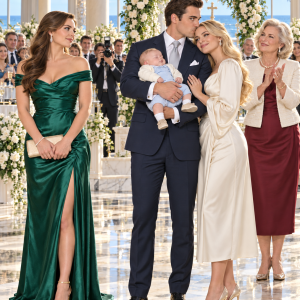
Beside him sat his bride, Taryn McKenna.
She was graceful and composed, with dark hair pinned neatly beneath her veil and a calm confidence that could not be taught by an expensive wedding planner.
There was something familiar in the way she carried herself.
Her shoulders were straight. Her movements were deliberate. Even while seated in a wedding gown, she seemed quietly prepared for anything.
I could not immediately understand why.
My assigned seat was at table thirty-six, positioned near a decorative column and partly hidden behind a large arrangement of white hydrangeas.
It was the kind of table chosen for a relative who technically had to be included but was not meant to be seen.
That suited me perfectly.
I had barely sat down when the music softened and several guests turned toward the entrance.
My father entered the ballroom.
At seventy-two, Winston Bancroft remained an imposing man. His white hair was perfectly styled, his black tuxedo had been tailored in Washington, and his expression carried the familiar confidence of someone who had spent his entire life believing every room naturally belonged to him.
My brother Russell followed closely behind.
Russell had inherited our father’s ambition, his polished manners, and his habit of smiling whenever someone else felt uncomfortable.
They both stopped when they saw me.
Surprise came first.
Then irritation.
Finally, calculation.
Russell approached before my father did.
“Well, look who finally remembered she had a family.”
Several nearby guests turned toward us.
My father stepped closer.
“Tessa,” he said, as though my name had left an unpleasant taste in his mouth. “I did not realize Camden had become so sentimental.”
“Hello, Winston.”
A woman at the next table raised her eyebrows when she heard me address him by his first name.
Russell gave a short laugh.
“Still determined to make everything dramatic, I see.”
My father looked me over slowly.
He noticed my simple dress, my practical shoes, and the absence of expensive jewelry.
I watched him create an entire story about my life from those details.
“You should understand something before you become confused,” he said. “Camden invited you because he felt sorry for you. No one here knows who you are, and no one has any reason to care.”
For one brief moment, the ballroom disappeared.
I was nineteen again.
Rain struck the front steps of our home outside Baltimore. My mother stood behind the closed door, crying softly but refusing to come outside. Russell leaned against the hallway wall, watching as our father placed my suitcases on the wet stone.
Winston had arranged for me to marry a wealthy investor nearly thirty years older than I was.
The man had offered to rescue one of my father’s failing development projects.
My father called it a responsible match.
I called it a life I did not choose.
“You were not raised to follow your feelings,” he had told me that night. “You were raised to protect this family.”
“Then this family should learn to survive without using me.”
He told me to leave.
Now, more than two decades later, he expected to find the same frightened young woman standing in front of him.
I took another sip of wine.
“I did not come here for you.”
His expression tightened.
Russell leaned closer.
“Watch your tone.”
“I have had twenty-one years to choose it carefully.”
Before either of them could respond, I noticed the bride rising from her chair.
Taryn was staring directly at me.
The color had left her face.
Her back became perfectly straight.
One hand trembled slightly against the tablecloth.
Camden asked her something, but she did not answer.
She simply continued looking at me as though a memory had suddenly stepped out of the past and taken a seat at table thirty-six.
The Speech My Father Never Expected

A wedding coordinator hurried toward Taryn and whispered something about the scheduled order of the toasts.
Taryn slowly sat down again, although her eyes never left me.
My father glanced toward the head table.
“See what your presence causes?” he said. “You are making even the bride uncomfortable.”
“I have never spoken to her.”
“Sometimes your presence is enough.”
Russell smiled.
“Perhaps you should return to your hidden table before anyone else notices you.”
I stood.
Russell reached for my arm out of habit.
His hand did not remain there long.
I looked down at it and then met his eyes.
“Let go.”
“Or what?”
I spoke quietly.
“Or you will remember this moment for much longer than you expect.”
Something in my voice erased his smile.
He released me.
I returned to table thirty-six and chose a seat with a clear view of the exits.
It was not fear.
It was training.
Even at a wedding, I noticed service doors, narrow hallways, security staff, and guests whose attention was focused more on the room than on the ceremony.
Old professional habits were difficult to silence.
Two distant cousins sat across from me. They pretended not to recognize me until the silence became uncomfortable.
One of them, Marjorie, finally cleared her throat.
“Tessa, this is certainly a surprise.”
“Apparently for everyone.”
Her college-aged daughter looked at me curiously.
“Where have you been all these years?”
Marjorie looked alarmed.
“Renee, do not ask personal questions.”
“It is all right,” I said. “I have been away.”
“Where?” Renee asked.
“Several places.”
“That sounds mysterious.”
“Most of it involved poor coffee, long meetings, and more paperwork than any reasonable person should ever see.”
Renee smiled.
Her mother did not.
At the front of the ballroom, my father stepped toward the microphone.
The lighting softened, and the conversations faded.
Winston Bancroft began speaking about family, legacy, loyalty, and the importance of protecting what previous generations had built.
Every word sounded respectable.
Yet beneath the polished language was ownership.
Camden was not simply his grandson.
He was the next Bancroft heir.
Taryn was not simply a woman Camden loved.
She was a valuable addition to the family.
Then my father looked toward the back of the ballroom.
“Some people confuse distance with dignity,” he said. “But tonight, we honor those who understand that loyalty to family must come before personal pride.”
Several guests followed his gaze toward me.
Renee leaned closer.
“Is he talking about you?”
“Yes.”
“That is awful.”
“That is Winston.”
I remained still as the memories returned.
The morning after my father sent me away, I sat inside a nearly empty bus terminal with damp clothes, ninety-two dollars in my purse, and no active credit cards because every account had been connected to my father.
I had nowhere to go.
Just after sunrise, I walked past a Navy recruiting office.